


FIFA Insists “Nobody Is Selling Football” as UEFA Threatens Boycott Over World Cup Stake Proposal
- Aug 1
- 3 min read
FIFA has strongly denied claims that it is attempting to privatise world football after UEFA threatened to boycott all FIFA competitions if plans to sell stakes in a commercial entity linked to the World Cup move forward.
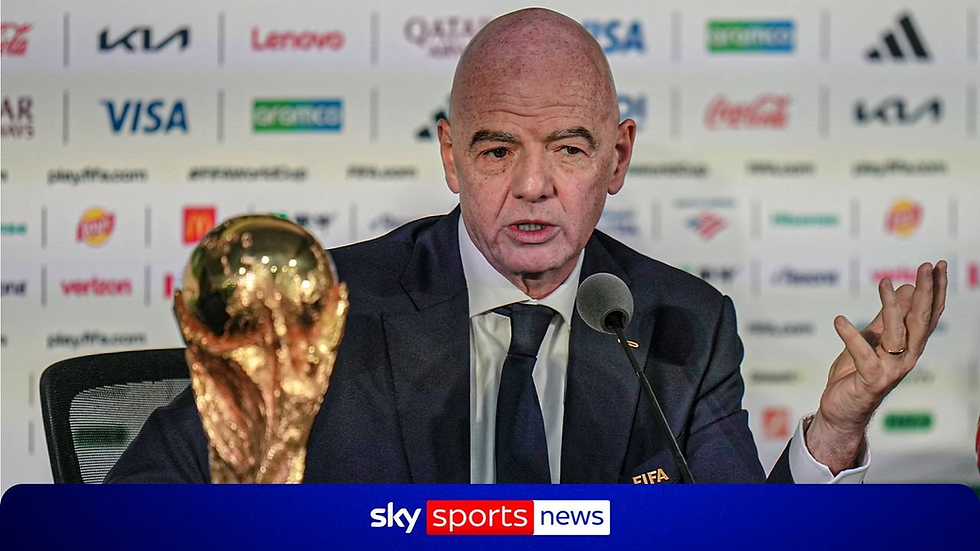
The governing body released a statement insisting that “nobody is selling football” and said it remained committed to a consultation process with its member associations. However, the controversy has intensified rapidly, with FIFA president Gianni Infantino facing mounting criticism from football authorities, political leaders and senior figures within his own organisation.
The latest blow came from UK Prime Minister Andy Burnham, who described Infantino as “the wrong man” to lead FIFA. Burnham argued that the very fact the proposal had been considered showed poor judgment at the highest level of world football governance.

Pressure on Infantino increased further after Carlos Cordeiro, a senior adviser to the FIFA president and former president of the United States Soccer Federation, resigned in protest. Cordeiro called the proposal “a bad deal for football” and “for the long-term future of the game.”
“As a senior adviser to the FIFA president, a former banker, and a lifelong football fan, I cannot stand by while FIFA considers selling a stake in the World Cup,” Cordeiro said. “I had no involvement in this proposal, and I oppose it unequivocally.”
The controversy centres on FIFA’s proposal to establish FIFA Forward Enterprise (FFE), a commercial entity that could allow private investors to acquire stakes linked to FIFA competitions, including the World Cup. FIFA says the objective is to provide national associations with greater opportunities to benefit from football’s commercial growth without compromising the governance of the sport.
In its statement, FIFA argued that media reports had misrepresented the proposal and disrupted the consultation process. The organisation said every member association would have the opportunity to vote based on accurate information and insisted that FFE was designed to expand commercial opportunities, not to sell ownership of football itself.
Despite those assurances, opposition has become increasingly coordinated. UEFA’s 55 member associations announced that they would refuse to participate in any FIFA competition while the proposal remains under consideration. CONCACAF, representing 41 nations from North America, Central America and the Caribbean, also rejected the plan outright.
The Asian Football Confederation, traditionally viewed as one of Infantino’s strongest supporters, issued a statement calling for an urgent review of FIFA’s governance and decision-making framework. The AFC stressed that meaningful democracy requires transparent governance, timely consultation and genuine participation throughout the decision-making process, marking a significant shift in its public stance toward the FIFA leadership.
Another damaging development came from within FIFA itself. Chief operating officer Kevin Lamour reportedly accused Infantino of keeping staff in the dark about the proposal and said employees “deserve better than contempt and intimidation.” According to Lamour, the World Cup privatisation plan was “the project of one person,” suggesting deep internal frustration over the president’s leadership style.
The investment group linked to the proposal is reportedly led by Thrive Eternal, a company founded by Joshua Kushner, brother of Jared Kushner, the son-in-law of former U.S. president Donald Trump. Trump stated on Friday that he had not discussed the matter with Infantino.
Critics fear that introducing private investors into FIFA competitions could place commercial interests above sporting priorities, potentially leading to larger and more frequent tournaments that would further congest the international football calendar and place additional strain on domestic competitions.
UEFA’s warning was particularly uncompromising. The confederation said no European national teams would participate in FIFA competitions while the proposal remains alive unless it is abandoned entirely and binding guarantees are provided that FIFA will never again consider opening its governance or competitions to private ownership.
Analysts believe the dispute has become the most serious challenge to Infantino’s authority since he became FIFA president in 2016. With support weakening among confederations, member associations and senior FIFA officials, speculation is growing that he could face a vote of no confidence or a strong challenge in next year’s FIFA presidential election.
For now, FIFA continues to insist that football is not for sale. But the backlash surrounding the proposed commercial restructuring has exposed unprecedented divisions within the global game and placed the future leadership of world football under intense scrutiny.



Comments