


England Player Ratings: Ollie Robinson and Josh Tongue Take Top Marks in Dominant Pakistan Test Win
- 3 hours ago
- 8 min read
Robinson and Tongue lead England’s demolition job
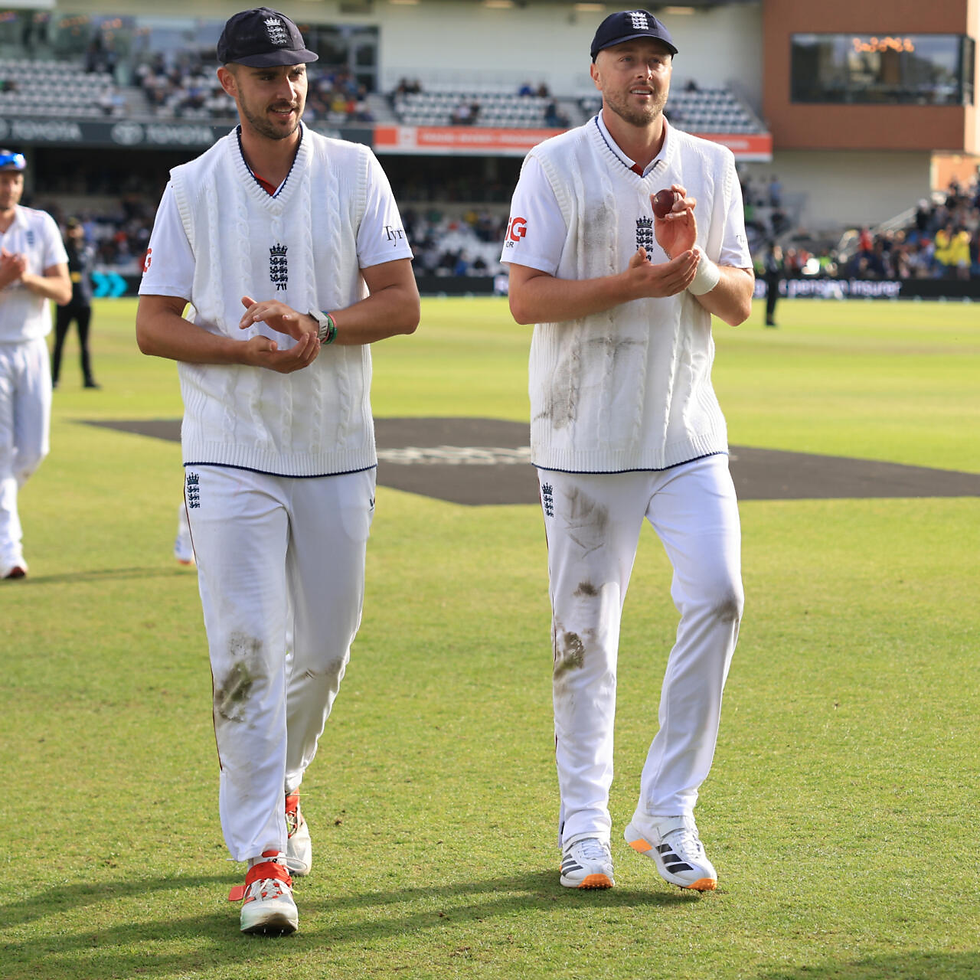
England’s new era under Joe Root began in emphatic fashion as they crushed Pakistan by an innings and 103 runs at Headingley, completing the first Test inside three days. With the match dominated by the bowlers, Ollie Robinson and Josh Tongue were impossible to separate at the top of England’s player ratings, both earning 10/10 after taking eight wickets apiece.
Robinson was named Player of the Match after producing a superb all-round bowling performance. The Sussex seamer claimed 5-51 in Pakistan’s first innings before adding 3-29 in the second, repeatedly finding the ideal line and length on a Headingley surface offering movement. Tongue was equally destructive, following his 5-46 in the first innings with 3-43 in the second as Pakistan collapsed for a second time.
England’s victory was their third in their last 11 Tests and represented an ideal beginning to Root’s second permanent stint as captain. The former captain replaced Ben Stokes in the leadership role after Stokes’ injury, while England were also forced to reshuffle their batting line-up following Jacob Bethell’s knee injury. Jordan Cox stepped into the No 3 position and immediately made a compelling case for a permanent place, while Harry Brook continued to demonstrate a more mature approach to his attacking game.
With the second Test at Lord’s approaching, England have several selection decisions to consider. Robinson and Tongue appear undroppable after their Headingley performances, while Cox’s emergence could eventually create a fascinating contest with Jamie Smith once Bethell returns.

Ollie Robinson – 10/10
Batting: – | Bowling: 5-51 & 3-29
Simply outstanding. Robinson produced the most complete bowling performance of the Test, taking eight wickets and repeatedly exposing Pakistan’s fragile batting line-up.
His first delivery of the match immediately set the tone. Robinson trapped Azan Awais lbw and then maintained relentless pressure through a probing line, subtle changes of pace and movement away from the bat.
His figures were made even more impressive by the fact that this was his first Test since the opening match of England’s summer against New Zealand, having been sidelined by a niggle. Concerns about his ability to remain fit for a sustained period are still understandable, but when Robinson is healthy, his control and skill make him one of England’s most dangerous red-ball bowlers.
The challenge now is simple: stay fit and keep bowling.
Josh Tongue – 10/10

Bowling: 5-46 & 3-43
Tongue was every bit as effective as Robinson and deserves equal recognition. His ability to build on Robinson’s early breakthroughs proved decisive as England maintained pressure throughout Pakistan’s first innings.
After Robinson had made the initial breakthrough, Tongue ended a 91-run third-wicket partnership and then tore through Pakistan’s lower middle order. His three wickets shortly after lunch on the third morning effectively guaranteed that England would finish the match without needing a fourth day.
Tongue’s eight wickets also continued the impressive progress he has made in Test cricket. He was a key contributor during the previous Ashes and has established himself as a bowler capable of making things happen when England need a breakthrough.
Former England seamer Stuart Broad described him as England’s “best and most valuable bowler” and a “real trump card”. His Headingley performance only strengthened that assessment.
Harry Brook – 9/10

Batting: 91 off 93 balls
Brook missed out on a century but produced one of the most encouraging innings of the match.
His 91 from 93 balls was aggressive without being reckless, demonstrating a level of control and maturity that has occasionally been missing from his Test batting. Brook has always possessed the talent to dominate attacks, but his tendency to attack almost every ball has sometimes brought unnecessary risks.
At Headingley, he appeared more selective.
Brook later explained that the pitch gave him confidence that he did not need to play rash shots, and that approach was evident throughout his innings. He attacked when opportunities presented themselves while maintaining enough discipline to build a substantial score.
There was one nervous moment when he could have been caught at slip, but he survived and made Pakistan pay. His eventual dismissal in the 90s was particularly painful because it was the second consecutive year that he had fallen short of a Test century at his home ground.
Nevertheless, as England’s vice-captain, Brook looked increasingly comfortable with the responsibility. If questions over his maturity played a part in the decision not to appoint him as Stokes’ successor, this was a strong response.
Joe Root – 9/10

Batting: 66 from 112 balls
Root’s return to permanent Test captaincy could hardly have gone better.
His batting was typically composed before he fell to an uncharacteristically poor shot, followed by an unsuccessful review. Aside from those moments, however, Root looked completely at home in both his old role as England’s premier batter and his new responsibility as captain.
His tactical work was particularly impressive. Having won the toss under overcast conditions, Root chose to bowl first and allowed his seamers to exploit the conditions. He also spent much of the innings at mid-off, ensuring he could communicate directly with his bowlers.
His field placements were inventive, including an unusual spell stationed at leg slip, and England consistently maintained pressure on Pakistan.
Root even showed a ruthless streak with the bat, hooking Jofra Archer after the fast bowler had endured two underwhelming overs in the first innings.
This was an excellent beginning to the second Root captaincy era.
Jordan Cox – 8.5/10
Batting: 73 from 100 balls
Cox may have been expected to fill in at No 3 until Bethell returns from injury, but his Headingley performance means that decision may no longer be straightforward.
His 73 from 100 balls was authoritative and controlled, giving England stability at first drop. Pakistan’s bowling attack helped him at times, but Cox still looked comfortable against Test-quality bowling and showed enough temperament to suggest he could remain in the side.
His flexibility could be particularly valuable. If Cox continues to score heavily, England could consider using him as a wicketkeeper-batter, potentially creating pressure on Jamie Smith for the gloves.
Cox also contributed two catches at slip on the third day, including an excellent diving effort after the ball ballooned off Smith’s thigh.
His immediate task is to back up this performance at Lord’s. If he does, England may have a selection headache on their hands.
Dan Lawrence – 8/10
Batting: 50 | Bowling: 0-0
Lawrence faced an almost impossible assignment, stepping into the side as the player effectively replacing the injured Stokes.
He responded impressively with the bat, scoring a composed half-century containing nine boundaries. There were occasional moments of uncertainty, but overall he played an important role in establishing England’s huge first-innings advantage.
His part-time spin was barely required, with only one over bowled in the second innings as England’s seamers dismantled Pakistan.
That could change if Pakistan improve at Lord’s or Edgbaston. Lawrence’s ability to contribute with the ball could become more important as the summer progresses, and his performances in the next two Tests may determine whether he is the long-term answer to England’s post-Stokes balance.
Jamie Smith – 6/10
Batting: 25 from 42 balls | Wicketkeeping: Excellent
Smith was largely flawless behind the stumps but will be frustrated by his dismissal.
He attempted to pull a short delivery but sent the ball tamely towards midwicket, ending his innings for 25. It ultimately had little impact on the result because England already held a commanding advantage and Smith had been left batting with the tail.
His wicketkeeping remained a major positive.
Smith has established himself as a talented keeper-batter, and if he can return to producing the consistent runs expected from him while maintaining his standards behind the stumps, his position should remain secure.
Cox’s emergence, however, introduces an intriguing subplot. If Cox continues to score heavily and Bethell eventually returns, England could face a difficult decision regarding the composition of their middle order and wicketkeeping options.
Jofra Archer – 7/10
Batting: 23 not out | Bowling: 0-26 & 3-50
Archer looked understandably rusty in the first innings after spending much of the recent period playing white-ball cricket.
His line drifted too far towards leg and he lacked the rhythm that eventually emerged on the third day. But his second-innings spell was a completely different proposition.
Archer bowled with greater pace, snap and confidence, removing Imam-ul-Haq and Azan Awais to reduce Pakistan to 13-2 before returning later to claim the decisive wicket of Mohammad Abbas.
He also impressed with the bat. His unbeaten 23 included the only six of the match and two fours, helping England push their first-innings advantage beyond 200.
The key for Archer will be building rhythm and fitness as he transitions back into regular Test cricket.
Gus Atkinson – 5/10
Bowling: 0-40 & 1-11
Atkinson endured a quieter Test, although there were signs of improvement in the second innings.
Like Archer, he was returning from a lengthy spell of white-ball cricket, including a stint with Hundred champions Manchester Super Giants. His first-innings figures reflected that lack of red-ball rhythm.
He was also operating in a slightly different role, with Robinson and Archer sharing the new ball while Atkinson came in as first change.
His second innings was much more effective. He conceded only 11 runs from eight overs and removed Mohammad Rizwan, putting England firmly on the brink of victory.
He will expect to make a bigger contribution at Lord’s.
Ben Duckett – 6/10
Batting: 15 from 28 balls
Duckett’s rating suffers mainly because Pakistan’s batting collapse meant England did not need to bat for a second time.
The opener made 15 from 28 balls in his only innings and was unable to build on the encouraging form he had rediscovered after a difficult Ashes campaign.
Duckett had impressed against New Zealand and in The Hundred, suggesting that his confidence and attacking instincts had returned. England will want more from him at Lord’s, where a substantial opening partnership could be crucial.
With Pakistan likely to come under pressure to respond after their Headingley defeat, Duckett may have a greater role to play in the second Test.
Emilio Gay – 6/10
Batting: 33 from 31 balls
Gay entered the match after making a pair in a warm-up game, so there were understandable nerves around his Test return.
He quickly settled those concerns with a series of beautifully struck boundaries before nicking off shortly after Duckett’s dismissal.
The Durham batter has shown plenty of promise early in his Test career, including two half-centuries against New Zealand. However, he remains vulnerable to deliveries angled across him, an area opponents will inevitably continue to target.
A substantial score at Lord’s would provide the next important step in his development.
Verdict: England’s attack gives Root the perfect start
The biggest conclusion from Headingley is that England’s bowling attack looks capable of carrying the team through difficult periods.
Robinson and Tongue were outstanding, while Archer showed signs that his red-ball rhythm is returning. Atkinson was less influential but still improved considerably in the second innings. With England able to dismiss Pakistan twice inside three days, the match never developed into a contest after the hosts established their enormous first-innings advantage.
The batting also offered plenty of encouragement. Root looked comfortable as captain, Brook demonstrated greater maturity, Cox immediately adapted to No 3 and Lawrence made a strong case for his place in the post-Stokes side.
The biggest question before Lord’s will be how England manage the balance of their XI once injuries and returning players become factors. Cox’s success at No 3 could create a genuine selection debate, particularly if Bethell returns as expected.
For now, however, Root can enjoy an almost perfect start to his second era as captain.
England have momentum, their bowlers are firing and several younger players are making compelling cases for extended opportunities.
The second Test at Lord’s should provide a much tougher examination. But after dismantling Pakistan in just three days at Headingley, England have given themselves the ideal platform from which to build.



Comments