


What does Elle Fanning say about OnlyFans and her controversial role in the new series?
- Jun 9
- 6 min read
Elle Fanning continues to navigate one of the most versatile careers in contemporary Hollywood, balancing high-profile television work, ambitious film adaptations, and collaborative projects with her sister Dakota Fanning. In a recent conversation about Margo’s Got Money Troubles, the Oscar-nominated actress reflected on the show’s provocative themes, behind-the-scenes moments, and the evolving direction of its potential second season, while also offering rare insight into her personal creative process and upcoming projects.
Fanning remains at the center of Margo’s Got Money Troubles, the Apple TV series adapted from Rufi Thorpe’s bestselling novel, which explores the life of a young college student who turns to OnlyFans after becoming a mother. The series has generated significant conversation due to its unflinching portrayal of sexuality, financial survival, and modern digital labor, themes that Fanning embraces as central to the character’s emotional arc.
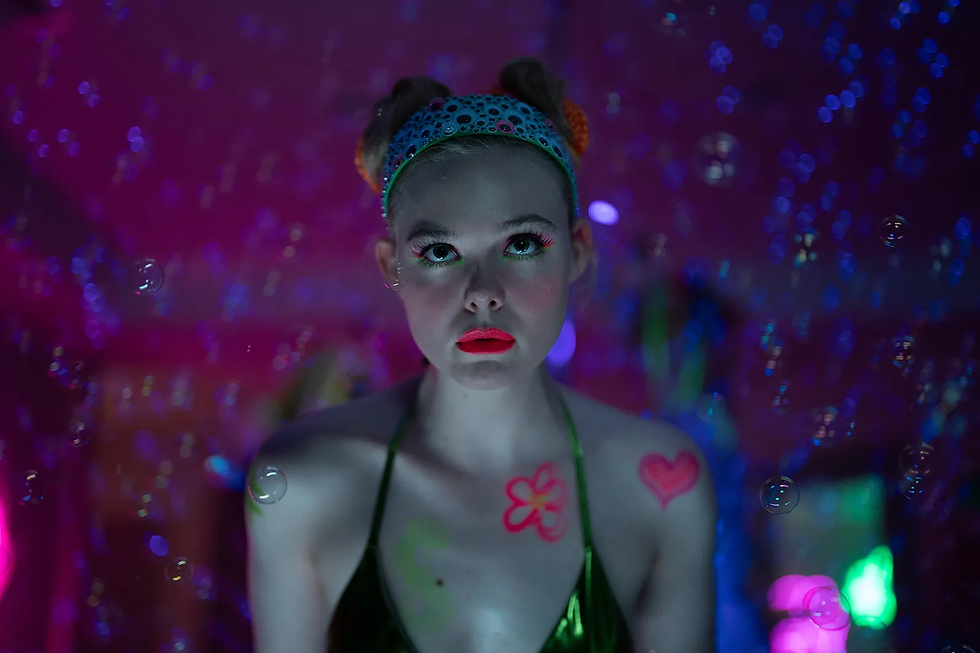
Speaking about the season one finale, Fanning recalled the chaotic energy of filming in Las Vegas alongside co-star Michelle Pfeiffer. “We’re on the Las Vegas Strip, and our heads are hanging out of this giant pink Hummer limo, which I’ve never done before,” she said, describing the moment with a mix of disbelief and enthusiasm.
She continued with a story that quickly became one of the most talked-about behind-the-scenes anecdotes from the production. “I asked A24 to find this footage, because I know it’s on camera,” she said. “We hear police sirens and a man with a megaphone going, ‘Get down, get down.’ Michelle and I were like, ‘Wooooo,’ and then—‘Wait a second, I think that’s for us.’”
Fanning explained that the incident may have been triggered by their unconventional filming setup, which included leaning out of a moving limousine on the Las Vegas Strip while dressed in theatrical costumes. Although authorities intervened, she noted that the situation never escalated into an arrest. “We didn’t get arrested, but we got the shot,” she said. “And I won $177 on the penny slots!”
Within the narrative of Margo’s Got Money Troubles, Fanning’s character experiences a dramatic transformation after becoming a young mother and entering the world of online content creation. The series follows her custody battle, her strained relationship with family members, and her attempt to balance survival with identity.
The show also features Michelle Pfeiffer as Margo’s mother, Shyanne, and Nick Offerman as her father, Jinx. The dynamic between mother and daughter becomes one of the emotional anchors of the series, particularly as Shyanne’s relationship with her new husband Kenny leads to a devastating betrayal that reshapes the storyline.
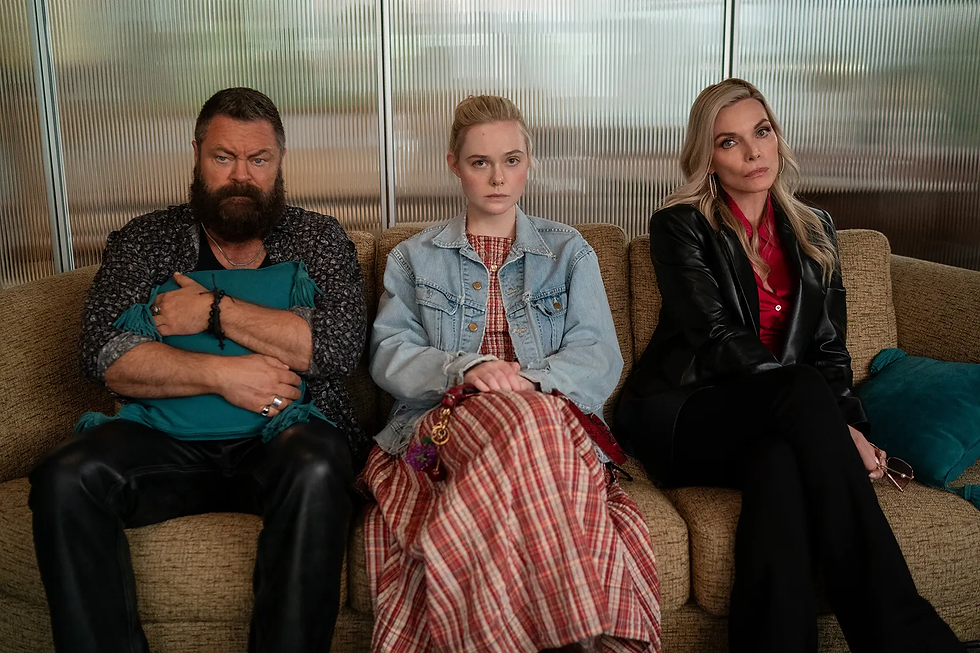
Fanning explained that a key adaptation choice altered the original structure of the novel. In the book, Shyanne is aware of Kenny’s actions regarding a CPS call, but in the series, the character is portrayed as being unaware, a shift that Fanning believes deepens the emotional complexity. “What David did with Shyanne’s character and their relationship, it’s really the heart of the show,” she said. “It just didn’t feel right with the character that Michelle created.”
She further reflected on how the change enhanced the mother-daughter dynamic at the center of the story. “It feels so true to mom-and-daughter dynamics of who’s the parent, who’s the child. They’re best friends at times. They tell each other everything, probably too much,” she added.
The series also explores Margo’s evolving relationship with sex work and digital platforms such as OnlyFans, a topic that has become increasingly prevalent in contemporary storytelling. Fanning emphasized that the show avoids sensationalism in favor of a more nuanced depiction of labor and survival.
One of the show’s recurring thematic debates revolves around whether Margo’s work should be considered exploitation or artistic expression. A character in the series states, “I don’t do porn. I make art,” to which another responds, “All sex work is art—performance, fantasy art.”
Fanning reflected on this dialogue, noting that the character’s journey is ultimately about self-acceptance. “Margo’s kind of shaming herself. And it’s like, no, it’s all art. You are creating it. Margo’s on a journey to accepting that,” she said. “At first, she’s just trying to get money, but then she starts to fall in love with the whole process.”

The series finale culminates in a symbolic moment for the protagonist, who embraces her online identity as part of her survival and self-definition. While the camera avoids explicit imagery, the emotional weight of the scene is centered on agency and transformation.
Fanning also spoke about the physical demands of the role, including the use of prosthetics during childbirth scenes. “I love that we have that in the first episode, because it’s opening a door to the audience, like, we’re going there,” she said. She also noted that prosthetics were used in breastfeeding scenes to maintain realism, describing the experience as both challenging and carefully crafted.
She added that accuracy was a priority, particularly when portraying motherhood. “Not being a mother myself, I wanted to make sure that it felt authentic,” she said. “There were a lot of mothers on set that I would be asking, ‘How does this feel?’”
Beyond Margo’s Got Money Troubles, Fanning is also preparing for another major project through her production company Lewellen Pictures, which she co-founded with her sister Dakota Fanning. The upcoming film The Nightingale, based on Kristin Hannah’s novel, marks the first time the sisters will star together as adults.
Directed by Michael Morris, the film follows two sisters in Nazi-occupied France and is scheduled for theatrical release in February 2027. The project represents a significant milestone for the Fanning sisters, who began acting at a very young age and have rarely shared the screen in meaningful roles since childhood.
Fanning expressed excitement about the collaboration, noting that any initial nervousness about working together has disappeared during production. “Dakota’s in the other room!” she said. “We’re over halfway done now.”
Reflecting on their dynamic, she added, “We thought that it was going to be awkward, us playing characters, and it hasn’t been at all. It’s like us playing pretend when we were kids again.”
The sisters previously appeared together briefly in 2001’s I Am Sam, but The Nightingale marks their first full dramatic collaboration, positioning both actresses in leading roles within a major historical adaptation.
Outside of her current projects, Fanning continues to be recognized for her early rise in Hollywood. She transitioned from child actor to critically acclaimed performer with roles in films such as Somewhere, Maleficent, and The Great, the latter of which further established her range in both comedic and dramatic performance.
Her career has been marked by a careful balance between commercial blockbusters and independent, character-driven stories. This duality has allowed her to maintain both mainstream visibility and artistic credibility, a balance that is increasingly rare in modern Hollywood.

Fanning has also become known for her collaborations with major filmmakers and production companies, often choosing roles that challenge conventional narratives about femininity, youth, and identity. Her recent work reflects a growing interest in complex female protagonists navigating moral ambiguity and societal pressure.
The themes present in Margo’s Got Money Troubles align with this trajectory, offering a portrait of economic precarity and digital-age survival that resonates with contemporary audiences. The series situates its protagonist within a cultural moment defined by online economies, shifting norms around sexuality, and the blurred boundaries between personal identity and performance.
As the series has been renewed for a second season, Fanning has hinted that the creative possibilities remain open-ended. “I have thoughts. I think other people have thoughts too,” she said. “It’s limitless with Margo.”
She also teased potential narrative directions, including a previously cut storyline involving a romantic relationship between Margo and one of her clients. While the plot was not included in season one due to structural constraints, Fanning suggested it could still be explored in future episodes.
“I love that storyline of Margo finding love,” she said. “That can be explored later. It was just too much to cram in for the first season.”
As she moves between projects, Fanning’s career continues to expand across genres and mediums, from streaming dramas to literary adaptations and independent productions. Her ability to navigate both intimate character studies and large-scale storytelling has positioned her as one of the defining actors of her generation.
With Margo’s Got Money Troubles continuing to evolve and The Nightingale on the horizon, Elle Fanning’s creative path reflects a broader shift in Hollywood storytelling—one that increasingly centers complex female narratives, intergenerational collaboration, and the merging of personal and professional artistry.


Comments