


The world fell in love with Tommy Shelby, but the truth about Cillian Murphy’s talent is even more extraordinary.
- May 7
- 8 min read
For years, Cillian Murphy existed in that rare category of actors audiences recognized instantly without ever fully understanding how extensive his range actually was. Before the sharp suits, clipped Birmingham accent, and cultural dominance of Tommy Shelby in Peaky Blinders transformed him into a global phenomenon, Murphy had already spent more than a decade quietly building one of the most compelling filmographies in modern cinema. His performances were rarely loud, rarely engineered for awards campaigns or tabloid headlines, yet they lingered long after the credits rolled. For many viewers, the arrival of Peaky Blinders felt like a discovery. In reality, it was more of a delayed recognition.
That delayed recognition is part of what makes Murphy’s career so fascinating today. There is a sense, looking back, that audiences collectively overlooked an actor who had been consistently exceptional across genres for years. Psychological thrillers, science fiction, historical dramas, intimate independent films, and large-scale blockbusters all seemed to reveal different versions of him. He could move from fragile to menacing within seconds, often without changing his tone of voice. The intensity was always there, hidden beneath restraint.

The renewed attention surrounding the release of Peaky Blinders: The Immortal Man has pushed many viewers back toward Murphy’s earlier work. Revisiting those performances today reveals how clearly the foundations of Tommy Shelby were already present in them. The icy composure, emotional isolation, and controlled charisma did not suddenly appear in Peaky Blinders. They had existed in fragments throughout his career long before mainstream audiences finally noticed.
One of the clearest examples remains Red Eye, directed by Wes Craven. The film begins almost deceptively, introducing Murphy as a charming stranger seated beside Rachel McAdams on a late-night flight to Miami. His smile is warm, his voice calm, and his presence disarmingly attractive. Then the atmosphere shifts. It becomes clear that his character is orchestrating a terrorist plot with meticulous precision. Murphy’s performance is effective precisely because he never overplays the menace. The danger comes from how little effort he appears to exert. His calmness becomes terrifying. Watching the film today, it is easy to understand why directors repeatedly trusted him with morally ambiguous characters. He understood how to make stillness feel threatening.
Science fiction offered Murphy another space to experiment with restraint. In In Time, directed by Andrew Niccol, he plays Raymond Leon, a “timekeeper” policing a dystopian society where time has literally become currency. The premise itself is surreal: human beings stop aging at twenty-five, but survival depends on earning additional minutes, hours, and years. Coffee is purchased with lifespan. Wealth becomes immortality. Although Justin Timberlake occupies the central role, Murphy quietly gives the film much of its emotional tension. His character believes in the system he enforces, even as he recognizes its cruelty. Rather than portraying Leon as a conventional villain, Murphy imbues him with exhaustion and internal conflict, making him feel like a man trapped inside the machinery he protects.

His collaboration with Christopher Nolan would eventually become one of the defining creative partnerships of his career. Long before Murphy led Nolan’s Oppenheimer, he appeared in several of the director’s most ambitious films, often in supporting roles that nevertheless carried emotional weight disproportionate to their screen time. Inception remains perhaps the best example. In a film celebrated for its intricate structure and visual spectacle, Murphy plays Robert Fischer, the heir whose subconscious becomes the center of an elaborate psychological operation. Surrounded by towering performances from Leonardo DiCaprio, Tom Hardy, and Marion Cotillard, Murphy somehow becomes the emotional core of the story. His portrayal of grief and vulnerability grounds a film built around layers of dreams and deception. What could have functioned merely as a narrative device instead becomes painfully human.
Historical drama revealed yet another side of him. The Wind That Shakes the Barley, directed by Ken Loach, placed Murphy within the brutal realities of the Irish War of Independence and subsequent civil war. The film follows two brothers joining the Irish Republican Army during the fight against British rule, gradually finding themselves divided by ideology and violence. Murphy’s performance as Damien O’Donovan is among the most emotionally devastating of his career. He begins as a doctor reluctant to engage in political conflict, only to become consumed by the moral complexities of revolution. There are moments in the film where Murphy says almost nothing, yet his face communicates despair more effectively than dialogue could. The role also carried personal resonance. As an Irish actor deeply aware of his country’s political history, Murphy approached the material with unusual seriousness and restraint.
Even in films that received mixed critical reactions, Murphy often emerged as one of the strongest elements. Anna, directed by Luc Besson, cast him opposite Sasha Luss in a world of espionage, manipulation, and double identities. Murphy plays CIA agent Lenny Miller with an understated elegance that contrasts sharply with the film’s more stylized action sequences. The relationship between Lenny and Anna exists in an uncertain emotional space, never fully romantic yet clearly charged with intimacy and suspicion. Murphy excels in these ambiguities. His characters often appear emotionally guarded, but there is usually a subtle vulnerability beneath the surface that prevents them from becoming emotionally inaccessible.
War cinema has repeatedly benefited from Murphy’s ability to portray psychological fracture without theatricality. In Dunkirk, another collaboration with Nolan, he portrays a traumatized soldier rescued during the evacuation of Dunkirk. The role is relatively small compared to the film’s sprawling structure, yet Murphy leaves a profound impression. Speaking about the character, he explained: “I think my character represents something that thousands of soldiers experienced, the deep emotional and psychological burden that war can leave behind. We first meet him when he is picked up by the Moonstone, one of the civilian boats crossing the English Channel to evacuate soldiers from Dunkirk. He is someone who has already survived an experience so traumatic that it changes the way you perceive reality, only to then be told, ‘Actually, we’re going back into it.’ The film follows several interwoven stories that together encompass the full course of events at Dunkirk. But because this is a Christopher Nolan film, those stories do not unfold linearly. Each has its own rhythm: a week on land, a day at sea, and an hour in the air, and my character appears in two of those three timelines.”

What makes Murphy unusual within modern celebrity culture is how successfully he has resisted becoming consumed by it. At the height of Peaky Blinders mania, when Tommy Shelby-inspired fashion trends spread across social media and Murphy became the subject of endless internet fascination, the actor himself remained remarkably detached from the machinery of fame. He rarely discusses his private life in interviews, avoids social media entirely, and continues to maintain a level of anonymity almost unheard of for someone with his global visibility.
Born in Douglas in 1976, Murphy originally imagined a future far removed from cinema. Music occupied much of his early life, and he performed in bands during his youth, heavily influenced by alternative rock and experimental music scenes of the 1990s. He briefly studied law at university but quickly realized academic life held little appeal for him. Acting arrived almost accidentally after he became involved in theatre productions in Cork. The stage, however, immediately revealed a magnetic presence that directors found difficult to ignore.
His breakthrough came with 28 Days Later, directed by Danny Boyle. Released during a period when zombie cinema had largely lost mainstream momentum, the film revitalized the genre through raw energy and psychological realism. Murphy played Jim, a bicycle courier who wakes from a coma to discover London devastated by a viral outbreak. The opening scenes, in which Jim wanders through an empty city in confusion and terror, instantly established Murphy as an actor capable of carrying a film through emotional authenticity rather than spectacle alone.
Hollywood noticed quickly after that. Yet even as larger studios approached him, Murphy consistently avoided the predictable path toward conventional leading-man status. He turned down opportunities that might have pushed him deeper into celebrity culture and instead gravitated toward directors with distinctive artistic voices. His career choices often prioritized atmosphere, complexity, and character psychology over commercial safety. That instinct ultimately gave his filmography unusual consistency.
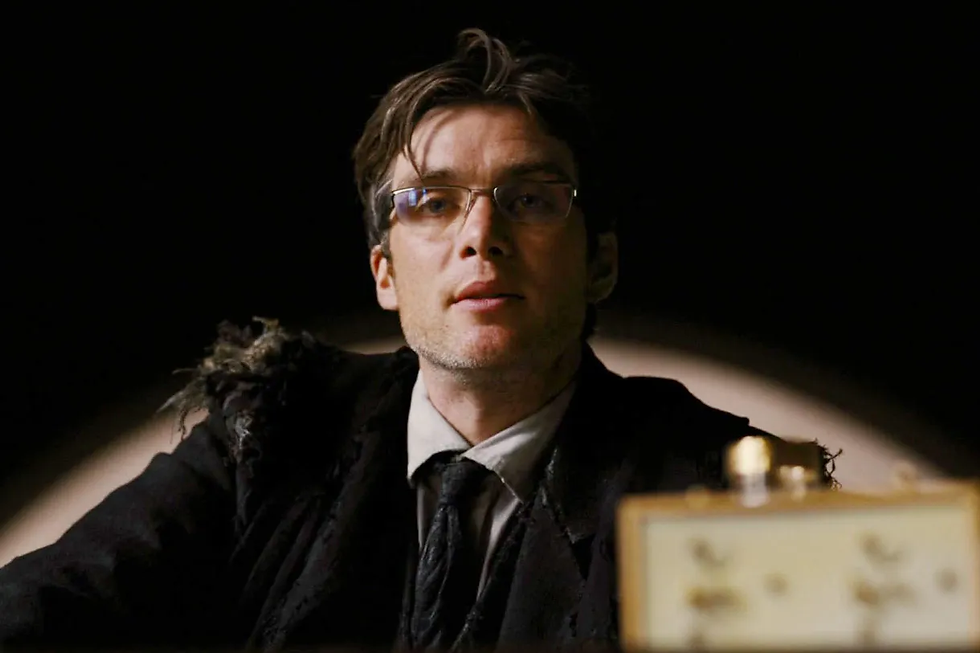
His long collaboration with Nolan deepened further through Batman Begins, The Dark Knight, and The Dark Knight Rises, where Murphy portrayed the psychologically damaged Jonathan Crane, better known as Scarecrow. Even surrounded by larger villains and expansive action sequences, Murphy’s eerie calmness made the character memorable. Nolan later admitted he repeatedly cast Murphy because of the intensity in his eyes and the intelligence he brought to every role.
While many actors of Murphy’s generation became frequent tabloid fixtures, his personal life remained strikingly stable. He married visual artist Yvonne McGuinness in 2004 after years of dating, and the couple share two sons together. Unlike many celebrity marriages subjected to relentless public scrutiny, theirs has largely unfolded away from cameras. The family spent years living in London before eventually returning to Ireland, partly because Murphy wanted his children to grow up closer to Irish culture and away from the intensity of celebrity life.
That decision reflected a broader discomfort Murphy has repeatedly expressed regarding fame itself. In interviews, he has often described celebrity culture as emotionally distorting and creatively limiting. He avoids red carpets whenever possible, declines many magazine shoots, and rarely speaks publicly unless promoting a project. This distance has only intensified public fascination with him. In an era when actors are expected to maintain constant online visibility, Murphy’s absence feels almost radical.
Despite his intensely private image, Murphy has not entirely escaped public speculation. During the peak years of Peaky Blinders, social media frequently turned him into an object of viral obsession, with fans dissecting interviews, mannerisms, and appearances in microscopic detail. Murphy himself appeared faintly amused by the phenomenon, though clearly uncomfortable with aspects of it. He once admitted that the internet’s fascination with Tommy Shelby occasionally blurred into assumptions about his own personality, despite the enormous difference between actor and character.
Professionally, the turning point that elevated him from respected actor to awards-season frontrunner arrived with Oppenheimer. After years of supporting roles in Nolan’s films, Murphy finally occupied the center of the director’s universe as physicist J. Robert Oppenheimer, the father of the atomic bomb. The performance required extraordinary emotional precision: intellectual arrogance, moral collapse, ambition, and guilt all coexisting within the same character. Critics widely described it as the culmination of everything Murphy had been refining throughout his career. The intensity that once operated quietly in smaller films now commanded the screen entirely.

Yet even after the success of Oppenheimer, Murphy’s appeal remains rooted in something unusually understated. Unlike many contemporary stars, he rarely appears interested in reinvention for its own sake. He does not chase visibility. He does not cultivate controversy. In fact, one of the most remarkable aspects of his career is the near-total absence of major scandals. His reputation within the industry has consistently centered on professionalism, discipline, and a refusal to engage in celebrity theatrics.
Directors frequently describe him as deeply prepared and almost obsessively committed to emotional truth. Co-stars often note how reserved he appears between takes, conserving energy rather than performing charisma off-camera. That reserve sometimes leads audiences to perceive him as mysterious, though colleagues tend to describe him instead as thoughtful and intensely focused.
There is also a uniquely literary quality to Murphy’s screen presence. Many actors communicate emotion outwardly, inviting audiences directly into a character’s psychology. Murphy often does the opposite. He withholds. The audience is forced to search his expression for clues, which paradoxically makes his performances more absorbing. It is the reason characters like Tommy Shelby, Robert Fischer, Damien O’Donovan, and Oppenheimer feel internally alive even during silence.

Looking back now, it becomes increasingly difficult to argue that Murphy was ever truly underrated. The evidence was always there: the emotional devastation of The Wind That Shakes the Barley, the chilling composure of Red Eye, the aching vulnerability inside Inception, the psychological exhaustion of Dunkirk. What changed was not the quality of his performances, but the scale of attention finally directed toward them.
Peaky Blinders may have transformed him into an icon, but it also unintentionally overshadowed the extraordinary diversity of work surrounding it. Revisiting those earlier films today reveals an actor who spent decades refining one of the most quietly remarkable careers of his generation. Long before the awards, internet edits, fashion tributes, and obsessive fan culture, Cillian Murphy had already mastered the art of holding an audience’s attention without demanding it.


Comments