


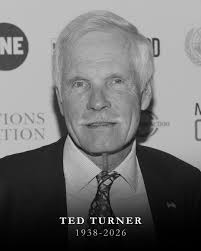
Ted Turner, CNN founder, media mogul, and philanthropist, has died at 87.
- May 7
- 5 min read
Ted Turner, CNN founder, media mogul, and philanthropist, has died at 87. He had been living with Lewy body dementia and was previously hospitalized last year with pneumonia before recovering.
The passing of Ted Turner marks the conclusion of a career that reshaped the contours of modern media and left a lasting imprint on how information is distributed and consumed. As the founder of CNN, Turner introduced a model of continuous news broadcasting that fundamentally altered audience expectations, establishing a format in which global events could be followed in real time. This innovation not only transformed journalism but also redefined the relationship between media organizations and the public.

Turner’s vision for CNN emerged at a time when traditional broadcast schedules dominated the landscape, and the concept of a 24-hour news channel was regarded with skepticism. His decision to pursue this model required both financial risk and a willingness to challenge established norms. Over time, CNN’s approach proved influential, prompting the emergence of similar networks and contributing to the globalization of news coverage. The network’s presence during major international events reinforced its role as a central platform for information dissemination.
Beyond his contributions to broadcasting, Turner’s career encompassed a broader engagement with media and entertainment. His involvement in various ventures reflected an understanding of the interconnected nature of content, distribution, and audience engagement. This perspective enabled him to navigate shifts within the industry, adapting to changes in technology and consumer behavior while maintaining a focus on innovation.
The philanthropic dimension of Turner’s life represents another significant aspect of his legacy. His contributions to environmental initiatives, public health, and international cooperation demonstrate a commitment to causes that extend beyond the commercial sphere. Through financial support and advocacy, he sought to address global challenges, aligning his resources with efforts aimed at long-term impact. This engagement reflects a broader view of responsibility, in which success in business is accompanied by a dedication to social and environmental concerns.
The mention of Lewy body dementia in relation to his later years provides context for the challenges he faced. This condition, characterized by cognitive and physical symptoms, affects both memory and motor function, presenting a complex set of difficulties for those diagnosed. Turner’s experience with the disease adds a human dimension to his story, illustrating the personal realities that can accompany public achievement. His previous hospitalization for pneumonia, followed by recovery, further underscores the fluctuations in health that often occur in advanced age.

Turner’s influence on media extends beyond the establishment of CNN. His approach to broadcasting emphasized immediacy and accessibility, principles that continue to shape the industry. By prioritizing continuous coverage, he contributed to a shift in how news is produced and consumed, encouraging a more dynamic and responsive form of journalism. This shift has had lasting implications, influencing not only television but also digital platforms that operate on similar principles of постоянное обновление.
The cultural impact of his work can be observed in the way audiences engage with information today. The expectation of real-time updates, once a novel concept, has become a standard feature of the media environment. Turner’s role in establishing this expectation highlights the extent to which individual innovation can influence collective behavior. His contributions have become embedded in the infrastructure of modern communication, shaping both professional practices and public habits.
In reflecting on his career, it is also important to consider the broader context in which he operated. The evolution of media during Turner’s lifetime involved significant technological and regulatory changes, from the expansion of cable television to the rise of digital platforms. His ability to navigate these transitions reflects a combination of strategic insight and adaptability, qualities that enabled him to remain relevant in a rapidly changing environment.
Turner’s philanthropic efforts further illustrate the breadth of his engagement with global issues. His support for environmental conservation, in particular, aligns with a growing recognition of the importance of sustainability. By directing resources toward initiatives aimed at preserving natural ecosystems, he contributed to a broader movement that seeks to balance economic development with environmental stewardship. This aspect of his legacy complements his achievements in media, presenting a more comprehensive picture of his impact.

The relationship between his professional accomplishments and personal life offers additional insight into his character. While widely recognized for his public achievements, Turner also maintained connections that shaped his perspective and priorities. These relationships, though less visible than his business ventures, form part of the narrative that defines his life. They provide context for the decisions he made and the values he expressed through his work and philanthropy.
The announcement of his passing invites reflection on the evolution of the media industry and the individuals who have contributed to its development. Turner’s role as a pioneer in 24-hour news broadcasting positions him within a lineage of innovators who have expanded the possibilities of communication. His work serves as a reference point for understanding how media systems evolve and how they respond to changing societal needs.
At the same time, his story highlights the intersection of innovation and responsibility. The platforms he helped create have become integral to public discourse, influencing how information is shared and interpreted. This influence carries implications for the accuracy, accessibility, and impact of news, underscoring the importance of maintaining standards within a rapidly evolving environment. Turner’s legacy, therefore, encompasses both the opportunities and challenges associated with modern media.
The circumstances of his later years, including his health condition, also draw attention to the human dimension of public figures. Despite a career defined by visibility and influence, his experience with Lewy body dementia reflects a vulnerability that is shared across individuals, regardless of status. This aspect of his life adds depth to the narrative, reminding observers that personal challenges often exist alongside professional achievements.
In considering the broader implications of his passing, it becomes clear that Turner’s contributions extend beyond specific accomplishments. They represent a shift in how media operates, how information is delivered, and how audiences engage with the world. His work has influenced subsequent generations of media professionals, shaping the practices and expectations that define the industry today.

The enduring presence of CNN as a global news network serves as a testament to the viability of his vision. Its continued operation reflects the sustainability of the model he introduced, even as the media landscape continues to evolve. This continuity underscores the lasting relevance of his approach, demonstrating how foundational ideas can persist through periods of change.
Turner’s philanthropic legacy, meanwhile, continues through the institutions and initiatives he supported. These efforts, focused on addressing global challenges, represent an ongoing contribution that extends beyond his lifetime. They reflect a commitment to leveraging resources for the benefit of broader المجتمع, aligning with principles that emphasize collective well-being.
As the narrative of his life is considered in its entirety, it becomes evident that Ted Turner’s impact is multifaceted. It encompasses innovation in media, engagement with global issues, and a personal journey marked by both achievement and challenge. His story illustrates the ways in which individual actions can influence systems, shaping the structures through which information and ideas are conveyed.
In the context of contemporary media, Turner’s contributions remain relevant as the industry continues to adapt to new technologies and audience behaviors. The principles he championed—immediacy, accessibility, and global reach continue to inform the development of platforms and practices. His legacy, therefore, is not confined to the past but persists in the ongoing evolution of communication.
Ultimately, the passing of Ted Turner marks the end of a significant chapter in the history of media. It provides an opportunity to reflect on the transformations he helped initiate and the broader implications of his work. Through his innovations and philanthropic efforts, he has left a lasting imprint on both the industry and the wider world, shaping the ways in which information is shared and understood.



Comments