


Taylor Swift’s Knicks Fan Past Resurfaces After Intense Courtside Moment With Travis Kelce at NBA Game.
- May 25
- 8 min read
The images of Taylor Swift in New York Knicks gear may have resurfaced only because of her latest courtside appearance with Travis Kelce, but the renewed fascination says as much about the public’s obsession with Swift’s evolving identity as it does about basketball fandom itself. Every era of her life, from her friendships and romances to the cities she has claimed as home, tends to be archived and rediscovered by fans with forensic precision. This time, it was a collection of mid-2010s photographs showing the pop superstar enthusiastically supporting the New York Knicks that suddenly returned to circulation after she attended an NBA playoff game alongside Kelce, a lifelong Cleveland Cavaliers supporter.
A fan account dedicated to the Knicks shared the old photographs on X, prompting an immediate wave of commentary from Swifties and sports fans alike. One image showed Swift standing beside Jimmy Fallon in 2015, both dressed in Knicks jerseys and caps while laughing courtside. Another featured the singer posing with former Knicks stars Amar'e Stoudemire and Carmelo Anthony on the basketball court. Additional photographs from 2014 showed Swift attending a Knicks game with her former close friend Karlie Kloss while wearing a purple Knicks T-shirt. In another resurfaced snapshot, she posed alongside former Knicks player Jerome Williams.
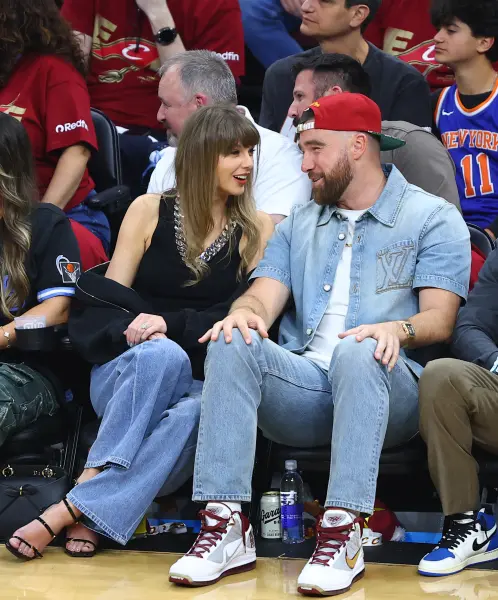
The timing of the resurfaced images was impossible to ignore. Just hours earlier, Swift and Kelce had made their highly publicized courtside appearance at Game 3 of the Eastern Conference Finals in Cleveland, where the Cavaliers faced the Knicks. Cameras repeatedly captured the couple smiling, chatting and reacting animatedly to the game as the Knicks ultimately defeated Cleveland 121 to 108. Kelce, who was born and raised in Ohio and has long been outspoken about his love for Cleveland sports, arrived wearing a blue Louis Vuitton short-sleeve button-up shirt, jeans, a red Cavaliers hat and a pair of LeBron James signature sneakers. Swift, meanwhile, opted not to wear any team merchandise, choosing instead a black jacket layered over a tank top with jeans and strappy sandals.
For many fans online, the contrast between Swift’s apparent Knicks history and her recent appearance supporting the Cavaliers quickly became the source of playful debate. Some described the resurfaced photos as “messy” or “cringe,” while others defended the singer, pointing out that celebrity sports allegiances are often fluid and deeply tied to relationships, geography and social circles. One fan bluntly wrote, “Doesn’t bother me,” reflecting a broader sentiment that Swift’s presence at games has less to do with unwavering loyalty to a franchise and more to do with the people she shares those experiences with.
That dynamic has become central to the public understanding of Swift during the last several years. Unlike earlier stages of her career, when she carefully separated her personal life from public appearances, Swift now appears far more comfortable allowing audiences to witness her private relationships unfolding in real time. Her romance with Kelce, which became public in 2023, quickly evolved into one of the most intensely covered celebrity relationships in modern entertainment culture. What initially appeared to many observers as an unexpected crossover between the worlds of pop music and professional football gradually transformed into a cultural phenomenon that reshaped both stars’ public images.
Kelce himself experienced a remarkable expansion in visibility after the relationship became public. Already one of the NFL’s most recognizable personalities thanks to his success with the Kansas City Chiefs and his podcast with brother Jason Kelce, he suddenly became familiar to audiences who had previously paid little attention to football. Swift’s appearances at Chiefs games during the 2023 and 2024 NFL seasons triggered enormous television ratings spikes, viral social media moments and even broader discussions about the intersection of celebrity culture and sports marketing.

At the same time, the relationship offered a noticeably different public narrative for Swift after years of intensely scrutinized romances. Earlier relationships with figures such as Harry Styles, Calvin Harris, Tom Hiddleston and Joe Alwyn were often framed through speculation, secrecy or media backlash. Her six-year relationship with Alwyn, in particular, unfolded largely behind closed doors, with Swift deliberately avoiding extensive public appearances and interviews about their life together. After that relationship ended, many observers noted a significant shift in her public demeanor. She appeared more visible, more socially engaged and less interested in maintaining strict boundaries between her celebrity persona and her private life.
That transition coincided with perhaps the most commercially dominant era of her career. The monumental success of the The Eras Tour transformed Swift from a major global pop star into an entertainment industry force operating at an almost unprecedented scale. The tour shattered revenue records worldwide, boosted local economies in multiple countries and inspired academic discussions about fandom, parasocial relationships and modern celebrity power. Economists even coined the phrase “Taylor Swift effect” to describe the measurable financial impact her appearances had on tourism and consumer spending in cities hosting her concerts.
By the time she began appearing publicly with Kelce, Swift had already achieved a level of influence extending far beyond music. She became increasingly associated with fashion trends, sports coverage, political discourse and even financial markets. Her every public appearance now functions almost like a global media event. That explains why something as seemingly insignificant as old Knicks photographs could instantly become headline material years later.
Yet Swift’s relationship with public scrutiny has always been complicated. Throughout her career, she has repeatedly faced criticism about authenticity, image management and perceived reinvention. During the mid-2010s, the same era in which the Knicks photographs were taken, Swift cultivated a highly visible “girl squad” image that dominated celebrity culture. Frequent outings with friends such as Karlie Kloss, Blake Lively, Gigi Hadid and others became cultural events in themselves. At the time, those friendships were often celebrated as symbols of female solidarity and glamorous celebrity social life.
However, public perception eventually shifted. Critics began accusing Swift of curating an overly polished image rooted in exclusivity and performative friendship dynamics. Her once highly publicized bond with Kloss later became the subject of endless online speculation after the two gradually stopped appearing together publicly. Neither woman extensively addressed the rumored fallout, which only intensified fan theories over the years. The resurfaced Knicks photos unintentionally revived memories of that era, reminding audiences of how dramatically Swift’s social world has evolved since then.
The singer’s ability to survive and adapt after periods of backlash remains one of the defining aspects of her career. In 2016, Swift experienced one of the most difficult public controversies of her life following her conflict with Kanye West and Kim Kardashian over the song “Famous.” After Kardashian released edited recordings of a phone call between Swift and West, social media erupted with accusations that Swift had manipulated the narrative. The backlash became so severe that Swift largely disappeared from public view for months.

Rather than ending her career, however, that controversy ultimately marked the beginning of a dramatic reinvention. Swift returned with Reputation, an album built around themes of media hostility, betrayal and public perception. The project allowed her to reclaim control over the narrative surrounding her image while embracing a darker, more confrontational artistic identity. In hindsight, many fans and critics now view that period as a turning point that fundamentally reshaped her relationship with fame.
The years that followed demonstrated an increasingly strategic version of Swift. She regained ownership over her narrative not only artistically but financially. Her battle over the ownership of her original master recordings became one of the music industry’s most discussed disputes after executive Scooter Braun acquired the rights to her early catalog. Swift responded by launching her ambitious rerecording project, releasing “Taylor’s Version” editions of her earlier albums. The campaign became both a commercial triumph and a symbolic statement about artist autonomy in the streaming era.
By 2026, Swift’s public image had evolved into something far broader than the role of singer-songwriter with which she first became famous. She is now treated almost like a cultural institution whose personal choices generate the same level of interest as her artistic output. Her relationship with Kelce only intensified that phenomenon because it merged two enormous fan ecosystems: pop music and professional sports.
Kelce, meanwhile, has benefited from the relationship in ways extending beyond media visibility. Already considered one of the greatest tight ends in NFL history, his crossover celebrity status expanded dramatically as brands, television producers and entertainment executives recognized his mainstream appeal. His easygoing charisma, comedic instincts and comfort with fame helped distinguish him from athletes who often struggle under the relentless scrutiny of celebrity relationships.
Observers have also noted that Swift and Kelce appear unusually relaxed together in public compared to many celebrity couples. Their recent outings in New York, including their dinner at Sartiano’s before the playoff game, have reinforced the perception that they are leaning into public visibility rather than resisting it. That openness has fueled continuing fascination surrounding their engagement and forthcoming wedding.

Reports suggesting that the couple plans to marry in New York City on July 3 only intensified public curiosity. According to insiders, save-the-date invitations have already circulated among close friends and family, though details about the ceremony remain tightly guarded. Swift’s longtime collaborator Jack Antonoff and other members of her inner circle have reportedly remained careful not to reveal any specifics publicly. The secrecy surrounding the wedding has become its own form of publicity, generating endless speculation online about guest lists, venues and potential performances.
The attention surrounding Swift’s future marriage also reflects a broader shift in how the public views her personal life. For years, her relationships were often discussed through the lens of heartbreak and songwriting inspiration. Today, however, conversations increasingly frame her as someone entering a more stable and settled chapter. Even coverage of seemingly trivial moments — such as attending a basketball game — now carries undertones of domestic partnership and shared lifestyle.
Still, Swift’s enduring appeal lies partly in her ability to remain emotionally legible to audiences despite her extraordinary level of fame. Fans project narratives onto her because her career has always encouraged emotional interpretation. Her songs function like autobiographical fragments, inviting listeners to connect public events with lyrical storytelling. That intimacy creates a feedback loop in which even old Knicks photos can suddenly acquire new meaning once they are reintroduced into a different context.
In many ways, the renewed conversation surrounding Swift’s basketball fandom is less about sports allegiance than about nostalgia itself. The resurfaced images evoke an earlier version of Swift: the highly visible New York socialite of the 2010s, surrounded by celebrity friends and constantly photographed courtside or walking through Manhattan. Her current life with Kelce may appear different in tone, but traces of that earlier era continue to shape how the public interprets her present.

The fascination also demonstrates how celebrity culture increasingly depends on archival memory. Fans no longer consume public figures only in the present tense; they continuously revisit and reinterpret past images, interviews and relationships through the lens of current events. Swift, perhaps more than any contemporary celebrity, exists within that constant cycle of rediscovery.
As she prepares for marriage while remaining at the peak of her professional influence, Swift occupies a uniquely powerful position in entertainment culture. She is simultaneously a musician, businesswoman, fashion figure, sports-world celebrity and internet obsession. The resurfacing of old Knicks photos may seem minor on the surface, but the reaction they generated reveals how every chapter of her life remains interconnected in the eyes of the public. For Taylor Swift, even a basketball jersey from 2014 can become part of an ongoing cultural narrative that refuses to fade.



Comments