


Nicolas Cage Returns in Lord of War Sequel — and This Time, His Most Dangerous Enemy Is His Own Son.
- May 7
- 7 min read
More than two decades after Nicolas Cage delivered one of the most memorable performances of his career as international arms dealer Yuri Orlov in Lord of War, the story is officially continuing. The long-awaited sequel, Lords of War, has secured U.S. distribution through Vertical and is now scheduled for a theatrical release in 2027, bringing Cage back to one of the darkest and most morally complicated characters he has ever portrayed.
Written and directed once again by Andrew Niccol, the sequel revisits Yuri Orlov years after the events of the original film. But this time, the conflict is no longer centered only around global weapons trafficking and political corruption. Instead, the story becomes deeply personal. Yuri discovers that he has a son, Anton, played by Bill Skarsgård, who has built his own mercenary army powerful enough to rival his father’s empire. Set against the backdrop of America’s wars in the Middle East, the film transforms into a tense father-son rivalry between two men shaped by violence, greed and ambition.

According to the official synopsis, Anton is far from a morally redeeming figure. If anything, he may be even more dangerous than Yuri himself. Andrew Niccol hinted at that dynamic while discussing the sequel’s central conflict. “As a storyteller, I always felt there was so much more to explore with the ‘merchant of death’ that is Nicolas Cage’s charming devil, Yuri Orlov,” Niccol explained. “This latest chapter gave me the chance to introduce his ultimate rival: his illegitimate son, Anton — illegitimate in every sense of the word — played by the equally roguish Bill Skarsgard. Set against the largely unseen world of mercenaries, the film quickly reveals that Anton isn’t out to right his father’s wrongs; he’s out to top them.”
The project recently wrapped production in Morocco, with Vendôme Pictures financing and producing the film. Alongside Cage and Skarsgård, the cast also includes Laura Harrier, Sylvia Hoeks and Greg Tarzan Davis. Vertical reportedly plans to present footage from the movie during CinemaCon, signaling growing confidence that the sequel could become one of the more talked-about adult-oriented thrillers of 2027.
When Lord of War first premiered, it stood apart from most crime thrillers of its era. Rather than glamorizing violence in a conventional action format, Andrew Niccol approached the global arms trade with a colder, more satirical tone. The film followed Yuri Orlov’s rise through international weapons trafficking while exposing the hypocrisy of governments, corporations and political systems profiting from endless conflict. Nicolas Cage’s performance became central to the film’s legacy. Charming, intelligent and terrifyingly detached, Yuri was portrayed not as a cartoon villain but as a man who viewed morality as secondary to survival and opportunity.
Over the years, Lord of War gradually developed cult status. While not initially considered a major awards contender, the film gained increasing recognition for how accurately it predicted many of the geopolitical anxieties that would dominate the following decades. Its cynical portrayal of international warfare, private military influence and political corruption feels even more relevant today than it did in 2005. That growing relevance is likely one reason the sequel has generated such significant attention before its release.
For Nicolas Cage, returning to Yuri Orlov also represents another fascinating chapter in one of Hollywood’s most unpredictable careers. Few actors have experienced a trajectory quite like his. Born into the famous Coppola family as Nicolas Kim Coppola, Cage famously changed his surname early in his career to avoid benefiting too directly from his family connections. Rather than relying on the prestige associated with directors like Francis Ford Coppola, Cage spent years building a screen identity entirely his own — eccentric, emotionally intense and often impossible to categorize.

During the 1980s and 1990s, he became one of the defining stars of American cinema through films such as Raising Arizona, Leaving Las Vegas, The Rock, Con Air and Face/Off. His performances balanced theatrical excess with genuine emotional vulnerability, creating a style that many actors tried unsuccessfully to imitate. In 1996, he won the Academy Award for Best Actor for Leaving Las Vegas, cementing his reputation as one of the industry’s most fearless performers.
Yet Cage’s career also became infamous for its instability. Throughout the 2000s and early 2010s, he moved between prestige dramas, bizarre independent films and financially motivated studio projects at an almost chaotic pace. Reports of major financial troubles — including massive real estate purchases, unpaid taxes and extravagant spending habits — turned him into a tabloid fascination. At one point, Cage reportedly owned castles, rare comic books, exotic animals and multiple luxury properties around the world. Rather than disappearing after those financial setbacks, however, he leaned even harder into constant work, accepting a huge volume of film roles across every possible genre.
For years, critics alternated between mocking and celebrating his unpredictability. But over time, public perception shifted dramatically. What once seemed erratic gradually began to look like artistic fearlessness. A younger generation of audiences rediscovered Cage through internet culture, memes and renewed appreciation for his willingness to fully commit to even the strangest material. Films such as Mandy, Pig and Dream Scenario triggered what many critics described as the “Nicolas Cage renaissance.”
That resurgence has been particularly interesting because it allowed Cage to embrace his own mythology rather than run from it. In The Unbearable Weight of Massive Talent, he even played a fictionalized version of himself, directly confronting decades of public fascination surrounding his eccentric persona. Instead of resisting the jokes or memes attached to his name, Cage increasingly seemed willing to transform them into part of his creative identity.
Returning to Yuri Orlov now feels especially fitting within that context. The character always represented one of Cage’s most restrained yet unsettling performances. Unlike many of his famously explosive roles, Yuri operated with calm calculation and emotional detachment. Bringing him back years later, older and confronted by a son arguably even more ruthless, creates an opportunity for Cage to revisit the role with entirely different emotional weight.

Meanwhile, Bill Skarsgård’s casting as Anton introduces another compelling generational dynamic. Over the last decade, Skarsgård has quietly become one of the most fascinating actors working in darker genre cinema. Best known globally for portraying Pennywise in It and It Chapter Two, he developed a reputation for performances mixing vulnerability, menace and psychological unpredictability. Coming from the famous Skarsgård acting family, Bill spent years trying to establish his own artistic identity separate from relatives like Stellan Skarsgård and Alexander Skarsgård.
Unlike some actors who rely heavily on conventional leading-man charisma, Bill Skarsgård often gravitates toward unsettling, emotionally damaged characters. Whether in horror, thrillers or psychological dramas, he tends to project a strange mixture of fragility and danger. That energy could make Anton a particularly volatile counterpart to Cage’s Yuri Orlov. Early descriptions suggest the character is not attempting to redeem his father’s legacy, but to surpass it entirely.
The sequel’s focus on mercenary armies also reflects how warfare itself has changed since the original film. When Lord of War premiered in 2005, conversations around private military contractors and non-state armed groups were only beginning to enter mainstream public awareness. Two decades later, the influence of private security firms, independent militias and proxy warfare has become far more visible globally. Andrew Niccol appears determined to update the franchise’s political themes accordingly.
Niccol himself has always been drawn to stories exploring morality within large systems of power. Beyond Lord of War, he also wrote and directed films such as Gattaca, In Time and Anon, often examining how technology, capitalism and institutions reshape human behavior. Even when working within science fiction or crime genres, his films frequently revolve around ethical compromise and the dehumanizing effects of modern systems.

Industry observers have also noted that Lords of War arrives during a period when Hollywood appears increasingly interested in reviving darker adult-oriented franchises from the 1990s and 2000s. While superhero films continue dominating box office conversation, there has been renewed demand for politically charged thrillers, grounded crime stories and morally ambiguous protagonists. The success of recent legacy sequels suggests audiences remain interested in revisiting familiar characters — particularly when those characters are allowed to age naturally rather than exist inside endlessly recycled blockbuster formulas.
For Cage personally, the sequel may further reinforce one of the most unlikely late-career reinventions in modern Hollywood. Once viewed as a cautionary tale about excess and career mismanagement, he is now frequently celebrated as one of the industry’s last truly unpredictable movie stars. Directors and younger actors increasingly speak about him with admiration rather than irony. His willingness to take risks, embrace failure publicly and continuously reinvent himself has given his career an unusual durability.
Offscreen, Cage’s personal life has remained almost as dramatic as many of his films. His multiple marriages, financial issues and eccentric collecting habits have long fueled tabloid fascination. Yet in recent years, he appears to have settled into a quieter phase. After marrying Riko Shibata in 2021 and becoming a father again later in life, Cage has spoken more openly about prioritizing family and personal stability. Observers close to the actor often note that he seems calmer and more reflective compared to the chaos that once defined his public image.
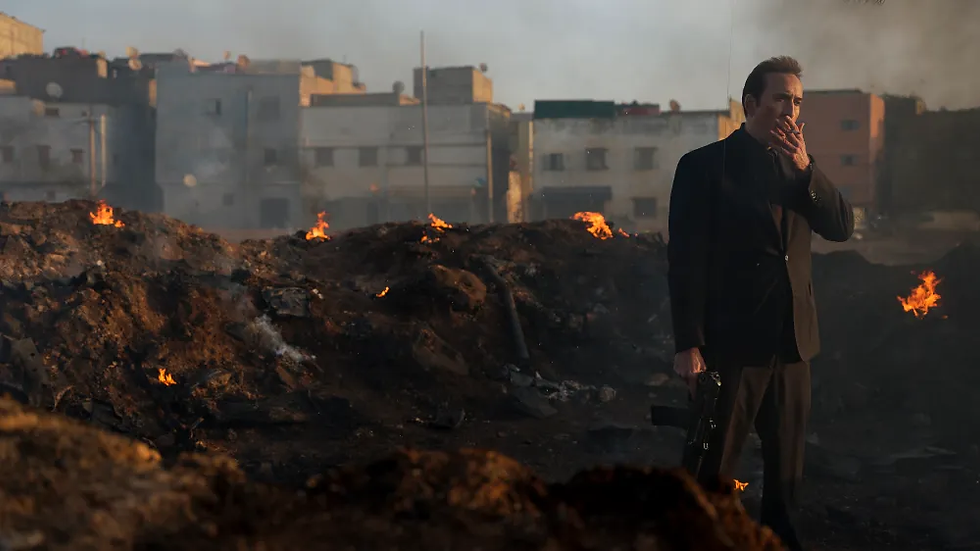
That contrast between past excess and present stability may ultimately add another layer to Lords of War. Yuri Orlov was always a man shaped by greed, ambition and emotional distance. Revisiting him now through the perspective of aging, fatherhood and legacy creates the possibility of a far more introspective film than audiences might initially expect. Whether the sequel leans more heavily into political thriller territory or psychological family drama, the central conflict between Yuri and Anton already suggests a story less interested in simple action spectacle than in inherited corruption and generational violence.
More than twenty years after Lord of War first examined the machinery of global conflict, its sequel appears ready to explore how those same systems evolve — and how the people profiting from them inevitably leave something behind for the next generation to inherit.


Comments