


Miranda Kerr appeared in an elegant white gown at the Met Gala, drawing all eyes to her.
- May 5
- 4 min read
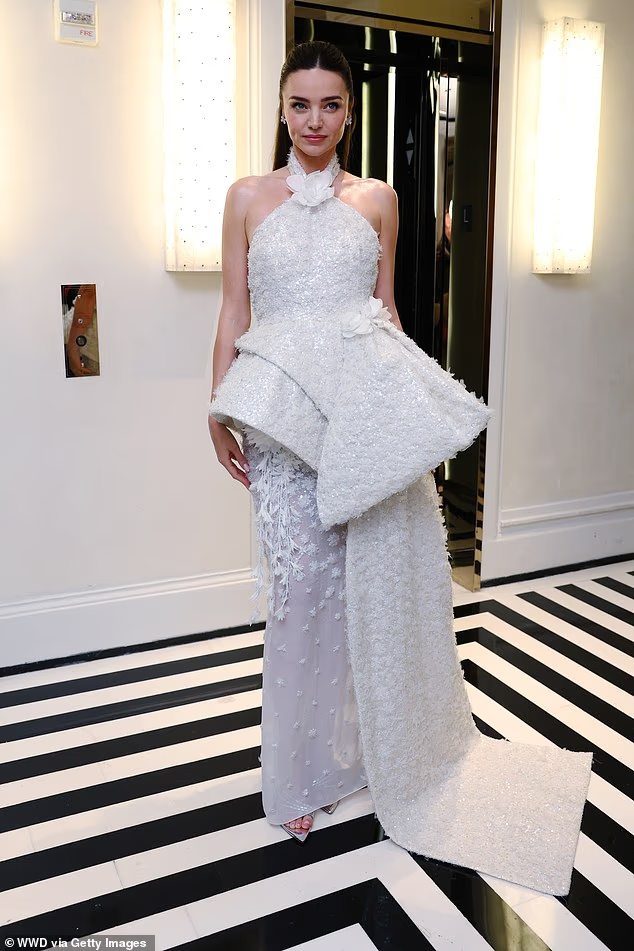
Miranda Kerr ensured all eyes were on her as she made a poised and polished entrance at the 2026 Met Gala in New York, embracing the evening’s “Costume Art” theme with a refined interpretation of modern couture. The Australian supermodel, long associated with effortless elegance, chose an all-white ensemble that blended structured tailoring with intricate decorative craftsmanship, reaffirming her status as one of fashion’s most enduring red-carpet figures.
Her floor-length gown featured a sculpted silhouette anchored by a structured peplum bodice, creating a dramatic yet controlled shape that framed her figure with precision. The design was elevated through elaborate textural detailing, including three-dimensional floral appliqués and delicate fringe elements that moved subtly with each step. A halter neckline completed the upper structure, softened by floral accents that tied the look back to the broader artistic theme of the evening.

Rather than relying on overt spectacle, Kerr’s appearance leaned into craftsmanship and restraint. Crystal-embellished heels peeked out from beneath the flowing hemline only occasionally, reinforcing the gown’s emphasis on form and detail over visibility. Her styling choices followed the same philosophy: a sleek updo that highlighted her facial structure, paired with classic makeup featuring defined brows and a luminous, natural base.
Speaking through her presence rather than words, Kerr embodied the type of red-carpet minimalism that contrasts sharply with the more provocative interpretations seen elsewhere at the Met Gala. In an event defined by extremes, her approach stood out for its balance and composure.
She attended the gala alongside her husband, Snapchat co-founder and CEO Evan Spiegel, who opted for a traditional black tuxedo. The couple’s coordinated appearance reflected a shared preference for understated sophistication amid a night filled with theatrical fashion statements.

The Met Gala itself, hosted annually at New York’s Metropolitan Museum of Art, remains one of the most influential fundraising events in the global fashion calendar. The 2026 edition centered on the theme “Costume Art,” encouraging guests to interpret how clothing interacts with the human form as a creative canvas. The accompanying exhibition, developed by the Costume Institute, explores historical and contemporary garments through conceptual lenses including anatomy, aging, and bodily expression.
For Kerr, the event represents another chapter in a career that has evolved significantly since her early days in the fashion industry. Rising to international prominence in the mid-2000s as one of the most recognizable Victoria’s Secret Angels, she quickly became a fixture on magazine covers and luxury campaigns. Her image was defined by a combination of softness and commercial appeal, allowing her to bridge high fashion and mainstream beauty branding with ease.
Beyond modelling, Kerr successfully transitioned into entrepreneurship with the launch of her beauty brand KORA Organics, positioning herself within the clean beauty movement long before it became a global trend. The brand’s focus on certified organic skincare reflected her personal emphasis on wellness, spirituality, and holistic living, elements she has consistently integrated into her public identity.

Her personal life has also drawn significant public attention over the years. Kerr was previously married to actor Orlando Bloom, with whom she shares a son, Flynn. Their separation in 2013 was widely covered but remained notably amicable, with both parties maintaining a cooperative co-parenting relationship in the years that followed. In 2017, she married Evan Spiegel, marking a shift toward a more private and family-centered chapter of her life. Together, they have built a relatively low-profile household despite their global visibility as a couple.
Unlike many figures in the celebrity fashion sphere, Kerr has largely avoided scandal-driven narratives, instead cultivating an image rooted in discipline, spirituality, and curated public engagement. This has contributed to her longevity in an industry often defined by rapid turnover and shifting aesthetic trends.
At the Met Gala, however, Kerr reasserted her relevance within the high-fashion conversation. While some attendees leaned into avant-garde provocation or conceptual exaggeration, her white couture look emphasized technical precision and artisanal detail. The choice aligned with her long-standing association with brands that prioritize elegance and craftsmanship over shock value.
Observers noted that her appearance also reflected a broader trend among established models returning to classic red-carpet codes after years of increasingly experimental fashion dominance. In this context, Kerr’s ensemble functioned not as a departure but as a reaffirmation of her aesthetic identity.

Inside the event, she was seen moving through the curated exhibition spaces, engaging with installations that explore the relationship between clothing and the human body. The Met Gala’s internal showcase, staged within the museum’s newly developed galleries, aims to position fashion alongside fine art, a framing that resonates with Kerr’s own history of blending commercial fashion with lifestyle branding.
Her presence also contributed to a broader generational continuity at the event, where legacy supermodels, contemporary influencers, and emerging performers coexist within the same visual landscape. Alongside figures such as Cara Delevingne and Rosie Huntington-Whiteley, Kerr represented a cohort of models whose careers helped define the transition from early 2000s runway culture to today’s digitally amplified fashion ecosystem.
In contrast to the more controversial or viral moments of the evening, Kerr’s appearance did not rely on shock or provocation. Instead, it reinforced a form of fashion literacy grounded in silhouette, texture, and construction. This approach has become increasingly rare at an event that often rewards immediacy and spectacle over subtlety.
Still, the Met Gala continues to function as a space where different interpretations of style coexist. For Kerr, it remains a platform where her established identity can be rearticulated within evolving aesthetic frameworks, reaffirming her position within the industry without requiring reinvention.
As the evening unfolded, her look was widely interpreted as a quiet counterpoint to more experimental ensembles on the carpet. Rather than competing for attention through extremes, it occupied a space of controlled visibility, drawing focus through refinement rather than disruption.
In that sense, Miranda Kerr’s 2026 Met Gala appearance extended beyond a single red-carpet moment. It reflected a broader trajectory in her career—one defined by longevity, adaptation, and a consistent alignment with elegance as both aesthetic and strategy.


Comments