


Jaafar Jackson opens up for the first time about the overwhelming pressure of portraying Michael Jackson: “I feel like he’s always with me.”
- May 19
- 7 min read
Jaafar Jackson is preparing for the most defining moment of his career so far as he steps into the role of his uncle, Michael Jackson, in the highly anticipated film Michael directed by Antoine Fuqua. For most young performers, portraying the King of Pop would already be an intimidating challenge. For Jaafar, however, the experience carries an even deeper emotional weight. He is not only interpreting one of the most famous entertainers in history for the screen, but also revisiting the life, legacy and pain of a man who shaped his own family history.
“It’s an honor of a lifetime. Definitely an experience I’ll never forget,” Jaafar said while discussing the project during the film’s international press tour. The 29-year-old performer, son of Jermaine Jackson, admitted that the emotional connection to the role made the preparation process uniquely personal. “I couldn’t be more proud and grateful to be able to tell Michael’s story in a cinematic way,” he explained, describing the project less as a traditional acting job and more as a responsibility tied to preserving family memory.

The film follows Michael Jackson’s rise from his childhood years in the The Jackson 5 to his transformation into the globally recognized “King of Pop.” It also marks Jaafar’s first-ever acting role, placing him under extraordinary scrutiny before even officially entering Hollywood. Unlike many biographical projects built around distance between actor and subject, “Michael” exists within a complicated emotional landscape. Jaafar grew up hearing stories about Michael within the family and even spent time with him during childhood, yet he still approached the role as an outsider trying to fully understand the mythologized figure behind the public image.
“It was important for me to start at the roots from the very beginning when the Jackson 5 started, and make sure I understood Michael’s point of view from the early days all the way through his adulthood,” Jaafar explained. “There’s a list of many things I did to feel ready for when I arrived on set. It was an extensive amount of prep work that started with dissecting many archival videos, listening to his music, and immersing myself in his personal writings.” According to those close to the production, Jaafar spent nearly two years researching Michael’s mannerisms, emotional rhythms and physical presence in order to move beyond imitation and toward something more psychologically layered.
Perhaps the most daunting challenge involved recreating Michael Jackson’s instantly recognizable performance style. Michael’s choreography remains among the most studied and imitated in entertainment history, making authenticity essential for the film’s credibility. To prepare, Jaafar worked closely with renowned choreographers Rich + Tone Talauega, who had previously worked directly with Michael during the “History” tour. “They were Michael’s actual choreographers he had on the ‘History’ tour,” Jaafar said. “I started to absorb all of Michael’s tours, and collected a library of any video I can find of him dancing. I really started studying it on a daily basis, and practicing in the mirror for hours and hours every day. It took a couple years until I felt confident with the dance moves.”
Those involved with the production have repeatedly emphasized how striking Jaafar’s resemblance to Michael becomes once he performs. Early footage from the film generated intense online discussion because of the uncanny similarities in body language, vocal cadence and facial expressions. For longtime Michael Jackson fans, the resemblance felt almost unsettling. Yet insiders insist the goal was never impersonation alone. Director Antoine Fuqua reportedly encouraged Jaafar to focus not only on technical precision but also on the loneliness, discipline and emotional isolation that defined much of Michael’s adult life.
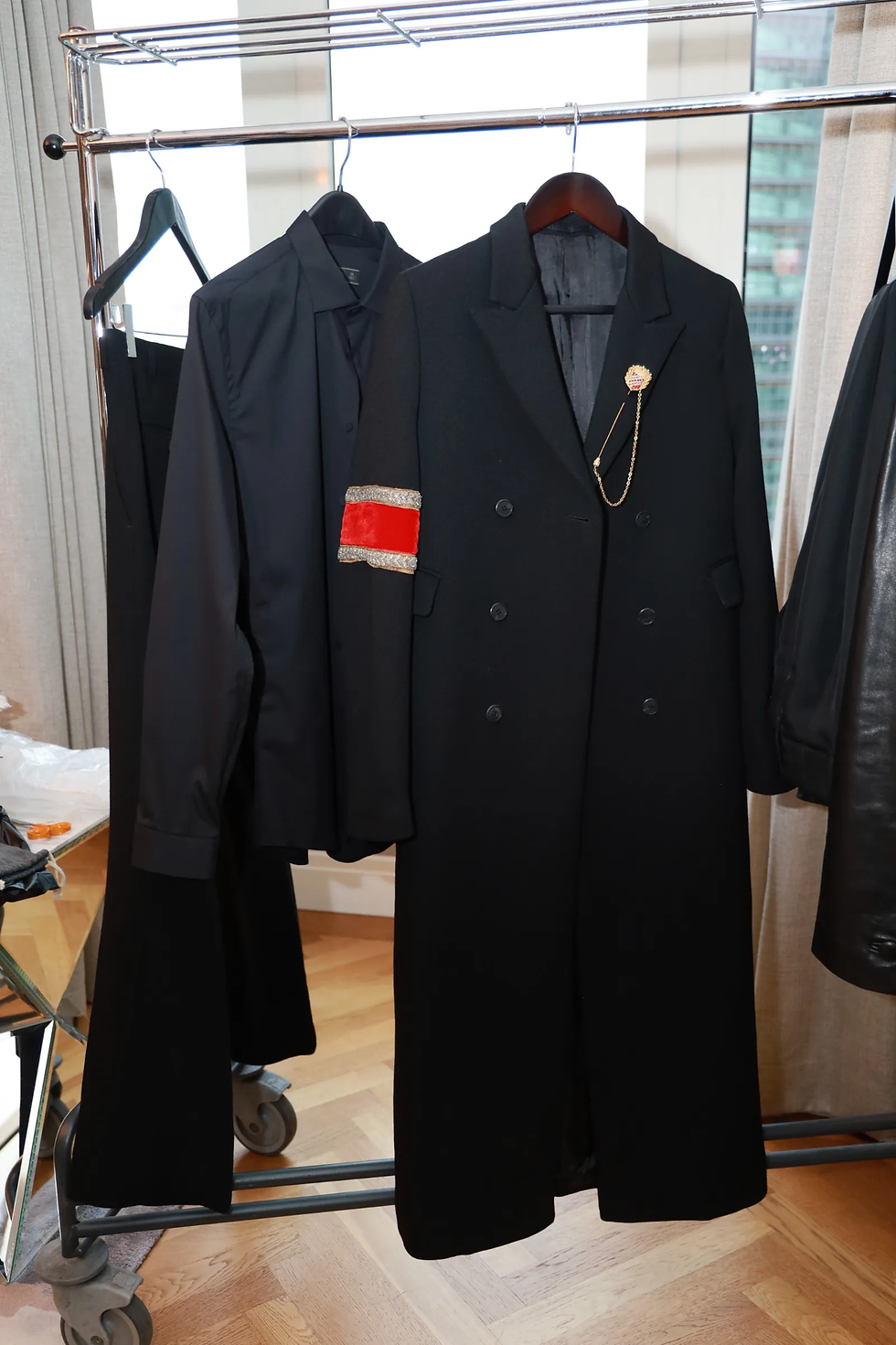
Costume design also became a central part of Jaafar’s transformation. The film’s wardrobe recreates some of Michael Jackson’s most iconic looks, from the red leather “Thriller” outfit to the military-inspired jackets that became synonymous with his stage persona. Designed by Marci Rodgers, the costumes helped Jaafar understand the deliberate theatricality Michael used to construct his image. “That was such a fun process for me, being able to try on all the wardrobe and also perform with those iconic outfits,” he said. “Seeing the clothing coming to life helped me to understand how specific and detailed Michael was on how he wanted to look on stage while dancing.” Among his personal favorites were the “Thriller” costume and the famous “Billie Jean” look from Motown 25.
Outside the film itself, Jaafar has also begun shaping his own celebrity identity through fashion during the press tour. Working with stylist Ilaria Urbinati, he has embraced tailored menswear that subtly references Michael’s aesthetic while remaining contemporary. For the Berlin premiere, Jaafar wore a black Prada overcoat accented by a red armband and brooch — details intentionally inspired by Michael’s stage wardrobe. “I wanted to [pay] homage to Michael, so I wanted to wear a red armband… I feel like he’s with me,” he explained. Across the tour, he has also worn embroidered Bode shirts, leather Amiri trench coats and a white polka-dot Kody Phillips suit he described as one of his favorite looks.
The emergence of Jaafar Jackson arrives at a complicated moment for the Jackson family legacy. More than fifteen years after Michael Jackson’s death in 2009, public fascination surrounding him remains as intense and polarizing as ever. To millions of fans worldwide, Michael remains one of the greatest entertainers in modern history — a revolutionary figure who reshaped pop music, music videos, live performance and celebrity culture itself. Albums like Thriller, Bad and Dangerous transformed him into a global cultural force whose influence stretched far beyond music.
At the same time, Michael’s legacy remains deeply shadowed by years of allegations, investigations and controversy surrounding accusations of child sexual abuse. The documentary Leaving Neverland reignited global debate over how audiences should reconcile admiration for Michael’s artistic genius with the disturbing accusations made against him. While the Jackson family has consistently denied the allegations and defended Michael’s innocence, the controversy continues to divide both the public and the entertainment industry.

That complicated legacy inevitably places enormous pressure on Jaafar and the filmmakers behind “Michael.” Critics have already questioned whether the project will honestly address the darker aspects of Michael’s life or function primarily as a protective family narrative. Producers have insisted the film will not ignore controversy entirely, though insiders suggest the project focuses more heavily on Michael’s emotional experiences, artistic brilliance and personal struggles than on exhaustive legal examination.
For Jaafar personally, navigating those tensions may become one of the defining challenges of his public career. Unlike actors portraying historical figures with no personal connection, he carries the emotional expectations of an entire family while simultaneously entering an entertainment industry that remains deeply conflicted about Michael Jackson himself. Every interview, premiere appearance and public statement therefore carries unusual symbolic weight.
The Jackson family has long existed as one of the most influential and turbulent dynasties in modern entertainment history. From the rise of the Jackson 5 in Gary, Indiana, to the worldwide fame of Michael and Janet Jackson, the family helped define the sound and image of late twentieth-century pop culture. Yet behind the success existed years of emotional strain, strict parental discipline and internal conflict, much of it linked to patriarch Joe Jackson. Michael himself frequently described his childhood as emotionally isolating and intensely demanding.
Jaafar grew up witnessing both the extraordinary privilege and the painful complexity that accompanied the Jackson name. While his father Jermaine enjoyed significant fame during the Jackson 5 era, the family also experienced financial disputes, fractured relationships and constant public scrutiny over decades. The Jackson surname therefore carries not only glamour and musical prestige, but also a history of instability, rivalry and emotional burden.

Before “Michael,” Jaafar maintained a relatively low public profile compared to many celebrity relatives. Though he occasionally shared music and fashion photography online, he largely stayed outside mainstream entertainment headlines. Family members, however, had long hinted at his similarities to Michael, particularly his voice, facial structure and natural movement style. Fans frequently commented on the resemblance in viral clips posted online years before the biopic was officially announced.
The casting itself immediately generated widespread attention partly because the choice felt unusually intimate. Hollywood biopics often rely on transformation through makeup and prosthetics. In Jaafar’s case, the emotional and physical resemblance already existed before filming even began. Producer Graham King described Jaafar as uniquely capable of channeling Michael’s spirit in a way that extended beyond appearance. According to those close to production, even longtime Jackson family members became emotional while watching early rehearsals.
Still, public curiosity surrounding the film extends beyond performance quality alone. Many viewers see “Michael” as a test of how Hollywood now handles controversial icons in the streaming era. Modern audiences increasingly expect biographical films to confront uncomfortable truths rather than simply celebrate celebrity mythology. Whether “Michael” can balance reverence, honesty and emotional complexity may ultimately determine both its critical reception and cultural significance.
For Jaafar, however, the project appears driven less by industry politics and more by personal devotion. “I hope people walk out of that theater with a deeper understanding of who Michael was at the core,” he explained. “To experience a side of him they haven’t seen in this way. I hope people leave dancing, singing, feeling inspired, while also wanting more.” His comments suggest a desire to humanize Michael beyond the extremes of worship and scandal that have dominated public discussion for decades.
As the film’s release approaches, Jaafar now faces the transition from private family member to international celebrity in his own right. The pressure is immense: audiences will not only judge his acting debut, but also compare him to one of the most famous entertainers who ever lived. Yet those close to him insist his calm demeanor and meticulous preparation reflect years of quietly carrying the expectations associated with the Jackson name.

The Berlin premiere offered an early glimpse of that transformation. Dressed in tailored Prada and standing before flashing cameras, Jaafar appeared simultaneously like a new Hollywood star and a ghostly echo of the past. The red armband on his coat served as a subtle tribute to Michael, but also as a reminder that the film represents something larger than nostalgia. It is an attempt to reintroduce Michael Jackson to a generation shaped by both admiration and controversy — through the eyes of someone who knew him not only as a legend, but as family.
Whether “Michael” ultimately reshapes public understanding of the King of Pop remains uncertain. What is already clear, however, is that Jaafar Jackson’s life has changed permanently. In stepping into his uncle’s shoes, he has inherited not only one of entertainment’s most iconic legacies, but also the impossible contradictions that come with it: genius and spectacle, loneliness and adoration, inspiration and scandal. For a young performer making his acting debut, there may be no more difficult role — or more personal one — to play.


Comments