


Gillian Anderson Says The Salt Path Controversy Felt Like a “Betrayal” After She Played Raynor Winn
- 4 days ago
- 9 min read
Gillian Anderson has opened up about the controversy surrounding The Salt Path, admitting that allegations questioning the accuracy of Raynor Winn’s bestselling memoir felt like “a betrayal” after she had spent time with the couple whose story she was portraying. Anderson played Winn in the film adaptation of the 2018 memoir, which tells how Raynor and her husband, Moth, embarked on a 630-mile journey along England’s South West Coast Path after losing their Welsh home and learning that Moth had a serious neurological condition. What was initially presented as a moving story about homelessness, illness, love and resilience has since been placed under intense scrutiny following an investigation by The Observer that challenged several aspects of Winn’s account.

For Anderson, the controversy was particularly difficult because her preparation for the role involved more than simply reading the memoir. She and Jason Isaacs, who plays Moth, spent time with Raynor and Moth Winn while preparing for the film. That personal contact meant the allegations did not feel like a distant publishing dispute. “We had been so surprised by its success: ‘What, really, this film about two old people going on a walk?’ It felt like such a betrayal because we'd spent time with [the Winns],” Anderson told The Times. She described the situation as “really disappointing” and said she had not heard from the couple since the controversy emerged. (The Times)
The film had originally been positioned as an intimate portrait of two people confronting a devastating change in their lives. In Winn’s memoir, the couple lose their home following what was described as a disastrous business deal, while Moth is diagnosed with corticobasal degeneration, or CBD, a rare neurodegenerative condition. With nowhere else to go, they begin walking the South West Coast Path with limited money and possessions. The journey becomes both a physical challenge and a way of confronting the uncertainty that has overtaken their lives. The book became a bestseller and eventually inspired the feature film starring Anderson and Isaacs.
The controversy emerged when The Observer investigated the circumstances surrounding the couple’s loss of their home and other elements of the memoir. According to the newspaper’s investigation, Winn, whose legal name is Sally Walker, and her husband, whose legal name is Timothy Walker, had lost their home under circumstances that differed from the account presented in The Salt Path. The newspaper reported that Winn had taken out a loan to repay money she had been accused of taking from a former employer, Martin Hemmings, a property professional in north Wales. Winn disputed the interpretation and maintained that the dispute with Hemmings was not what caused the couple to lose their home. These claims remain contested, and they should be understood as allegations and findings reported by The Observer, rather than as an established account accepted by all parties.

Winn has repeatedly defended the memoir and rejected the suggestion that its central story was fabricated. In a statement, she described The Salt Path as an account of what happened to her and Moth after they became homeless, emphasizing that the book was never intended to document every single event in their lives. “The Salt Path is about what happened to Moth and me, after we lost our home and found ourselves homeless on the headlands of the south west,” she said. “It's not about every event or moment in our lives, but rather about a capsule of time when our lives moved from a place of complete despair to a place of hope.” She previously characterized The Observer article as “highly misleading” and said she and Moth were taking legal advice.
Questions have also been raised about Moth’s medical condition. The memoir places his diagnosis of corticobasal degeneration at the heart of the couple’s decision to undertake the long coastal walk. However, The Observer said it consulted medical experts who expressed skepticism about the diagnosis based on the symptoms described and Moth’s apparent ability to recover or reverse certain symptoms. In response, Winn posted clinic letters on Instagram in July 2025 addressed to Timothy Walker, saying they showed that “he is treated” for CBD “and has been for many years”. The medical questions have added another layer to an already complicated dispute because the diagnosis is not merely a detail in the memoir; it is one of the central elements underpinning the emotional narrative of the entire book.
Another issue concerned Winn’s claim that The Salt Path was her first book. She had presented herself as a debut writer and received recognition associated with being a first-time author. However, her lawyers later confirmed that she had previously published a book called How Not to Dal Dy Dir under the name Izzy Wyn-Thomas. The book had been published by Gangani Publishing, a company owned by Winn and her husband. Winn also acknowledged that the couple had been behind a prize draw connected with their home near Pwllheli in north Wales. She later described the scheme as a mistake, saying: “It was a mistake, as it clearly wasn't going to work. We cancelled it and refunded the few participants.”

The revelations inevitably changed the context surrounding the film, particularly because The Salt Path had been receiving attention as an uplifting story before the allegations emerged. Anderson said that the controversy arrived at an especially difficult moment for the production. In an interview with Radio Times, she explained that the film had been performing better than she expected in Britain and that the timing of the Observer article was particularly unfortunate. “I think we were about to sign with Sony Classics for the United States the week when the article came out, so it sucked, and continues to suck,” she said. Anderson added that she had hoped audiences would be able to experience the movie “as its own entity”, separate from the debate surrounding the source material.
Jason Isaacs has taken a similarly measured approach. The actor, best known internationally for playing Lucius Malfoy in the Harry Potter films, plays Moth opposite Anderson. Speaking about the planned American publicity campaign, he admitted that the situation was “going to be interesting”. He recalled asking the distributors, “Are you sure you want us to do publicity?” and receiving the answer, “Absolutely.” Isaacs said he supported the decision because he believed the movie remained a “beautiful film” and that “much of it is still completely valid”. At the same time, he acknowledged the obvious difficulty created by the allegations: “Obviously, some of the things have been questioned. It's going to be an interesting experience.”
The controversy has therefore placed Anderson in an unusual position. She is not the author of the memoir, nor is she responsible for establishing whether every detail of Winn’s account was accurate. Her role was to interpret a woman whose life story had already been published as nonfiction. Yet because she met Winn personally and attempted to understand her before portraying her, the subsequent allegations have inevitably affected Anderson on a more personal level. Her description of the situation as “a betrayal” appears to reflect that sense of trust rather than simply frustration over the commercial consequences for the film.
The episode is particularly striking given the trajectory of Anderson’s career. Born in Chicago in 1968 and raised partly in London and the United States, she initially built her reputation on stage before being cast as FBI Special Agent Dana Scully in The X-Files in 1993. The role transformed her into an international star and made Scully one of the most recognizable female characters in television. Anderson’s performance earned her major awards, including an Emmy and Golden Globe, while the character itself became culturally influential. Scully’s combination of scientific skepticism, intelligence and professional authority also helped inspire what became known as the “Scully Effect”, referring to the influence the character had on women pursuing careers in science, medicine and related fields. (Screenonline)
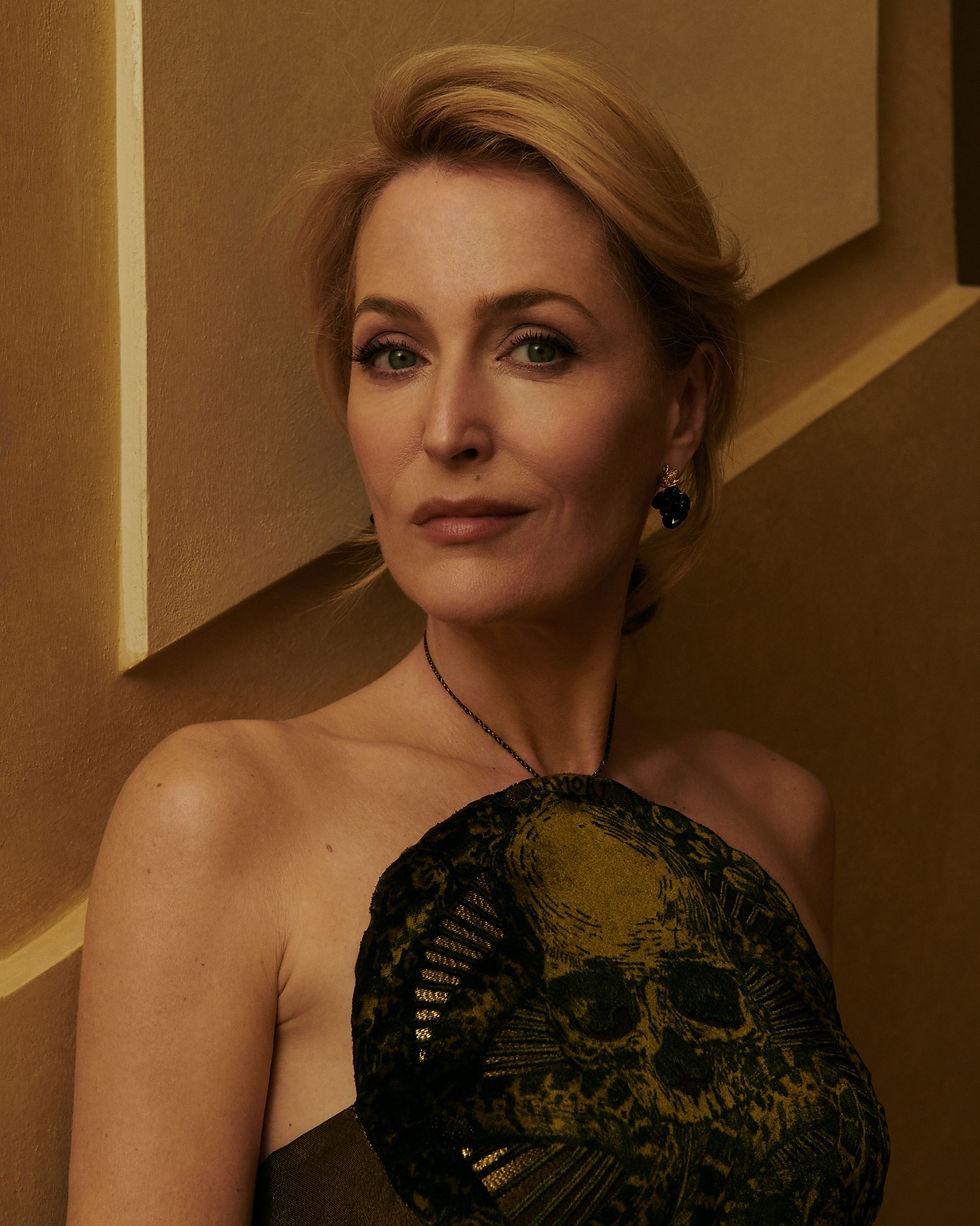
Anderson never allowed The X-Files to become the only definition of her career. After the series ended in 2002, she returned to Britain and increasingly divided her time between film, television and theatre. Her performances in projects such as The House of Mirth, Bleak House, The Fall and Hannibal demonstrated a willingness to move away from the controlled, analytical image associated with Scully. Later, her role as sex therapist Jean Milburn in Netflix’s Sex Education introduced her to a younger international audience, while her portrayal of Margaret Thatcher in The Crownbrought another major award-winning performance. Her Thatcher performance earned her an Emmy and reinforced her reputation as an actress capable of transforming herself for complex, controversial characters. (Wikipedia)
Her personal life has also unfolded alongside an unusually demanding career. Anderson married Clyde Klotz, an assistant art director she met while working on The X-Files, in 1994. Their daughter, Piper Maru, was born later that year, and the marriage ended in 1997. Anderson subsequently married documentary filmmaker Julian Ozanne in 2004, but the couple separated in 2006 and later divorced. She then had a long-term relationship with businessman Mark Griffiths, with whom she has two sons. Anderson is now the mother of three children, and she has previously spoken about the difficulty of balancing motherhood with the relentless demands of an acting career. (Wikipedia)
In recent years, Anderson has also become considerably more open about parts of her private life that she once kept away from the public. She has spoken about relationships with women as well as men, including a relationship with an older girl during high school that she described as secretive at the time. Rather than presenting her sexuality through a fixed label, Anderson has emphasized the importance of the individual connection between two people. Her recent comments have added another dimension to the public image of an actress who has increasingly become willing to discuss identity, relationships and personal experiences on her own terms. (Page Six)
That openness is also reflected in the types of roles Anderson has chosen in recent years. Rather than relying on the prestige attached to her earlier work, she has continued to pursue projects that challenge her image. The Salt Path was another example of that approach. Raynor Winn is not a glamorous Hollywood figure or a conventionally powerful character. She is portrayed as an ordinary woman confronting financial collapse, homelessness, illness and uncertainty. For Anderson, the attraction was precisely the opportunity to inhabit a character whose strength comes from endurance rather than authority. The allegations surrounding the memoir therefore create a particularly uncomfortable contradiction: the qualities that drew Anderson to the story are now inseparable from questions about the story’s factual foundations.
The publishing industry has also been forced to address questions about how thoroughly memoirs are fact-checked before they reach readers. Penguin, the publisher behind The Salt Path, said it had undertaken the necessary pre-publication due diligence, including obtaining an author warranty concerning factual accuracy and carrying out a legal review. The publisher also stated that, before The Observer began its investigation, it had not received concerns about the book’s content. The case has consequently raised broader questions about the distinction between memoir, personal interpretation and factual record, particularly when a book’s commercial success depends heavily on readers believing that the events described actually happened.

The controversy has already had consequences for Winn’s publishing plans. Her next nonfiction book, On Winter Hill, had originally been scheduled for publication in 2025 but was subsequently delayed until 2028. Penguin attributed the delay to the “considerable distress” experienced by the author. Meanwhile, the American release of The Salt Path was postponed from its original May date to September, meaning the film will now enter the US market under very different circumstances from those initially anticipated. For Anderson and Isaacs, the promotional campaign is likely to involve questions about the allegations alongside the usual discussion of acting, filmmaking and the emotional themes of the movie.
For Anderson herself, however, The Salt Path is only one chapter in a career that continues to evolve. She is returning to London’s West End in Who's Afraid of Virginia Woolf? and has also taken on new film projects, including Jane Schoenbrun’s Teenage Sex and Death at Camp Miasma. At the same time, she continues to develop writing and creative projects beyond acting. Her career has moved from science-fiction television to literary adaptations, historical drama, comedy, theatre and more experimental cinema, with Anderson repeatedly choosing roles that allow her to move beyond the expectations created by Dana Scully. (The Times)
The Salt Path controversy therefore arrives at a moment when Anderson appears increasingly comfortable with uncertainty and reinvention. What makes this situation different is that the questions surrounding the film are not about her performance but about the reality behind the character she was asked to portray. She can defend the quality of the film without being able to resolve the factual dispute at its center, which explains why she has emphasized her hope that audiences will experience the adaptation “as its own entity”. Isaacs has expressed a similar position, arguing that “much of it is still completely valid”, even while acknowledging that parts of the original story have been questioned.
Ultimately, the most difficult aspect of the situation for Anderson may be the distance between the woman she believed she was portraying and the questions now surrounding that woman’s story. She approached Raynor Winn as an actress preparing to play someone whose experiences had been presented as real, spent time with the couple and helped transform their memoir into a cinematic narrative. Now, with allegations challenging parts of that account, Anderson has been left to navigate a controversy she did not create but cannot entirely escape. Her description of the experience as “a betrayal” captures the personal dimension of a dispute that began as an investigation into a bestselling memoir and has since reached the actors, filmmakers, publishers and audiences who helped turn that story into something much larger.
For now, The Salt Path remains a film that exists between two realities: the emotional story presented on screen and the unresolved questions surrounding the memoir that inspired it. Anderson has made clear that she wants the work to be judged on its own terms, while Isaacs has defended what he believes remains valuable in the finished film. Whether American audiences will separate the cinematic adaptation from the allegations surrounding Raynor and Moth Winn remains to be seen. What is certain is that, for Gillian Anderson, the experience has become far more complicated than simply playing a character in a successful literary adaptation. After more than three decades in an industry where she has repeatedly reinvented herself, she now finds herself confronting a different kind of challenge: discovering how to stand behind a piece of work while questioning the story that first brought it to her. (The Times)



Comments