


Elizabeth Debicki, the actress from The Crown, narrowly avoided a wardrobe malfunction in a daring Grecian-style gown at the Met Gala.
- May 5
- 5 min read
Elizabeth Debicki once again commanded attention on one of fashion’s most scrutinised stages, stepping onto the Met Gala 2026 red carpet in New York in a look that fused classical inspiration with modern couture precision. The Australian actress, known for her statuesque presence and refined red-carpet choices, embraced the evening’s “Costume Art” theme with a Grecian-inspired aesthetic that balanced elegance with deliberate risk-taking.
Wearing a custom Vera Wang creation, Debicki presented a silhouette that clung closely to her frame, emphasizing both structure and fluidity. The gown featured a halter neckline and sculpted tailoring that accentuated her elongated form, while open side panels under the arms subtly exposed her skin, creating what some observers described as a near wardrobe malfunction moment. The design also incorporated a thigh-high split that revealed her legs as she moved across the carpet, reinforcing the dramatic yet controlled energy of the look.

The dress itself was anchored by a flowing black train, gathered at the hip and extending into an oversized sash that trailed behind her with theatrical impact. The contrast between the minimalist front and the voluminous rear added to the Grecian goddess impression, aligning with the event’s broader exploration of the human form as artistic canvas. Despite the revealing structure of the gown, Debicki carried herself with composure, maintaining a poised presence throughout her walk and interactions on the red carpet.
Footwear became one of the most discussed elements of her ensemble. Departing from traditional red carpet expectations, she opted for flat, strappy gold sandals, a choice rarely associated with high-profile gala appearances. The decision reinforced the classical theme of her styling, evoking references to ancient Greek sculpture and mythology, while also challenging conventional expectations of glamour and height-enhancing footwear in such settings.
Perhaps the most debated element of her appearance, however, was her headpiece. Debicki wore a historic tiara dating back to 1957, originally commissioned for American socialite Betsey Cushing Whitney. The piece was created for her husband, Ambassador John Hay Whitney, when he was presented to Queen Elizabeth II at the Court of St James. Known as the Verdura Feather Tiara, it draws inspiration from the 1907 US $10 gold coin and features 1,223 diamonds, weighing a total of 28.32 carats. The jewel added a layer of historical significance to her look, contrasting with the contemporary minimalism of her gown.
Debicki attended the event as a member of the Gala Host Committee, reinforcing her growing status within the international fashion and entertainment landscape. She was also seen walking alongside designer Vera Wang, highlighting the collaborative nature of the ensemble’s presentation and underscoring her longstanding relationship with high fashion houses that often dress her for major public appearances.

Her Met Gala moment also arrived during a particularly visible period in her career. In recent years, Debicki has become widely recognised for her portrayal of Princess Diana in the final seasons of the acclaimed series The Crown. Her performance was praised for its emotional restraint and physical precision, capturing the late royal’s presence during the most scrutinised years of her public life. The role earned her an Emmy Award in 2024 for Outstanding Supporting Actress in a Drama Series, further cementing her position as one of the most respected performers of her generation.
Reflecting on her acceptance speech at the time, Debicki revealed a personal quirk that shaped her preparation process: “I didn't write anything down because I'm very superstitious and now I'm in a real pickle,” she said on stage. The remark, delivered with humour, reflected the understated personality that often contrasts with her commanding screen and red carpet presence.
Her career trajectory has been marked by a steady rise through both independent cinema and large-scale international productions. After gaining attention in films such as The Great Gatsby and Widows, she expanded into the global franchise space with roles in projects including Tenet and Guardians of the Galaxy Vol. 2, where she portrayed the high priestess Ayesha. Despite working across blockbuster and prestige formats, she has maintained a reputation for selective role choices and a preference for complex, character-driven narratives.
Beyond her professional achievements, Debicki has largely kept her personal life out of the public spotlight, rarely engaging in public discussions about relationships or private affairs. This discretion has contributed to her image as an actor focused primarily on craft rather than celebrity culture, even as she continues to appear at some of the most photographed events in the world.

Her Met Gala appearance also arrived in the context of renewed media attention following comments made at the 2025 Emmy Awards by actress Jennifer Coolidge. During a comedic on-stage segment, Coolidge referenced Debicki in a joke that circulated widely online, saying: “I thought I had gotten really close with my fellow nominees especially after I won. [But] I'm pretty sure they removed me from the group chat. I was referring to having won two consecutive Emmys for my scene-stealing supporting role as needy and self-absorbed heiress Tanya McQuoid-Hunt in the first two seasons of HBO hit drama, The White Lotus. We were all supposed to go on a trip to Ibiza and I found out that I wasn't included. And the only reason I knew that was because Elizabeth Debicki and I have the same Ozempic dealer. At least hers is working! But now that I think about it, winning the Emmy, I think it might have been the worst thing that's ever happened to me.” The moment, widely shared across social platforms, further embedded Debicki into broader pop culture discourse, even if indirectly.

In addition to awards season attention, Debicki has also continued to evolve her fashion identity. Earlier in the same year, she attended the Schiaparelli: Fashion Becomes Art exhibition gala dinner in London, where she wore a striking illusion dress featuring a printed torso design. The look, structured with a high neckline and sleeveless silhouette, emphasized sculptural fashion as wearable art. Styled with black pointed heels and gold earrings, and finished with an elegant updo, the ensemble reinforced her affinity for conceptual red carpet dressing.
Debicki has previously spoken about the challenges of portraying Princess Diana, particularly in mastering her voice. “What you as the actor playing that character owe the audience is a very specific sonic imprint,” she explained in a discussion with Variety. “I felt a huge responsibility to get as close to it as I could. I've lived in London a long time, so my Australian accent is kind of transmorphed anyway. But of all the accents I've ever learned to do… For Diana, it felt like a music. And that music and that rhythm was so far from how I sense myself as a person. So I worked extremely hard.”
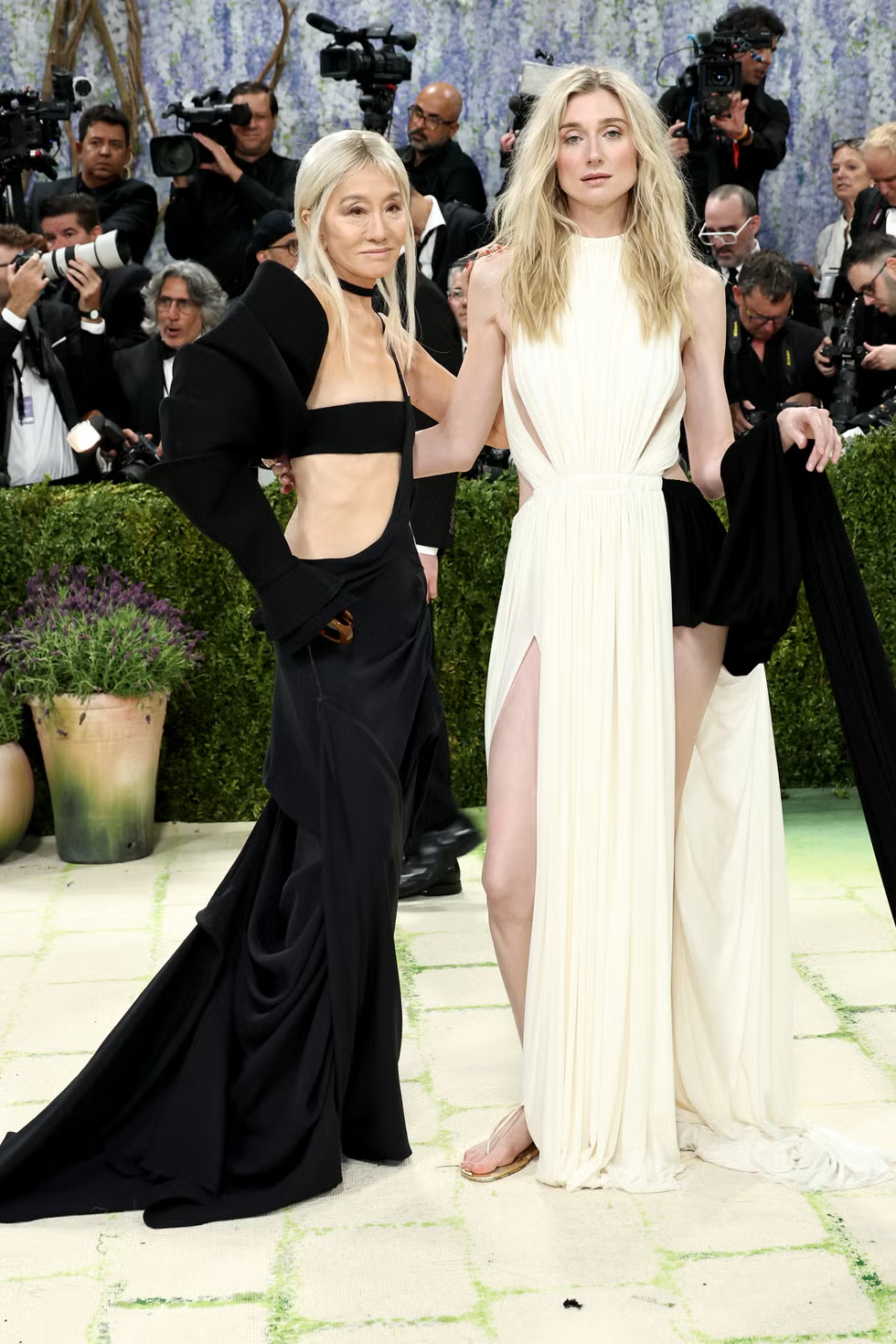
This attention to detail and commitment to transformation is mirrored in her approach to fashion, where she often selects pieces that extend beyond aesthetic appeal into narrative expression. Her Met Gala 2026 look, with its interplay of historical jewellery, classical styling references, and modern structural risk, fits within this broader pattern of deliberate visual storytelling.
As the Met Gala continues to function as both a fashion spectacle and cultural barometer, Debicki’s presence reinforced her position as one of the event’s most compelling figures. Neither overtly theatrical nor conventionally restrained, her interpretation of the theme balanced risk and refinement, prompting discussion not only about the dress itself but also about the evolving language of red carpet fashion.
In a night defined by bold statements and exaggerated silhouettes, her look stood out for its controlled tension between exposure and elegance, history and modernity, simplicity and ornamentation. It is this balance that has come to define Elizabeth Debicki’s public image: precise, intentional, and consistently attuned to the narrative power of style.


Comments