


“Cillian Murphy returns to Peaky Blinders: Turning 50 and the shocking truth about Tommy Shelby that will keep fans hooked”
- Apr 7
- 6 min read
Peaky Blinders returns once again, this time not as a television series but as a cinematic conclusion with Peaky Blinders: The Immortal Man, a film that extends the legacy of one of the most influential crime dramas of the past decade. Few series have managed to occupy such a unique cultural space—simultaneously a critical success, a mass obsession, a stylistic reference point, and a modern myth. At its centre stands Tommy Shelby, a character whose evolution has mirrored not only the shifting tides of history but also the internal fractures of the man portraying him, Cillian Murphy.
The original series told a story that went far beyond its premise of gang warfare in Birmingham. It was, at its core, an exploration of power and violence, wrapped in the allure of tailored suits, controlled swagger, and carefully curated iconography. Yet beneath that aesthetic surface lay something far more fragile and haunting: a narrative about men irreparably marked by war, about family as both refuge and burden, and about a nation struggling through modernity while still carrying the weight of its past. That duality is what allowed the series to transcend imitation, establishing itself as something singular.

With The Immortal Man, that mythic narrative shifts to the big screen, bringing Tommy Shelby back to Birmingham during the Second World War. The film is conceived not as an extension but as a reckoning—a closing chapter that seeks to confront the accumulated consequences of everything that came before. When the story resumes, Tommy is no longer the calculating figure orchestrating events from positions of political influence. Instead, he exists in a self-imposed exile, withdrawn after years of grief, betrayal, and violence that have taken their toll.
Rumours circulate within the world of the film that he has retreated into obscurity to write his memoirs. He is indeed writing, but what emerges is less a traditional account and more a confession. It is an attempt to process the weight of war, family tragedy, and personal guilt that has defined his life. The narrative structure reflects this introspection, with fragments of memory and reflection guiding the audience through both past and present, bridging the gap between long-time viewers and those returning after a distance.
For the creator, the film represents the fulfilment of a long-held vision. The idea of concluding the story against the backdrop of the Second World War had existed since the earliest days of the series. That ambition, once speculative, has now materialised. The decision to end the story in Birmingham, under the shadow of bombings, reinforces the cyclical nature of both history and Tommy’s personal journey.
Despite the historical scale, the film remains anchored in character. It is, fundamentally, about Tommy Shelby—his trajectory, his choices, and the question of who he ultimately becomes. That journey is reignited not only by the global conflict unfolding across Europe but also by unfinished family matters. The re-emergence of his son, Duke, introduces a new dynamic that reframes the story as one of generational tension.

Duke, now grown and in control of the Peaky Blinders organisation, embodies a different kind of leadership—more volatile, less restrained by the moral codes that once guided the family. His actions push the organisation into darker territory, creating a contrast between inherited power and earned authority. The relationship between father and son becomes central, shaped as much by absence as by blood. Duke’s understanding of his father is constructed through myth, and the encounter between them exposes the distance between legend and reality.
For Murphy, returning to Tommy after several years required both familiarity and reinvention. Having inhabited the character for over a decade, he carries with him an accumulated understanding that cannot be replicated. “I think the luxury of having played him for so long is that all the research is kind of done,” he explains. “You’ve got 13 years of it there, you’ve lived it alongside him, and you’ve kind of aged alongside him. That’s unique. I’ll never experience that again.” Yet the transition to film demanded something more—a justification for revisiting a story that had already reached significant depth.
That justification, he suggests, lies in returning to the core theme that has always driven the narrative. “The main thematic drive has always been family. If we continued with that and made it a father-and-son story, then we knew we were on the right track.” In that sense, the film does not expand outward but rather turns inward, focusing on the emotional and moral questions that have lingered beneath the surface.
Visually and structurally, the film benefits from the shift in medium. The condensed format allows for a more focused narrative, with greater emphasis on atmosphere and deliberate pacing. The ability to hold moments longer, to embrace stillness as well as intensity, contributes to a different rhythm of storytelling—one that aligns with the introspective tone of Tommy’s final chapter.
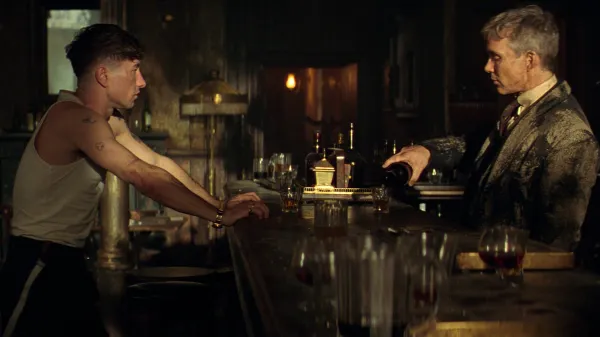
Music, as always, plays a crucial role in shaping the identity of Peaky Blinders. The series has long been defined by its use of anachronistic soundtracks, blending modern sounds with historical imagery to create a timeless aesthetic. The film continues this tradition while introducing new collaborations, notably with contemporary artists whose work reflects the same darkness and intensity that defines the narrative world.
Murphy himself played a role in initiating one such collaboration, drawn by a sense of alignment between the music and the emotional landscape of the story. The integration of music into the filmmaking process goes beyond simple accompaniment, becoming part of the creative dialogue. Tracks were developed in response to the evolving edit, with some scenes even filmed alongside the music itself. This approach reinforces the symbiotic relationship between sound and image that has always distinguished the series.
Amid these artistic considerations, the film also introduces new characters, expanding the world while maintaining continuity with its past. These additions bring fresh perspectives, particularly in relation to themes of heritage and identity that have always been present but not always foregrounded. The inclusion of characters connected to Romany culture, for instance, deepens the narrative’s engagement with its roots.
At its heart, however, the film remains a meditation on consequence. From the beginning, the story has understood that Tommy Shelby’s brilliance is inseparable from his damage. His success has always come at a cost, and the ghosts of his past have never been fully silenced. The transition to wartime Europe only amplifies these tensions, placing personal reckoning within a broader historical context.

The central question that emerges is both simple and profound: what does Tommy Shelby actually stand for? Beyond the accumulation of wealth and power, beyond the construction of an empire, what remains? “What do you actually stand for,” Murphy reflects, “aside from making money and building an empire, and abandoning things along the way? That’s the question he has to answer. And by the end of the film, I think he begins to realise what he actually stands for.”
This exploration of identity resonates with Murphy’s own approach to his career. Unlike many of his contemporaries, he has consistently resisted the pull of celebrity culture. His choices have been guided less by visibility than by substance, resulting in a body of work that prioritises depth over breadth. From early performances in independent films to collaborations with major directors, his trajectory has been defined by a commitment to craft.
Outside of acting, Murphy’s life remains notably private. Married for over two decades, he has built a stable family life away from the constant scrutiny that often accompanies fame. His decision to return to Ireland after years abroad reflects a desire for normalcy, a grounding influence that contrasts sharply with the intensity of his on-screen personas. This separation between public and private spheres has allowed him to maintain a sense of authenticity that is increasingly rare.
His background in music, often mentioned but rarely emphasised, continues to inform his artistic sensibility. The discipline and emotional awareness required for songwriting find echoes in his acting, particularly in the way he approaches rhythm, silence, and expression. Though he ultimately chose a different path, that early passion remains an integral part of his creative identity.
Importantly, Murphy’s career has been largely free of controversy. In an industry frequently defined by scandal, his reputation has remained steady, shaped more by his work than by his personal life. This consistency reinforces the perception of him as an actor first and foremost, uninterested in cultivating a public persona beyond what is necessary.
As Peaky Blinders: The Immortal Man brings the story of Tommy Shelby to a close, it also marks a significant moment in Murphy’s own journey. Having spent over a decade inhabiting the character, he now steps away from a role that has become inseparable from his identity as an actor. The film serves not only as a conclusion but as a reflection—on time, on change, and on the enduring complexity of human nature.
In the end, the story of Tommy Shelby is not one of simple resolution. It is a narrative shaped by contradictions, by the tension between ambition and consequence, between power and vulnerability. Through Murphy’s performance, those contradictions are given form, creating a character who remains compelling precisely because he is never fully understood.
And as Murphy himself suggests, the significance of that journey lies not in definitive answers but in the act of questioning. The search for meaning, for purpose, for something beyond survival and success, is what ultimately defines both the character and the actor who has brought him to life.


Comments