


Bitcoin Under Pressure at $84K: Did U.S. Government Wallet Moves Trigger a New Sell-Off
Bitcoin slipping towards the $84,000 area is enough to make traders nervous. Add reports of coins moving from wallets linked to the U.S. Government, and the market starts asking a sharper question: was this just another volatile session, or did official wallet activity help spark fresh selling?
The short answer is cautious. A government-linked wallet move can pressure sentiment, especially when Bitcoin is already fragile. But a transfer alone does not prove a sale. On-chain data can show that coins moved. It cannot always show intent.
That distinction matters. In a market driven by liquidity, leverage and headlines, the idea of a large seller can move price before any actual selling happens.

What a U.S. Government wallet move actually means
When people talk about U.S. Government Bitcoin wallets, they usually mean addresses that blockchain analysts have linked to coins seized in law enforcement actions. The most familiar examples in crypto history involve confiscated Bitcoin from criminal cases, later held, transferred or sold through official processes.
A wallet movement can mean several things:
Coins moved to a new custody address
Funds were consolidated from several addresses
A test transaction took place
Coins moved towards an exchange or broker
A sale may be planned, pending or already under way
Those are not the same event.
A transfer from one wallet to another can be routine housekeeping. Crypto custody involves security upgrades, address rotation and operational checks. Large holders, including public bodies and institutional custodians, may move assets without intending to sell them immediately.
The market rarely waits for full confirmation. If a wallet labelled as government-linked sends Bitcoin to an address associated with a major exchange or institutional broker, traders often read it as a possible sale signal. That reaction can be rational, even if it later turns out to be premature.
A wallet move is not a sale. It is a signal that the market tries to interpret, often with incomplete information.
The problem is that blockchain transparency cuts both ways. Everyone can see large transfers. Few can see the legal, operational or trading instructions behind them.
Why wallet movements can pressure Bitcoin before any sale
Bitcoin trades around narrative as much as flow. A large transfer creates a story, and stories move fast.
At $84,000, Bitcoin would already be sitting in a zone where traders may be watching support levels, liquidations and momentum. If price is falling and a government-linked wallet moves coins at the same time, many market participants will connect the two events.
That does not prove cause and effect. It does explain why the reaction can be sharp.
There are four main reasons.
Traders fear fresh supply
The U.S. Government has historically held Bitcoin from seizures. If even a portion of those coins were sold, the market would need to absorb extra supply.
Bitcoin is liquid, but liquidity changes by venue, time of day and market mood. A large seller can have a bigger impact during thin conditions or when buyers are already cautious.
The fear is not only about the number of coins. It is about timing. A sale during a weak market can weigh more heavily than the same sale during strong demand.
Leverage makes reactions faster
Crypto markets often carry heavy leverage. When price drops, leveraged long positions can be forced to close. That forced selling can push price down further, which can trigger more liquidations.
A wallet alert can become the spark, even if it is not the fuel.
In that setting, the sequence may look like this:
A government-linked wallet moves Bitcoin
Traders assume a sale could follow
Spot buyers step back
Short sellers become more aggressive
Leveraged longs face pressure
Liquidations deepen the move
The original transfer may be small compared with total daily market volume, yet the psychological effect can still be large.
Headlines compress uncertainty
On-chain alerts are often short, urgent and stripped of context. A post saying that government-linked coins moved will spread faster than a careful explanation of custody mechanics.
This creates a gap between what is visible and what is known.
Visible data may include the sending address, receiving address, amount and timing. Unknowns include the reason, whether the coins will be sold, who controls the receiving wallet and whether the move was part of a planned sale, internal transfer or custody change.
Markets dislike uncertainty. When traders cannot verify intent, many choose to reduce risk first and ask questions later.
Bitcoin was already under technical pressure
A coin transfer matters more when it lands during weakness.
If Bitcoin is struggling near $84,000, traders may already be watching whether that level holds. A move below a widely watched area can trigger stop-loss orders, even without any wallet news.
That means the government wallet story may have acted as an amplifier rather than the primary cause.
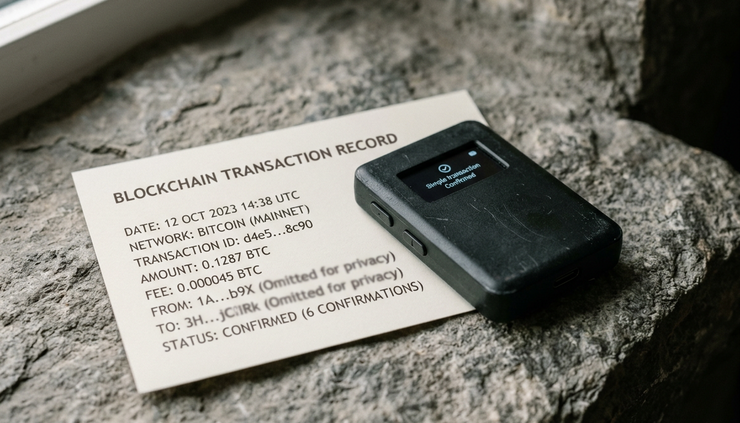
Did the wallet move trigger the sell-off or just add pressure?
The honest answer is that the wallet move may have contributed to the sell-off, but it would be too strong to say it single-handedly caused it without verified trade data.
Crypto markets rarely move for one reason. A sell-off near $84,000 could reflect several forces at once:
Profit-taking after a strong run
Weaker risk appetite across markets
Funding pressure in perpetual futures
Spot ETF flow concerns
Technical selling after a support break
Large-holder activity, including government-linked wallets
The question is not whether the wallet move mattered. It likely mattered to sentiment. The better question is whether it led to real sell-side flow large enough to change the market balance.
That requires stronger evidence than a transfer alert.
A confirmed sale would usually need supporting signs, such as coins arriving at known exchange deposit addresses, order book pressure, official disposal records or clear market impact around the time of execution. Even then, matching a specific seller to a specific price move can be difficult.
A simple framework helps.
Market signal | What it may suggest | What it does not prove |
Coins move between labelled wallets | Custody change or operational activity | A sale has happened |
Coins move towards exchange-linked addresses | Possible preparation to sell | The full amount will be sold |
Price falls after the transfer | Traders reacted or selling increased | The transfer caused the fall |
Official auction or sale notice appears | Disposal is planned or completed | Exact market impact without more data |
The strongest case for wallet activity causing pressure comes when multiple signals line up. For example, if coins move to exchange-linked wallets, spot order books weaken, funding flips sharply, and price breaks key support within the same window, the market can reasonably treat the move as part of the selling pressure.
Still, clean proof is rare.
Why government-linked Bitcoin carries extra weight
Not all whale wallets are equal in the market’s mind.
A transfer from an early miner may cause curiosity. A transfer from a dormant exchange wallet may raise operational questions. A transfer from a government-linked address feels different because it suggests a potential non-economic seller.
Private holders may choose not to sell if the market looks weak. Governments holding seized assets may have legal or administrative reasons to dispose of them, regardless of market sentiment. That perceived lack of price sensitivity can make traders more defensive.
There is also a memory effect. Crypto traders remember past episodes when large public sales, exchange failures or seized-asset movements created fear. Even if the facts differ, the market often responds to familiar patterns.
That is why a government wallet alert can punch above its actual size.
It speaks to three anxieties at once:
Supply risk
Regulatory attention
Loss of market control by bulls
When Bitcoin trades strongly, buyers may shrug off those concerns. When it is falling, the same concerns can look serious.

What to watch next
The next stage matters more than the first alert. If Bitcoin remains under pressure near $84,000, traders and long-term holders will look for confirmation or refutation of the sale narrative.
Several signals deserve attention.
Exchange inflows from labelled wallets
If coins move from government-linked addresses to wallets widely associated with exchanges or institutional brokers, the market will treat that as a stronger sale warning.
Even then, inflow does not always equal immediate selling. Coins can be staged, held, transferred again or sold in blocks away from public order books.
The key is whether inflows continue and whether they match visible market pressure.
Follow-up transactions
A single transfer can be operational. A sequence of transfers can suggest a plan.
Repeated movements, address consolidation and movement towards known liquidity venues would carry more weight than a one-off wallet shift.
Traders often watch whether the original receiving address sends coins onwards. If coins sit still, the urgency fades. If they keep moving, speculation grows.
Spot market depth
The clearest test is whether buyers absorb supply.
If Bitcoin dips but quickly finds bids, the market may conclude that the transfer was either harmless or already priced in. If bids thin out and each rebound fails, fear of further supply may remain.
Order book depth is not perfect. It can change quickly, and visible liquidity can disappear. Still, weak depth during a wallet scare can worsen price moves.
Derivatives positioning
Perpetual futures and options can magnify spot moves. When funding rates, open interest and liquidation data show crowded long positioning, wallet news becomes more dangerous.
If leverage clears out and price stabilises, Bitcoin may recover even if the transfer story remains unresolved. If leverage builds again while spot demand stays weak, another downside move becomes easier.
Official communication
Governments do not always explain wallet movements in real time. Sales of seized assets may appear through legal filings, public notices or later reports.
Until official information appears, the market works with partial evidence. That is why careful language matters. “Moved” is not the same as “sold”.
How traders should read the $84,000 level
The $84,000 area matters because round-number zones and recent support levels can become psychological markers. If Bitcoin is trading just above that region, bulls want to see a firm defence. If price breaks below and fails to reclaim it, sellers may gain confidence.
Still, no single level carries magic.
A better approach is to watch behaviour around the level:
Does price rebound quickly after dipping below it?
Does volume rise on the sell-off or on the recovery?
Are long liquidations driving the move?
Are spot buyers present, or is the bounce mostly derivatives-led?
Do wallet-linked flows continue after the first alert?
For long-term holders, the key issue is different. A government-linked transfer may create short-term volatility, but it does not change Bitcoin’s fixed supply schedule, network operation or basic custody model. It can change price in the near term. It does not automatically change the long-term thesis.
For active traders, the risk is more immediate. A headline-driven market can move before the facts are clear. Position size, stop placement and avoiding over-leverage matter more when rumours and on-chain alerts drive sentiment.
This article is for information only and is not financial advice. Crypto assets are volatile, and market conditions can change quickly.

The takeaway
The wallet move probably mattered, but not in the simple way the market first imagined.
Bitcoin near $84,000 was already vulnerable to selling pressure. A reported movement from wallets linked to the U.S. Government may have added fear of fresh supply, pushed traders to reduce risk and helped accelerate the move. That makes it a credible trigger for sentiment.
It does not make it confirmed proof of a government sale.
The cleanest reading is this: the transfer acted as a pressure point in an already nervous market. If follow-up transactions point towards exchange inflows or official disposal, the sell-off story gains strength. If the coins remain parked and buyers return, the move may look more like a fear-driven overreaction.
For now, the market is watching the same chain everyone else can see, but the intent behind the transactions remains the missing piece.



Comments