


Bitcoin Slumps to $80,507 as 114 Billion in Liquidations Sparks Fear of $75,000 Drop
Bitcoin’s drop to $80,507 was not just another red candle. It came with a reported $1.14 billion in crypto liquidations, a figure large enough to shake confidence across the market and force traders to ask a blunt question: is BTC now on a path towards $75,000?
The move matters because liquidations can turn a normal pullback into a sharper sell-off. When leveraged traders get forced out, exchanges close positions automatically. That selling can feed on itself, especially when support levels break and fresh fear enters the market.
This is not a prediction that Bitcoin must fall to $75,000. Markets rarely move in straight lines. But the latest slide has changed the short-term picture. Traders are now watching whether Bitcoin can reclaim lost ground, or whether the break lower opens the door to another leg down.
This article is for information only and is not financial advice.
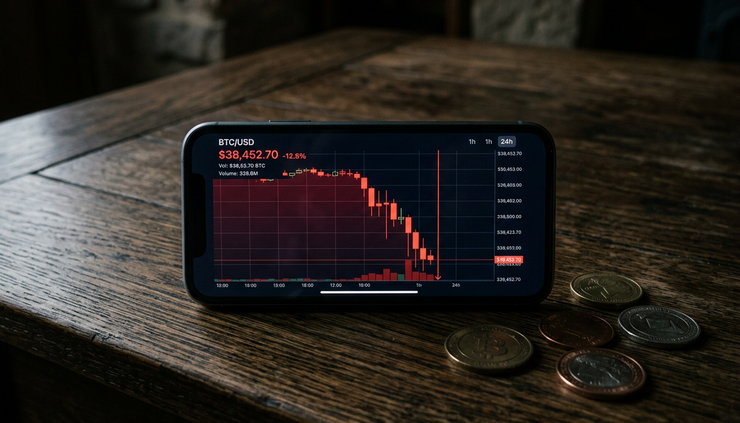
The drop to $80,507 changed the short-term mood
Bitcoin had already been under pressure before the fall to $80,507. The liquidation wave made the move feel more urgent because it suggested that many traders were positioned the wrong way.
In simple terms, liquidations happen when traders borrow money to increase the size of a position, then the market moves against them. If losses get too large, the exchange closes the trade to prevent the account from going below required margin. That forced closure can create extra buying or selling pressure.
In this case, the market was hit by a broad liquidation event across crypto. A reported $1.14 billion in positions getting wiped out means the move was not isolated to one small group of traders. It pushed through the wider market and likely included a mix of Bitcoin, Ether, and other major tokens.
The important point is not just the size of the liquidations. It is what they reveal.
They show that the market had built up risk. Too many traders were leaning in one direction. When price moved the other way, the unwind became violent.
That is why the fall has sparked talk of $75,000. Once Bitcoin loses a key area, traders often look for the next level where buyers may step in. For many, that next area now sits around the mid to high $70,000s.
Why liquidations can make Bitcoin moves more severe
Bitcoin is volatile even without leverage. Add leverage, and the swings can become much sharper.
A normal seller chooses when to sell. A liquidated trader does not. The exchange closes the position automatically. That distinction matters because forced selling does not wait for a better price, good news, or a calmer moment.
When many leveraged long positions get liquidated at once, several things can happen:
Price drops faster than expected
Forced selling adds pressure while buyers step back.
Stop losses cluster near obvious levels
Traders often place exits around the same support zones, which can create a chain reaction.
Market makers widen spreads
In fast markets, liquidity can thin out, making each order move the price more.
Fear spreads into spot markets
Traders who are not using leverage may still sell because the move looks dangerous.
That chain is why crypto sell-offs often feel sudden. The market can look stable, then break quickly when a heavily watched level gives way.
There is another side, though. Large liquidation events can also clear out excess leverage. After a deep flush, the market sometimes becomes healthier because overextended positions are gone. That does not mean price must rebound at once, but it can reduce some of the pressure that built up before the drop.
The key question is whether the latest liquidation wave was a final flush, or the start of a deeper reset.
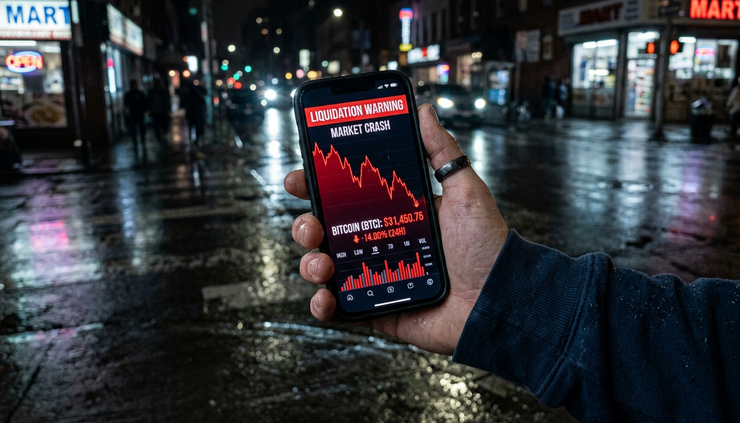
The $75,000 level is now the market’s fear line
The fear of a drop to $75,000 is not random. Markets often move from one liquidity zone to the next. When Bitcoin loses a major area, traders start scanning lower levels where buyers previously acted, where orders may be sitting, or where round-number psychology becomes important.
The $75,000 area stands out for three reasons.
It is a clean psychological level
Round numbers matter because traders remember them. $75,000 is not just a price. It is a simple reference point.
Retail traders talk about it. Short-term traders place orders around it. Analysts build scenarios around it. That attention can make the level more active than a less memorable price.
It may attract dip buyers
A move from $80,507 to $75,000 would be painful, but it would not be unusual by Bitcoin standards. Bitcoin has a long history of sharp pullbacks inside larger uptrends. Buyers who missed earlier entries may view a mid-$70,000 area as a second chance.
That does not guarantee support. It only means the level could bring a reaction if price reaches it.
It could become a trap for crowded shorts
When fear rises, traders often chase the move lower. If too many short positions build near a widely watched target, Bitcoin can snap back violently. A quick bounce can liquidate late shorts, just as the earlier drop liquidated longs.
That is why the $75,000 level should be treated as an area to watch, not a certainty. If Bitcoin reaches it, the reaction may matter more than the touch itself.
A strong bounce with rising volume would suggest buyers still have control on larger time frames. A weak bounce, followed by another breakdown, would suggest the correction has further to run.
The market is not only asking whether Bitcoin can reach $75,000. It is asking whether buyers will defend it if it gets there.
What traders are watching after the crash
After a move like this, the next few sessions often shape the market’s direction. Traders tend to watch several signals to decide whether the sell-off is fading or spreading.
Reclaiming $80,000 would calm nerves
Bitcoin falling through $80,000 or hovering near it creates anxiety because it is a major round number. If Bitcoin can reclaim and hold above that area, it may reduce pressure and pull some sidelined buyers back in.
A quick reclaim would suggest the drop washed out leverage faster than it damaged demand. A failed reclaim would keep sellers in control.
Volume matters more than headlines
Price alone can mislead. A bounce on thin activity may fade quickly. A bounce supported by strong spot demand carries more weight.
Traders often look for signs that real buyers are stepping in, not just short-term traders covering positions. That can show up through stronger volume, firmer order books, and fewer sharp rejections at resistance.
Funding rates can show whether leverage has reset
In derivatives markets, funding rates help show whether longs or shorts are paying to keep positions open. After a liquidation event, extreme funding can cool down.
If funding normalises, it suggests leverage has been reduced. If traders quickly rebuild aggressive long positions, the market may remain vulnerable to another flush.
Wider risk sentiment still matters
Bitcoin does not trade in isolation. It often reacts to liquidity conditions, expectations for interest rates, the strength of the US dollar, and appetite for risk assets. If wider markets are under pressure, Bitcoin may struggle to recover quickly.
That connection is not perfect, but it matters more during stressful periods. When traders reduce risk, they rarely sell only one asset.

The bullish case has weakened but has not vanished
A fall to $80,507 hurts short-term momentum, but it does not automatically end Bitcoin’s broader trend. Bitcoin has seen many severe pullbacks during past bull markets. Some looked frightening at the time, then later became normal corrections on a larger chart.
The bullish case depends on whether buyers defend key areas and whether the market can absorb the liquidation shock.
There are a few reasons the bull case may still survive.
Leverage has been reduced.
Large liquidation events clear out crowded trades. If the move was mainly driven by excessive leverage rather than a collapse in long-term demand, the market may stabilise.
Bitcoin remains a high-liquidity crypto asset.
During sell-offs, capital often leaves smaller tokens first. Bitcoin can still attract buyers looking for relative strength inside crypto.
Volatility cuts both ways.
The same mechanics that fuel a sell-off can also fuel a rebound. If shorts crowd in near $75,000 or below, a strong upside move can force quick covering.
Still, bulls need proof. Hope is not a strategy. A cleaner setup would include Bitcoin reclaiming lost levels, volume improving on green candles, and volatility cooling after the liquidation wave.
Until then, the market remains fragile.
The bearish case is now easier to argue
The bearish argument has become more convincing in the short term because the market failed to hold higher levels and liquidations exposed weak positioning.
Sellers will point to several risks.
A break below recent support can bring more technical selling. Traders who bought higher may exit if Bitcoin fails to recover quickly. Funds and larger market participants may reduce exposure if volatility rises beyond their risk limits.
There is also the risk of a confidence loop. When Bitcoin falls sharply, altcoins often fall harder. Losses in altcoins can force traders to sell Bitcoin to cover margin or reduce risk. That can put pressure back on BTC, even when the original problem started elsewhere.
If Bitcoin loses $80,000 cleanly and struggles to reclaim it, attention may shift quickly to $75,000. If $75,000 fails with force, the market could begin pricing in a deeper correction.
That would not mean Bitcoin is broken. It would mean the short-term trend has turned defensive.
What a sensible approach looks like now
Periods like this punish emotional decisions. The market moves fast, headlines are loud, and social feeds often reward extreme calls. One side shouts for a crash. The other calls every dip a gift.
A calmer approach starts with recognising what has changed.
Bitcoin has suffered a sharp drop. Leveraged traders have been flushed out. The $75,000 area is now a live downside risk. At the same time, a liquidation cascade can sometimes mark exhaustion rather than the start of a long downturn.
For traders and investors, the practical questions are simple:
Is Bitcoin reclaiming broken levels or rejecting from them?
Are buyers stepping in with conviction, or are bounces fading?
Has leverage cooled, or is the market getting crowded again?
Is the wider market supporting risk-taking, or reducing it?
Those questions matter more than a single price target.
Long-term holders may see this as another volatility event in Bitcoin’s history. Short-term traders may treat it as a warning to reduce size, avoid high leverage, and wait for clearer confirmation. Both views can be valid, as long as they match risk tolerance and time horizon.

The takeaway for Bitcoin after the liquidation shock
Bitcoin’s slide to $80,507 and the reported $1.14 billion in crypto liquidations have put the market back on edge. The fear of a drop to $75,000 is reasonable because liquidation-driven moves often search for the next clear support area.
But $75,000 is not guaranteed. The next move depends on whether buyers can defend current levels, whether Bitcoin can reclaim lost ground, and whether leverage has truly been cleared out.
For now, the market is in a test phase. A strong recovery above key levels would suggest the crash was a sharp washout. A weak bounce followed by renewed selling would make the $75,000 scenario harder to ignore.
The best signal now is not a loud prediction. It is how Bitcoin behaves after the fear.


Comments