


All Blacks Crush Wallabies 50-19 to Retain Bledisloe Cup for 24th Consecutive Year
New Zealand overwhelmed Australia in the second half at Eden Park to extend their Bledisloe Cup dominance into a 24th year. The Wallabies showed promise early on but were unable to maintain their intensity after the break, suffering a heavy defeat that raises questions ahead of next year’s home Rugby World Cup.
New Zealand delivered a commanding second-half performance to defeat Australia 50-19 at Eden Park on Saturday, retaining the Bledisloe Cup for the 24th consecutive year. The All Blacks also extended their unbeaten run against the Wallabies at the Auckland venue, continuing a remarkable period of dominance over their trans-Tasman rivals.
Australia, coached by Les Kiss, began brightly and remained competitive for much of the opening half. However, the visitors fell apart after the interval, conceding five tries as New Zealand took control and turned a close contest into a convincing victory. The defeat ended the Wallabies’ six-match unbeaten run and left captain Harry Wilson reflecting on a missed opportunity.
The result was particularly frustrating for Australia because they had entered the match with growing confidence after a series of encouraging performances, including a victory over world champions South Africa. Their first-half display suggested they could challenge New Zealand, but the second period exposed the gap they still need to close.
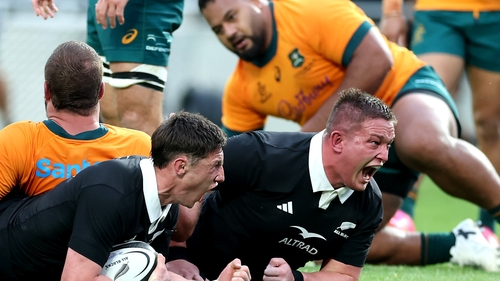
Wallabies start strongly but New Zealand respond
Australia dominated the opening 10 minutes, keeping the All Blacks pinned inside their own half. Wilson declined an early opportunity to kick for goal, showing the visitors’ ambition to pursue a try rather than settle for three points.
Although a knock-on from Len Ikitau prevented Australia from capitalising on one promising attack, the Wallabies soon broke through. A well-executed backline move, featuring a delicate pass from fly-half Ben Donaldson, created space for Tom Wright to score the opening try.
However, Australia struggled to maintain that early momentum. A kick out on the full from Donaldson interrupted their progress, and New Zealand quickly exploited defensive weaknesses in the visitors’ midfield. The All Blacks scored twice in a short period to turn the contest around, demonstrating their ability to punish even brief lapses.
New Zealand controlled much of the remainder of the first half and added a penalty after opting against an earlier opportunity to take three points. Australia nevertheless stayed in contention, with strong forward play and improved defensive organisation preventing the hosts from building an insurmountable lead.
Wilson try keeps Australia in the contest
The Wallabies produced an encouraging response just before half-time. Strong carries from Joseph-Aukuso Suaalii helped move Australia into attacking territory before Donaldson and Wilson combined effectively to break through the New Zealand defence.
Donaldson found a gap outside the opposition 22, while Wilson remained alert to take the inside pass and cross for a crucial try. The score reduced the deficit to 17-14 at half-time, leaving Australia within striking distance.
Australia’s lineout had also provided a useful source of possession, with Jeremy Williams disrupting New Zealand’s throw on two occasions and contributing a turnover at the breakdown. Those moments offered evidence that the Wallabies could compete with the world’s second-ranked side, at least when their execution was accurate.
But their promising first half ultimately proved insufficient. Wilson later admitted that Australia had failed to win the decisive moments that define matches against the All Blacks.
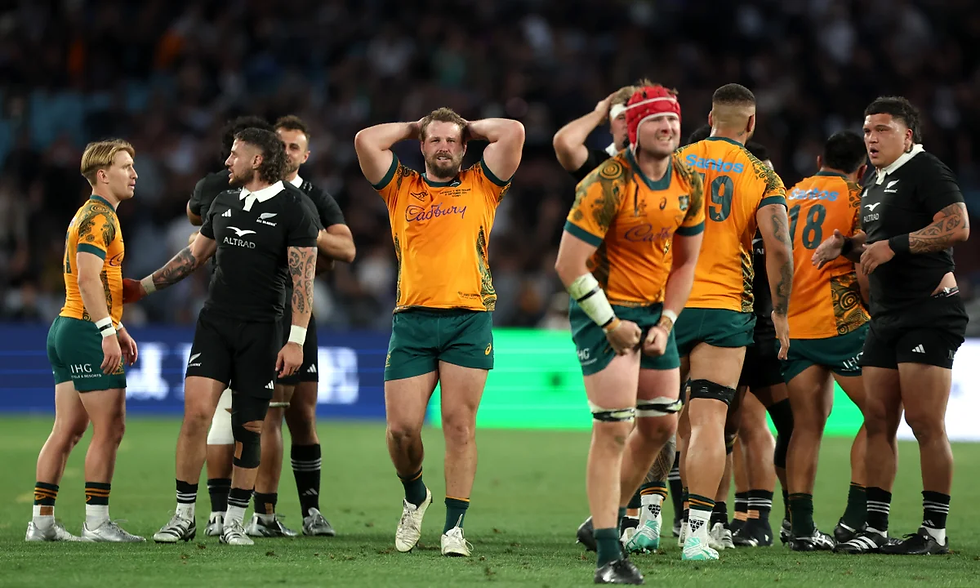
Roigard sparks New Zealand’s second-half rout
The turning point arrived shortly after the restart. Australia had an attacking lineout just five metres from the New Zealand tryline, presenting a major opportunity to score and put pressure on the hosts.
Instead, the Wallabies’ attempt to form a maul resulted in an obstruction penalty. New Zealand recovered possession and shifted the pressure back onto Australia, with scrum-half Cam Roigard scoring in the 48th minute to begin a devastating second-half sequence.
Captain Codie Taylor followed with another try, before substitute Josh Moorby, Will Jordan and Leroy Carter added further scores. New Zealand’s attacking speed and precision proved too much for an increasingly stretched Australian defence.
The Wallabies managed no points during most of the second half before Josh Nasser crossed late for a consolation try. Jordan then completed the scoring with a runaway effort that took New Zealand to 50 points.
Wilson described the defeat as disappointing, acknowledging that Australia had entered the match believing they could win but failed to take advantage of important opportunities.
A warning ahead of the Rugby World Cup
Despite the heavy scoreline, Australia can take some encouragement from the opening 50 minutes, when they challenged New Zealand at a venue where the All Blacks have enjoyed decades of success.
However, the collapse after the break provides a clear warning for Kiss and his players. With the Rugby World Cup set to take place on home soil next year, Australia must demonstrate greater consistency and an ability to maintain their performance under pressure against elite opposition.
The Wallabies will have an immediate opportunity to respond when the teams meet again in Sydney next week. Another heavy defeat would risk undermining the progress made during Kiss’s first year in charge.
For New Zealand, the result reinforces their hold over the Bledisloe Cup and their continued dominance at Eden Park. For Australia, the challenge now is to turn the lessons of a painful afternoon into a stronger performance in the next encounter.



Comments