


Why Katy Perry Was Not Mentioned in Russell Brand’s Trial
Katy Perry’s absence from the public proceedings in Russell Brand’s trial has prompted questions from many observers. The two were once married in a relationship closely followed by the media, so when Brand was convicted of one count of rape and three counts of sexual assault in a London court, Perry’s name was largely absent from the prosecution’s case. Her absence, however, was not a mysterious detail about her private life, nor did it suggest that she was connected to the charges before the court.

Brand was convicted by a jury following a four-week trial at Southwark Crown Court. The offences involved four women and occurred between 2004 and 2009. That period came before he began his relationship with Perry, married her in 2010 and divorced her in 2012. Their highly publicized marriage was therefore outside the specific timeframe and facts the jury was asked to consider.
Before the trial began, prosecutors had planned to refer to Katy Perry in their opening address. Following legal submissions from the defense, however, that reference was removed. Pre-trial documents showed that prosecutor Riel Karmy-Jones KC wrote: “The prosecution recognise that matters post 2009 involving his relationship with Katy Perry may be sensitive, as may his previous faiths, and we are content to remove these from the opening.”
The decision reflected a central principle of criminal proceedings: jurors should hear evidence that is directly relevant and admissible in relation to the specific charges. Russell Brand’s former marriage to an internationally known pop star may be a notable part of his biography, but celebrity status and relationship history are not automatically evidence of criminal conduct. In a serious trial, the court must distinguish between material that may interest the public and evidence that can help establish the facts of the case.
Katy Perry was also not asked to provide a witness statement during the investigation. Senior Crown Prosecutor David Roberts explained: “We followed all reasonable lines of inquiry in statements that would have been relevant to the specific charges, and I’m satisfied that all reasonable lines of inquiry were covered.” In other words, prosecutors did not identify Perry as someone with information necessary to the charges being tried.
That point needs to be understood carefully. A person not being called as a witness does not confirm what they did or did not know about the defendant. It simply means investigators and prosecutors did not identify evidence from that person that was directly relevant to the allegations before the court. In this case, the conduct leading to Brand’s convictions predated the period when he and Perry became a couple.

The verdict was delivered on November 5 after the jury considered witness testimony and other evidence. Brand was convicted of one count of rape and three counts of sexual assault. He was also found not guilty of two other rape counts and one count of attempted indecent assault. The distinction between the convictions and the allegations that did not result in convictions is important: the jury reached its decisions charge by charge, based on the evidence relating to each individual count.
During the trial, Brand denied the allegations. He told the court that he had been obsessed with sex when he was younger and had led a promiscuous life, but denied ever forcing anyone to do anything against their will. “Consent is fundamental, essential, necessary, and indeed in many ways more important than sex itself,” he said. Following the verdict, Brand was remanded in custody and was due to return to court for sentencing.
Prosecutors described Brand as someone who exploited fame and status to commit crimes, while investigators emphasized the courage of the women who came forward. The identities of victims of sexual offences are protected for life under British law. Any account of the case should therefore remain focused on the court’s verdict and respect the privacy of those involved, rather than turning the proceedings into a story about well-known figures who played no role in the evidence.
Russell Brand was once a prominent figure in British entertainment. He became known for provocative stand-up comedy, radio and television work, then expanded into film. Roles in Forgetting Sarah Marshall and Get Him to the Greek gave him wider international recognition. His rebellious public image, rapid-fire style of speaking and frequently discussed private life made him one of the most closely watched figures in popular culture during the late 2000s.

It was during that period that Brand met Katy Perry. They met around the time Get Him to the Greek was being made and quickly became a heavily covered celebrity couple. Perry was enjoying a major breakthrough in music, while Brand was entering a period of heightened global visibility. They married in Rajasthan, India, in October 2010 in a ceremony with traditional elements.
The marriage lasted a little over a year. Brand filed for divorce in December 2011, and the divorce was finalized in 2012. Their split became a major media story, partly because both had enormous careers and rarely escaped public attention. Still, the end of their marriage has no connection to the conduct for which Brand was tried and convicted in the current case.
In 2020, Perry spoke rarely about that period. She described the relationship as “just like a tornado,” saying that “everything [was] happening at once.” The singer also called the marriage “the first breaking of my idealistic mind.” Those remarks reflected her personal emotional experience of a brief and turbulent marriage; they were not testimony connected to the criminal charges against Brand.
Perry entered public life on a very different path. Born Katheryn Elizabeth Hudson, she made her breakthrough in 2008 with “I Kissed a Girl,” then developed an artistic identity built around colorful pop music, theatrical visuals and memorable hooks. Her album One of the Boys introduced her to a wider audience, while Teenage Dream cemented her place among the biggest pop stars of her generation.
Teenage Dream produced an exceptional run of chart success, generating five Billboard Hot 100 number-one singles from one album: “California Gurls,” “Teenage Dream,” “Firework,” “E.T.” and “Last Friday Night (T.G.I.F.).” The achievement made Perry the first woman to reach that milestone and only the second artist after Michael Jackson. With songs including “Roar,” “Dark Horse,” “Wide Awake” and “The One That Got Away,” she maintained a lasting presence on the charts and in pop culture.
Beyond music, Perry has pursued television, brand partnerships and philanthropic work. She served as a judge on American Idol, mounted large-scale tours and supported work for children as a UNICEF Goodwill Ambassador. Although her artistic image has often been bright, playful and deliberately extravagant, her personal life has consistently attracted public interest, particularly after her marriage to Brand and the relationships that followed.
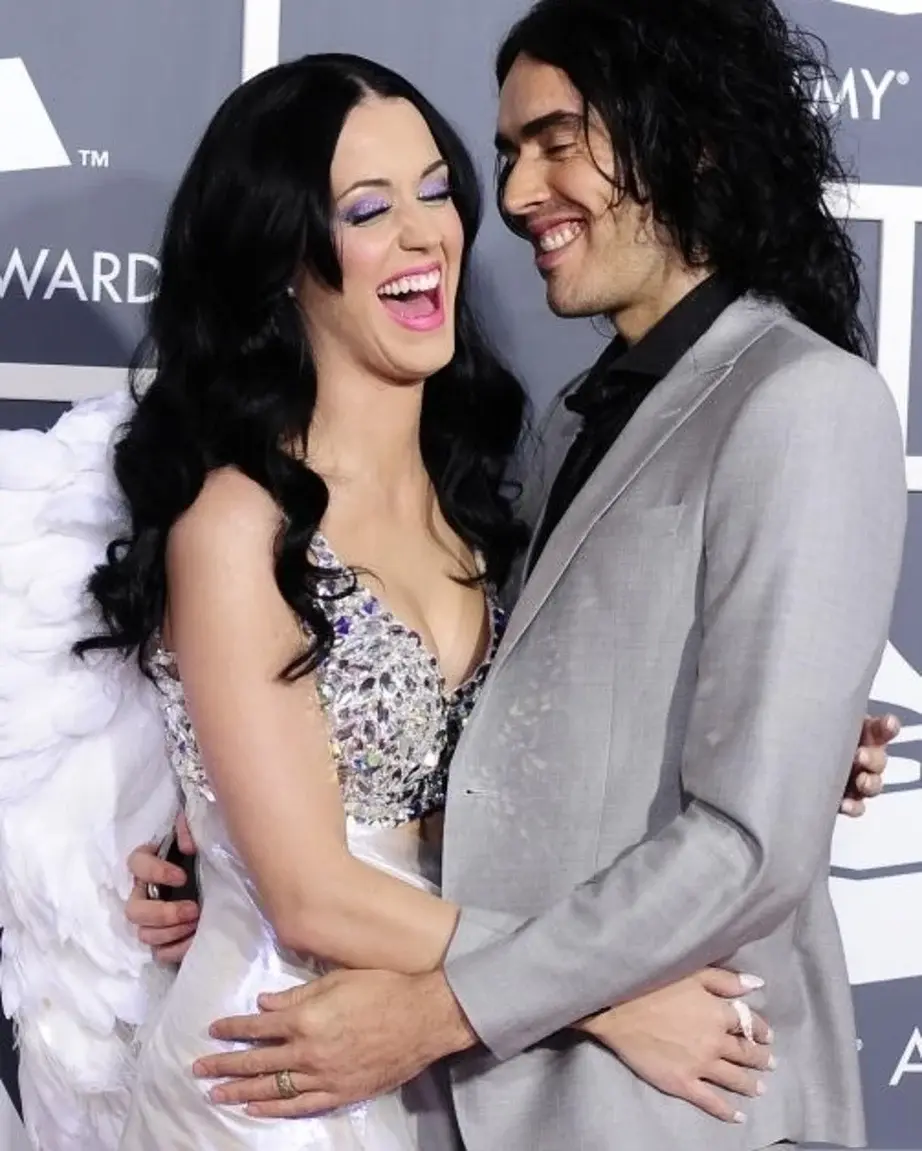
After divorcing Brand, Perry began a long-term relationship with Orlando Bloom. They became engaged, welcomed their daughter Daisy Dove in 2020, and later announced that they were shifting their relationship toward co-parenting. That chapter of Perry’s private life is separate from her brief marriage to Brand. In recent years, she has continued to focus on music, touring and motherhood.
Brand, meanwhile, moved away from much of the mainstream entertainment world and built a substantial online audience through content about wellness, religion, politics and controversial subjects. That shift in his public identity did not change what the court had to assess: specific allegations, witness evidence, admissible material and the standard of proof in a criminal trial. His former fame, current views and relationships with other celebrities could not replace the process of evaluating evidence.
The question of why Katy Perry was not mentioned therefore has a straightforward answer. The events surrounding their marriage took place after the period covered by the offences for which Brand was convicted, and prosecutors did not identify Perry as a necessary witness for the specific charges. Prosecutors agreed to remove references to her from the opening address following legal submissions, keeping the trial focused on directly relevant evidence.
Perry’s name being absent from the courtroom should not be interpreted as a hidden detail or a sign that something else has gone unspoken. The conviction of Russell Brand was based on conduct the jury heard evidence about and then assessed. As for Perry, she should be understood as someone who had a past relationship with Brand, not as a witness or a figure in the criminal case. That distinction keeps the story grounded in the legal facts and respectful of everyone involved.



Comments