


West Ham snatch a crucial point, officially relegate Wolves and push Tottenham into the danger zone in a dramatic survival battle!
- Apr 21
- 5 min read
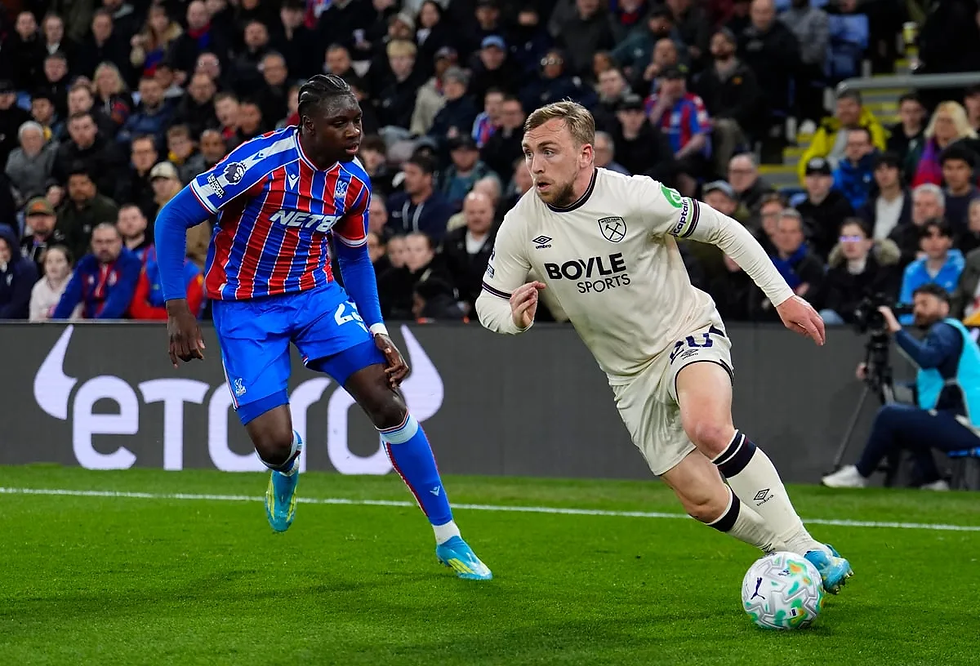
West Ham continued their steady climb toward Premier League safety with a hard-fought draw at Selhurst Park, a result that simultaneously confirmed Wolverhampton Wanderers’ relegation and kept the London side’s fate firmly in their own hands. It was not a match rich in attacking quality, nor one that will linger long in the memory, but its implications at the foot of the table were significant. For Nuno Espírito Santo, facing the club he once guided, there was a quiet sense of vindication in a point that could yet prove decisive, even if the performance itself lacked fluency.
Crystal Palace, perhaps still carrying the emotional and physical residue of their recent European exertions, looked short of their usual sharpness. This marked their eighth goalless draw of the campaign, a statistic that underlines both their defensive solidity and their recurring struggle to convert moments into goals. Yet they were indebted once again to Dean Henderson, whose reflexes ensured that West Ham left south London with no more than a point. His flying save to deny Konstantinos Mavropanos just before half-time stood out as the defining moment of a contest otherwise dominated by caution.

For West Ham, the frustration lay in a missed opportunity to further distance themselves from Tottenham Hotspur. Having clawed back ground over recent weeks, a victory here would have widened the gap to four points. Instead, the margin remains narrow, ensuring that the relegation battle continues to simmer. Nevertheless, there was resilience in their approach, a quality that has come to define their late-season push.
“We know that it’s going to be a fight to the end, the table is very tight. We realise that every day is important,” said Nuno.“We’ve been proving that we don’t give up, we are committed. You can see today, even though it’s not a perfect game for us, it was a game that we fought, we were organised, committed and showed spirit. I can see that we will keep fighting to the end.”
The context surrounding the fixture added an extra layer of intrigue. Palace’s midweek travels in the Conference League, combined with widely circulated footage of players celebrating with supporters in Florence, suggested a squad perhaps not entirely focused on domestic duties. West Ham, by contrast, had enjoyed a full ten days to prepare, buoyed by a convincing victory over Wolves in their previous outing. Yet the anticipated sharpness did not materialize, and the visitors struggled to impose themselves.
Oliver Glasner, forced into changes due to injuries and rotation, had to do without key midfielder Adam Wharton, who is recovering from a recurrence of an adductor issue. His absence was felt in Palace’s midfield balance, even as the Austrian coach sought to manage the demands of a congested schedule. Despite this, the home side remained organized, limiting West Ham’s attacking threat for large portions of the game.
Earlier in the season, West Ham had trailed Tottenham by 13 points, a seemingly insurmountable gap at the time. Their resurgence, built on defensive improvement and incremental gains, has been one of the more compelling narratives in the league’s closing months. The arrival of Axel Disasi on loan in January has brought stability at the back, allowing the team to build from a more secure foundation.

Palace, meanwhile, showcased glimpses of their attacking potential through players like Jørgen Strand Larsen and Brennan Johnson, though neither could find the breakthrough. Johnson, in particular, endured a frustrating afternoon, missing several clear chances and extending his goal drought since his move from Tottenham. His hesitancy in front of goal reflected a broader lack of confidence that has followed him in recent weeks.
West Ham’s most promising moment came via Taty Castellanos, whose acrobatic overhead kick briefly threatened to ignite the contest. Yet Maxence Lacroix was alert to the danger, clearing decisively. Moments later, Henderson redeemed a rare misjudgment with a spectacular save, preserving the deadlock and reinforcing his importance to Palace’s defensive unit.
“Our defence is always our foundation,” said Glasner. “It’s a product of his quality and his character.”
The second half followed a similar pattern, with both sides struggling to generate sustained attacking pressure. Glasner’s frustration was evident as Palace failed to build momentum, prompting a series of substitutions that introduced fresh energy but little in the way of cutting edge. West Ham, too, turned to their bench, with Callum Wilson entering the fray in search of a decisive moment.
There was late drama when Ismaïla Sarr found the net, a moment that briefly raised hopes among Tottenham supporters watching anxiously from afar. However, the goal was swiftly disallowed for handball, a decision that encapsulated the fine margins defining the relegation battle. As the final whistle sounded, both teams were left to reflect on a match that offered effort and organization but little else.
Beyond the immediate context of the fixture, the figure of Nuno Espírito Santo remains central to the unfolding narrative. His managerial journey has been one marked by resilience, adaptability, and a quiet determination that mirrors the qualities he now seeks to instill in his players. Born in São Tomé and Príncipe but raised in Portugal, Nuno’s early career as a goalkeeper saw him represent clubs such as Porto, where he experienced domestic success, and Deportivo La Coruña in Spain. Though not among the most celebrated players of his generation, his understanding of the game and leadership qualities were evident even then.

Transitioning into management, Nuno initially made his mark with Rio Ave before taking charge of Valencia, where he guided the club back into the Champions League. However, it was his tenure at Wolverhampton Wanderers that truly defined his reputation. Under his guidance, Wolves achieved promotion to the Premier League and established themselves as a competitive force, even securing European qualification. His tactical discipline, emphasis on defensive structure, and ability to maximize the potential of his squad earned widespread recognition.
Yet football, as ever, is a game of cycles. Nuno’s time at Wolves eventually came to an end, and a brief, challenging spell at Tottenham followed. Expectations in north London proved difficult to meet, and his tenure was short-lived. For many managers, such setbacks can define a career, but Nuno’s response has been characteristic of his understated approach: a return to fundamentals, a focus on collective effort, and a refusal to be drawn into external narratives.
Away from the touchline, Nuno is known for his private nature. He has largely kept his personal life out of the spotlight, a rarity in the modern football landscape. Married with children, he has often spoken about the importance of family as a grounding influence, particularly during the volatile periods that characterize a managerial career. Those close to him describe a figure who values loyalty and consistency, traits that have shaped both his professional and personal relationships.
There have been few controversies attached to his name, a testament to his measured demeanor. In an era where managerial personalities often dominate headlines, Nuno’s preference for discretion sets him apart. His focus has remained firmly on the pitch, on the incremental progress that defines long-term success rather than the fleeting drama of individual results.
As the Premier League season approaches its conclusion, the stakes continue to rise. For West Ham, the path to safety is not yet secure, but performances such as this suggest a team willing to endure and adapt. For Nuno Espírito Santo, it represents another chapter in a career defined not by spectacular highs or dramatic lows, but by a steady, unwavering commitment to the craft.
In the broader narrative of English football, such figures often go underappreciated. Yet it is precisely this consistency, this refusal to yield in the face of adversity, that underpins the sport’s enduring appeal. As West Ham edge closer to their objective, the influence of their manager is unmistakable, even in matches where the spectacle itself falls short.


Comments