


Shocking on-air kiss: Julia Louis-Dreyfus reveals the “cringe-inducing” truth behind Stephen Colbert moment.
- May 14
- 6 min read
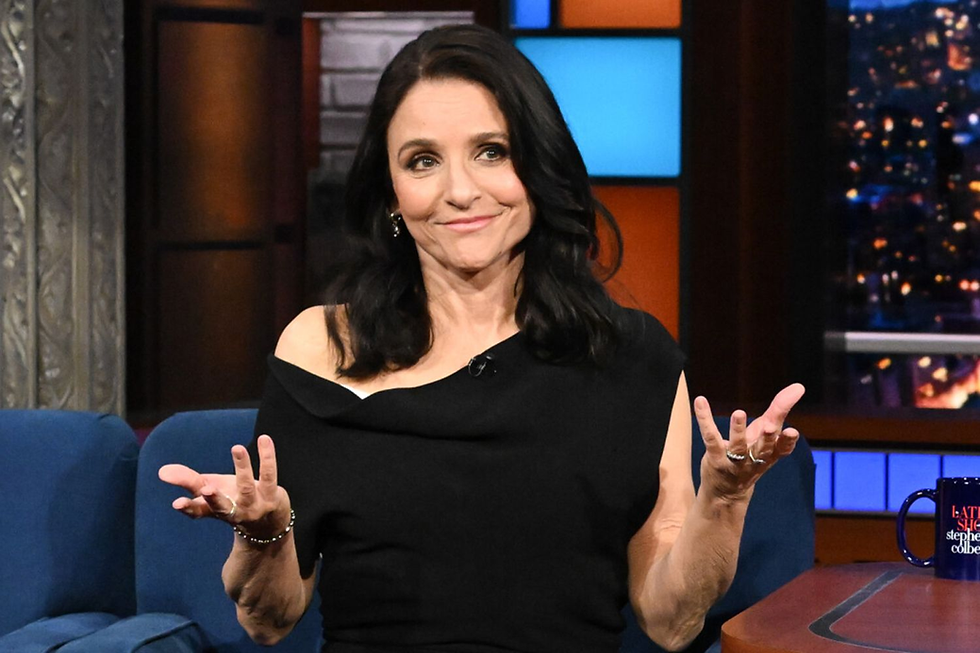
The recent discussion surrounding Julia Louis-Dreyfus and Stephen Colbert has drawn renewed attention to a light-hearted yet unexpectedly awkward moment on The Late Show with Stephen Colbert, where the two shared an on-air kiss that Louis-Dreyfus later described as “so awkward.” What appeared to be a comedic, improvised television segment quickly evolved into a behind-the-scenes anecdote revealing the tension, humor, and personal boundaries that often coexist in live entertainment.
Reflecting on the moment in a later interview, Louis-Dreyfus admitted that the idea of kissing Colbert on camera came with immediate hesitation. “It was so awkward,” she said of the segment. “As we started to do this bit, I thought, ‘Oh no. Is this gonna work?’ I get very cold feet.” Her candid reflection underscored how even seasoned performers with decades of experience can find themselves unsettled by spontaneous comedic choices, especially when they involve physical comedy that blurs personal comfort zones.

The segment itself unfolded after Colbert had discussed on air the various high-profile guests he had kissed during the show’s run. Encouraged by the playful tone of the conversation, Louis-Dreyfus suggested revisiting a previous clip before escalating the joke further by proposing a kiss of her own. The exchange, initially framed as a humorous callback to the show’s long history of celebrity interactions, quickly became one of the most memorable unscripted moments of the episode.
During the broadcast, Louis-Dreyfus addressed the audience with a teasing reassurance: “No one’s watching. It’s just between us,” she told the host. Colbert responded with equal humor, asking, “What harm is there?” to which she replied, “None! What could possibly go wrong?” The light exchange reflected the chemistry between two performers who have spent decades mastering comedic timing, improvisation, and audience engagement in high-pressure live environments.
However, what followed added an unexpected layer of realism to the performance. Before the kiss, both Louis-Dreyfus and Colbert joked about the presence of their respective spouses backstage. “Brad is larger than I am,” Colbert said, referring to Louis-Dreyfus’ husband, Brad Hall. Louis-Dreyfus responded in kind, saying, “Evie’s stronger than I am,” referencing Colbert’s wife, Evelyn McGee-Colbert. The humor, rooted in affection and mutual respect, highlighted the way personal lives often intersect with the constructed spontaneity of late-night television.
When the kiss finally happened, it was extended, theatrical, and embraced by the studio audience, who reacted enthusiastically. Yet, as Louis-Dreyfus later revealed, the off-camera reality was far more complicated. “He goes to me, ‘Your husband’s backstage,’” she recalled of Colbert. “And of course, Evie is backstage too. We were all just dying. It was AWKWARD.” Her comment reflected not discomfort with the act itself, but rather the layered social awareness that accompanies performing intimate gestures in front of colleagues, partners, and a live audience.
For both entertainers, the moment was less about controversy and more about the peculiar intimacy of comedy itself, where professional boundaries are constantly tested for the sake of humor. In Louis-Dreyfus’ interpretation, the awkwardness became part of the joke rather than a disruption of it, reinforcing her long-standing reputation for navigating comedy with precision and self-awareness.
The appearance also coincided with a reflective period for The Late Show with Stephen Colbert, which is set to conclude after a decade on air. The show, which premiered in 2015 under Colbert’s hosting, became known for its blend of political satire, celebrity interviews, and monologues that frequently addressed the cultural and political climate of the United States. Its impending conclusion has prompted numerous guests, including Louis-Dreyfus, to reflect on its cultural impact.

Louis-Dreyfus has long been considered one of the most influential comedic actresses in American television. Rising to prominence through her role as Elaine Benes on Seinfeld, she became part of one of the most successful sitcom ensembles in television history. The show’s sharp writing and observational humor established her as a defining figure in 1990s television comedy, earning her widespread recognition and multiple awards.
Her career later experienced a resurgence with Veep, where she portrayed Selina Meyer, a fictional Vice President and later President of the United States. The role showcased her ability to balance satire with emotional complexity, earning her critical acclaim and solidifying her status as one of television’s most decorated comedic performers. Over the course of her career, she has received numerous Emmy Awards, reflecting both longevity and consistent excellence in performance.
Beyond her professional achievements, Louis-Dreyfus’ personal life has often been characterized by stability and long-term partnership. She has been married to Brad Hall since the early stages of her career, and the couple has maintained a relatively private family life compared to many Hollywood figures. Their relationship, which began during their time at university, has been frequently cited as an example of enduring partnership in an industry often defined by volatility.
Stephen Colbert’s own trajectory in entertainment reflects a similarly layered career path. Before becoming host of The Late Show with Stephen Colbert, he gained prominence through The Colbert Report, where he portrayed a fictional conservative pundit. The show became a defining force in political satire during the 2000s and 2010s, blending humor with sharp commentary on American media and politics.
Colbert’s transition into traditional late-night hosting marked a significant shift in tone, as he moved from character-driven satire to a more personal and conversational format. Over time, his show evolved into one of the most influential platforms for political commentary in late-night television, particularly during periods of heightened political tension in the United States.
Outside of television, Colbert’s personal life has remained relatively grounded. His marriage to Evelyn McGee-Colbert has been frequently described as a stabilizing force in his career, and the couple has maintained a low-profile family life despite his public visibility. The interplay between his professional persona and personal identity often becomes a subtle undercurrent in moments like his on-air interactions with guests such as Louis-Dreyfus.
The awkward kiss incident, while humorous on the surface, also highlights the broader dynamics of live television production, where spontaneity and rehearsal frequently collide. Late-night shows like The Late Show with Stephen Colbert rely heavily on improvisation, yet are simultaneously structured around precise timing, audience expectation, and broadcast standards. This tension often produces moments that feel organic but are deeply shaped by behind-the-scenes coordination.
Louis-Dreyfus’ later reflection to The Hollywood Reporter added another dimension to the story. She noted that she had initially asked producers to revisit a clip of Colbert kissing previous guests before suggesting her own participation. Her willingness to engage in the bit was tempered by instinctive hesitation, a reaction she described as “cold feet,” illustrating how even veteran performers approach improvisation with caution.
The emotional undertone of her comments also coincided with broader reflections on the end of Colbert’s program. Louis-Dreyfus described the conclusion of the show as a significant cultural moment, noting its role in shaping public discourse. She expressed admiration for Colbert’s ability to use comedy as a reflective tool for society, particularly during politically charged periods.

Her comments also touched on the idea of comedy as a form of cultural responsibility. In discussing the show’s impact, she remarked, “He holds a very powerful mirror up to our democracy. I believe that it’s the comedians who we rely on in these trying times.” This perspective aligns with a long tradition of American political satire, where comedians often function as informal commentators on national identity and governance.
She further expressed concern about the broader media landscape, suggesting that the conclusion of such programs may represent a cultural shift. “This is right out of the authoritarian playbook, so I’m deeply concerned as an artist,” she said, reflecting her view that satirical voices play a crucial role in maintaining public discourse.
Despite these serious reflections, Louis-Dreyfus also maintained a sense of optimism about Colbert’s future. “His bright future is so bright. I can’t wait to see what he does,” she said, adding that she would be open to collaborating with him again. Her comments reinforced the professional respect between the two performers, who share a long history of navigating the intersection of humor, media, and public life.

Ultimately, the on-air kiss that sparked Louis-Dreyfus’ later reflections stands as a small but revealing example of the complexities behind televised comedy. What appears effortless to audiences often conceals layers of preparation, negotiation, and personal consideration. In the case of Louis-Dreyfus and Colbert, it became a moment that encapsulated both the spontaneity and the vulnerability inherent in live performance, while also highlighting the enduring appeal of two performers who have shaped modern American television comedy in distinct yet overlapping ways.


Comments