


LEONARDO DICAPRIO AND THE REAL BLOOD SHED ON THE SET OF DJANGO UNCHAINED
- 6 hours ago
- 6 min read
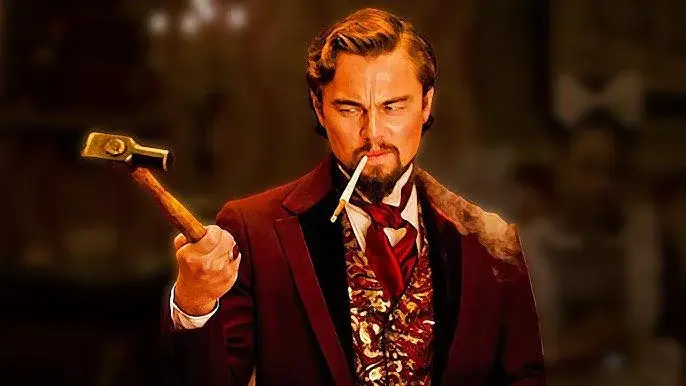
Among the most memorable moments in Django Unchained, the scene in which Calvin Candie slams his hand onto the table during dinner at Candyland remains particularly striking. The character, played by Leonardo DiCaprio, is already furious and losing control, but what makes the scene even more disturbing was not entirely part of the script. When DiCaprio slammed his hand down, he shattered a crystal glass, cutting his palm and causing it to bleed. Instead of stopping, the actor continued performing, allowing the real injury to become part of Candie’s fury.

The accident happened as Candie began to realise that his guests were hiding their true reasons for visiting his plantation. Django, played by Jamie Foxx, and Dr. King Schultz, portrayed by Christoph Waltz, were attempting to rescue Broomhilda, played by Kerry Washington. As their plan began to unravel, Candie shifted from his initial politeness to intimidation, trying to regain control of the conversation through dominance and violence.
During the tense dinner-table monologue, DiCaprio slammed his hand down onto the crystal glass. The shards cut into his palm, and he began to bleed. This was not a special effect prepared in advance for the scene. The injury was real, and the actor’s reaction in that moment was not part of the original script. Nevertheless, DiCaprio remained in character, turning the unexpected accident into part of the performance.
Rather than allowing the pain to break Candie’s composure, DiCaprio continued speaking with the character’s calm but threatening manner. His bleeding hand became a detail that made Candie appear even more unpredictable. Candie was trying to prove that he remained in control of the room, and the sudden appearance of a real wound as he was losing his temper inadvertently made him even more frightening. After the scene was completed, DiCaprio received treatment for the cut, while Quentin Tarantino decided to keep the footage.
The effectiveness of the scene does not simply come from the fact that an actor was genuinely injured. What matters is that the accident occurred at precisely the moment when the character was supposed to appear aggressive and out of control. DiCaprio did not turn toward anyone for help or visibly reveal that something had gone wrong. He continued playing Candie, making it difficult for viewers to separate the character’s reaction from the actor’s real response. That ambiguity gives the entire sequence its particularly unsettling quality.
The dinner scene at Candyland already contains several layers of meaning. Candie is a wealthy plantation owner, confident in his power and willing to use pseudoscientific arguments to justify slavery. During his speech, he refers to phrenology, a discredited theory that once attempted to associate the shape and physical characteristics of the skull with intelligence, personality and behaviour.
Within the film, Candie uses these arguments to give his racist ideology the appearance of intellectual authority. Tarantino does not present phrenology as credible science. Instead, the scene demonstrates how pseudoscientific ideas can be manipulated to legitimise oppression. Candie discusses physical characteristics of Black people and uses them to rationalise the system of slavery from which he benefits.
In the middle of that speech, DiCaprio’s bloodied hand appears in the frame. The unexpected detail does not change what the scene is about, but it significantly heightens its sense of violence. Candie is talking about domination and power while the actor portraying him has just been injured by his own violent gesture. The boundary between performed violence and its real-world consequence therefore becomes difficult to distinguish.

DiCaprio’s ability to continue performing while injured may also be partly explained by the body’s physiological response to acute stress. When the body enters a heightened state of arousal, adrenaline and related stress mechanisms can temporarily reduce the perception of pain. This does not establish exactly what DiCaprio experienced at that moment, but it offers a possible explanation for how someone can continue functioning for a short period despite suffering an injury.
Tarantino’s decision to keep the footage also illustrates one of the distinctive aspects of how he builds cinematic moments. An accident on a film set would normally be a reason to abandon a take, particularly for safety reasons. In this case, after DiCaprio completed the performance and received medical attention, the footage became something unusually valuable. The spontaneity of that moment could never have been perfectly recreated through a second, carefully rehearsed take.
Django Unchained was released in 2012 and continued Quentin Tarantino’s distinctive approach to filmmaking, combining violence, dark humour and extreme characters. Set in the American South before the Civil War, the film follows Django, a formerly enslaved man, as he attempts to find and rescue his wife, Broomhilda. DiCaprio does not play the lead, but Calvin Candie quickly became one of the film’s most memorable characters.
The role also revealed another side of DiCaprio’s acting ability. He had already played numerous complicated characters, but Candie represented a particularly disturbing type of villain. He is wealthy, educated and outwardly sophisticated, yet beneath his polite manner lies an ideology built around power and brutality. DiCaprio does not portray Candie as a simple villain. Instead, he gives him a composed manner that makes his extreme behaviour even more unsettling.
By the time Django Unchained was released, Leonardo DiCaprio’s career had already entered a mature phase. Born in 1974 in Los Angeles, he began attracting attention as a young actor through television and films such as This Boy’s Lifeand What’s Eating Gilbert Grape. His performance in What’s Eating Gilbert Grape earned DiCaprio an Academy Award nomination for Best Supporting Actor while he was still a teenager, beginning a film career that would span several decades.
DiCaprio’s international fame exploded after Titanic in 1997. As Jack Dawson, he became one of the world’s biggest young stars. Rather than relying entirely on the image of a romantic heartthrob, however, DiCaprio quickly sought out more challenging projects. He worked with directors including Martin Scorsese, Steven Spielberg, Christopher Nolan and Quentin Tarantino, repeatedly choosing characters with complex psychological dimensions.
Before Django Unchained, DiCaprio had already worked with Scorsese on Gangs of New York, The Aviator, The Departed and Shutter Island. He also starred in Christopher Nolan’s Inception and appeared alongside Kate Winslet in Revolutionary Road. These choices gradually helped DiCaprio move beyond the image of Jack Dawson and establish himself as an actor known for his range.
Calvin Candie was therefore only one chapter in DiCaprio’s long line of increasingly complex characters. He later drew further attention with The Wolf of Wall Street, in which he portrayed Jordan Belfort, a real-life figure known for his extravagant lifestyle and controversial financial activities. DiCaprio eventually won the Academy Award for Best Actor for The Revenant, reaching an important milestone in a career that had already included several Oscar nominations.
DiCaprio’s private life has also frequently appeared in the headlines, although he rarely discusses his relationships in detail. The actor has been linked to a number of models and well-known women, including Gisele Bündchen, Bar Refaeli and Camila Morrone. These relationships have attracted considerable media attention, partly because DiCaprio has generally maintained a relatively private approach to his personal life and has never married.
In recent years, DiCaprio’s dating life has continued to attract attention from the media and social networks. At the same time, however, the actor has increasingly devoted public attention to environmental issues. He established the Leonardo DiCaprio Foundation in 1998, supporting projects focused on conservation, climate change and environmental protection. His environmental advocacy has become an important part of his public identity outside the film industry.
DiCaprio is therefore now known through several different roles: one of Hollywood’s most recognisable actors, a film producer and a prominent environmental advocate. Although his private life continues to attract media interest, he has rarely allowed those stories to completely overshadow his professional career.
Looking back at Django Unchained, the Candyland dinner remains one of the clearest examples of how an unexpected accident can become an artistic advantage. DiCaprio did not need an additional special effect to make Candie more frightening. The blood came from a genuine accident, while his decision to continue performing made the moment unforgettable.
More than a decade after the film’s release, the story of DiCaprio’s injured hand continues to be discussed because it reveals a rarely seen side of filmmaking. On screen, audiences see Calvin Candie losing control during a tense dinner. Behind the camera, an actor had actually been injured but continued completing the scene. The coincidence between the accident and the character’s emotional state transformed an on-set mishap into one of the most memorable details of Django Unchained.


Comments