


Justin Rose falls short at the Masters again but refuses to stop: “Re-energized” at 45 and ready to chase more major titles!
- Apr 15
- 5 min read
Justin Rose once again found himself at the heart of Masters Sunday drama, navigating the unforgiving contours of Augusta National with a blend of experience and renewed conviction. For a fleeting moment on the back nine, it appeared that the Englishman might finally rewrite a narrative that has so often left him just short of a green jacket. Instead, he finished in a tie for third, two shots behind Rory McIlroy, who successfully defended his title. Yet, rather than disappointment, Rose departed with a sense of purpose, refusing to dismiss his chances of future major success.
The echoes of recent history were impossible to ignore. Just a year earlier, Rose had pushed McIlroy to a playoff at Augusta, coming agonisingly close to adding a second major title to his résumé. This latest performance marked his fourth top-six finish in his last eight major appearances, a statistic that underlines not only his consistency but also his enduring competitiveness at the highest level of the sport.

Reflecting on his performance, Rose offered a candid assessment of his journey: “In the last two years I’ve really re-kicked on and re-energised my career and myself and have a lot of belief there is a lot of runway ahead.” The words carried the weight of experience, shaped by both triumphs and periods of uncertainty. His final-round 70, undone in part by the treacherous stretch known as Amen Corner, did little to diminish the broader narrative of resurgence that has defined this stage of his career.
“There was a tough period, sort of 2021, 2022, 2023, but from the middle of 23 onwards I played some good golf,” he continued. The admission reflects a phase that tested his resilience, during which form dipped and questions inevitably arose about his place among the game’s elite. Yet, as is often the case with seasoned champions, adversity became a catalyst for renewal rather than decline.
Rose’s relationship with Augusta National is both intimate and unfinished. With eight top-10 finishes at the Masters, including three runner-up results, the course has repeatedly offered glimpses of glory while withholding its ultimate prize. It is a dynamic that speaks to the unique demands of Augusta, where familiarity and patience can be as decisive as technical precision.
“These are the tournaments I focus on. These are the tournaments why I practise. These are the tournaments that get me going that extra mile to have to show up and keep being in these great arenas,” Rose said. His emphasis on the majors underscores a mindset that prioritises legacy over volume, a perspective increasingly common among players who have already achieved significant success.
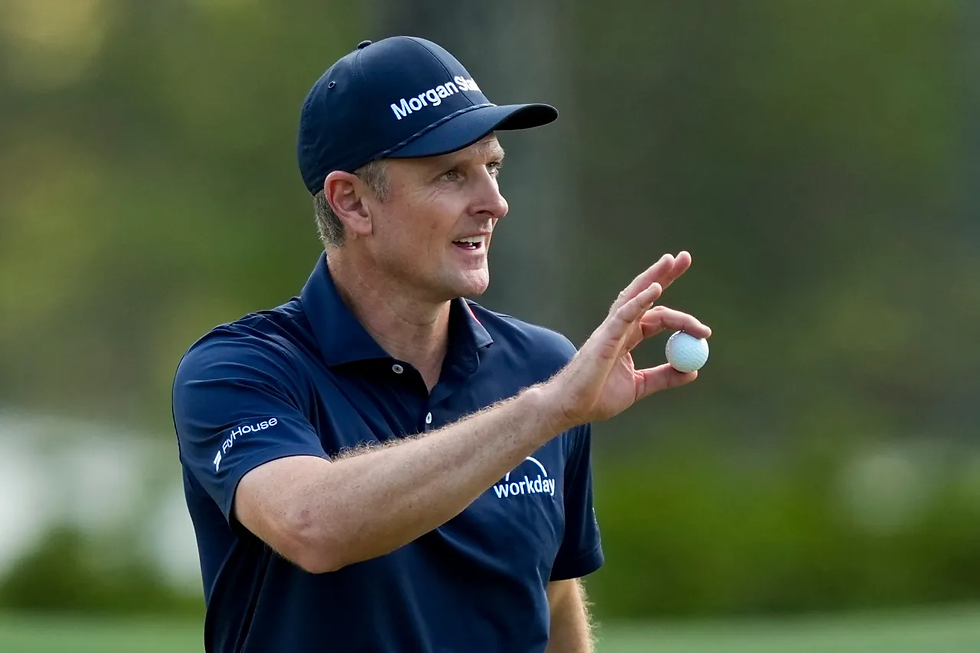
Indeed, Rose’s career is defined by moments that extend far beyond Augusta. His victory at the U.S. Open in 2013 remains a cornerstone achievement, marking his arrival as a major champion. That triumph, combined with an Olympic gold medal at the 2016 Rio Olympics, has secured his place among the most accomplished golfers of his generation.
Yet, like many elite athletes, Rose’s journey has not been without its fluctuations. The early 2020s brought a period of inconsistency, during which injuries, swing adjustments and the natural evolution of the professional game posed significant challenges. For a player accustomed to competing at the highest level, such phases can be particularly testing, both technically and mentally.
What distinguishes Rose is his ability to adapt. His recent victory on the PGA Tour earlier this year served as tangible evidence that his game remains sharp. More importantly, it reinforced his belief that he can still contend with—and defeat—the sport’s younger stars, many of whom have emerged during his two-decade career.
The presence of veterans such as Fred Couples and Bernhard Langer at Augusta offers additional inspiration. “You look at Freddie [Couples], the way he plays around here. Bernhard Langer, the guys get around,” Rose noted. “It does show this course, maybe more than anywhere, suits maybe personal style or knowledge.” In these reflections lies an acknowledgment that longevity in golf is not merely possible but can be a strategic advantage.
Off the course, Rose’s life has been marked by stability and discretion. Married to Kate Phillips, a former international gymnast, he has often credited his family with providing balance amid the demands of professional sport. Unlike many high-profile athletes, his personal life has largely remained free from controversy, allowing his achievements on the course to take centre stage.

This sense of equilibrium has arguably contributed to his recent resurgence. As the pressures of establishing a career have given way to the perspective of experience, Rose appears to have rediscovered both enjoyment and clarity in his game. It is a combination that can be particularly potent in major championships, where mental composure is as critical as technical execution.
Alongside Rose, Tyrrell Hatton also delivered a notable performance, finishing in a tie for third after a final-round 66 that included six birdies and an eagle. For Hatton, it represented his best finish in a major and a continuation of a steady upward trajectory in the game’s most prestigious events.
“I try not to treat them any differently,” Hatton said. “Still go out there every day and every round, every shot and try the best I can.” His approach contrasts with the heightened expectations that often accompany major tournaments, suggesting a philosophy rooted in consistency rather than occasion.
Hatton also acknowledged areas for improvement, particularly in preparation. “Maybe I would need to find a way of preparing a little bit better, whether that be more putting or something throughout the early part of the week just to get a bit more ready.” Such reflections highlight the fine margins that separate contention from victory at this level.
For Rose, the broader narrative remains one of persistence. At 45, he occupies a space where experience intersects with ambition, challenging conventional assumptions about the trajectory of athletic careers. His performances suggest that, far from winding down, he is actively redefining what the later stages of a golfer’s career can look like.
Augusta National, with its storied history and exacting demands, continues to serve as both a proving ground and a source of motivation. For Rose, each return represents another opportunity to complete an unfinished chapter. The near-misses, rather than discouraging him, appear to have deepened his resolve.

In an era increasingly defined by youth and power, Rose’s presence among the contenders offers a compelling counterpoint. His game, built on precision, intelligence and adaptability, demonstrates that success in golf remains multifaceted. It is not solely the domain of the longest hitters or the newest talents, but also of those who can evolve.
As the season progresses, the question is not whether Rose can still compete, but how far he can go. His recent form suggests that another major victory is not beyond reach. More importantly, his attitude indicates that he is fully prepared to pursue it.
Ultimately, Justin Rose’s story at this stage of his career is less about chasing validation and more about embracing possibility. In continuing to place himself in contention at the game’s biggest events, he affirms a simple yet powerful idea: that belief, when sustained by experience and effort, can extend a career far beyond its expected limits.


Comments