


Jude Bellingham and Thomas Tuchel: England's fiercest partnership could be their biggest World Cup weapon
- Jul 13
- 3 min read
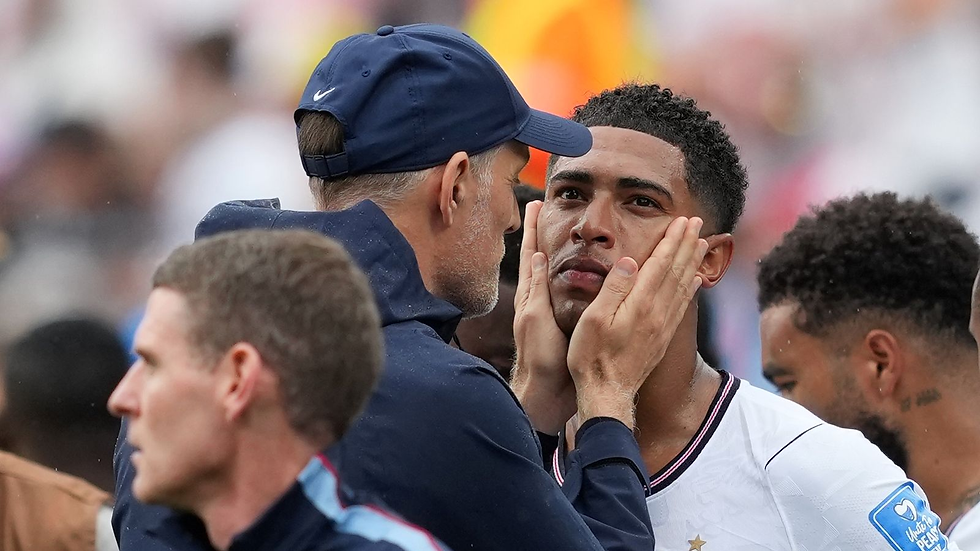
As England march into the 2026 FIFA World Cup semi-finals, one storyline has become impossible to ignore: the fascinating relationship between Jude Bellingham and head coach Thomas Tuchel.
Following England's dramatic 2-1 quarter-final victory over Norway, where Bellingham scored both goals, attention shifted away from the result and onto the tense post-match exchange between the midfield superstar and his manager. While some interpreted the disagreement as evidence of growing friction, the reality appears far more complex—and perhaps far more beneficial for England.
Different visions, same ambition

Bellingham and Tuchel share many qualities. Both are fiercely competitive, demand excellence and refuse to settle for mediocrity. Their only real disagreement lies in how England's biggest star should be used.
Bellingham has always preferred the freedom to roam across midfield and dictate games on instinct. Tuchel, however, has insisted that even his most gifted player must operate within a disciplined tactical structure designed for the collective good.
Rather than showering Bellingham with praise, Tuchel has consistently challenged him, publicly highlighting the importance of defensive work, positioning and sacrificing individual brilliance for the team.
A tougher Bellingham is emerging
That demanding approach appears to be paying dividends.
Against Norway, Bellingham didn't just score twice. He also dominated defensively, won more duels than anyone else on the pitch and relentlessly pressed opponents throughout the match.
The performance showcased perhaps the most complete version of the 22-year-old England has ever seen—combining creativity, leadership and tireless work ethic.
It's exactly the kind of all-round display Tuchel has spent months trying to cultivate.
Past tensions haven't disappeared
The relationship hasn't always been smooth.
Over the past 18 months, Tuchel has occasionally pushed Bellingham to the limit. At one stage he even left the Real Madrid star out of an England squad to reinforce the importance of team unity, despite Bellingham having just been named England's Player of the Year.
Earlier comments suggesting his own mother sometimes found Bellingham "repulsive" on the pitch also caused controversy before Tuchel later apologised.
Those moments created headlines, but neither side allowed them to become lasting divisions.
The Norway exchange sparks fresh debate

After eliminating Norway, Tuchel described England's overall display as "sloppy" despite reaching the last four.
Bellingham, exhausted after producing the match-winning performance in sweltering conditions, responded by suggesting it was easy to criticise without understanding what playing knockout football in extreme heat actually feels like.
The exchange quickly fuelled speculation of a rift.
In reality, both perspectives carried weight.
Tuchel wanted to remind his squad that performances must improve if England are to defeat Argentina and potentially Spain or France. Bellingham, meanwhile, was defending teammates who had battled through brutal conditions to secure victory.
England may be benefiting from creative tension
Far from damaging the squad, the relationship between Tuchel and Bellingham increasingly resembles a healthy competitive partnership.
Tuchel continues pushing England's biggest star beyond his comfort zone, while Bellingham responds by delivering bigger performances on football's biggest stage.
That mutual drive has helped produce one of the tournament's standout players.
A partnership built to win
With Argentina awaiting in the semi-finals, England know the challenge will become even greater.
But if Bellingham continues combining his natural brilliance with the discipline Tuchel demands, England may possess the perfect formula for lifting the World Cup.
Sometimes the strongest partnerships aren't built on constant agreement—they're forged through relentless ambition and a shared obsession with winning.



Comments