


Champions League madness: Paris Saint-Germain edge Bayern Munich 5-4 in a breathless semi-final thriller, with Harry Kane scoring but unable to save his team!
- Apr 29
- 5 min read
Paris Saint-Germain and Bayern Munich produced one of the most extraordinary Champions League encounters in recent memory at the Parc des Princes, a match that ended 5-4 in favour of PSG but left the tie finely balanced ahead of the second leg. What unfolded over 90 minutes was not a conventional knockout clash but a relentless, almost surreal display of attacking football from both sides, with nine goals scored in a semi-final first leg — the most ever recorded at this stage of the competition.
Paris Saint-Germain began the night with intent, fielding a dynamic front line featuring Khvicha Kvaratskhelia, Ousmane Dembélé, and João Neves driving forward from midfield. Their approach was matched by Bayern Munich, who responded with vertical, aggressive attacking play led by Harry Kane, Michael Olise, and Luis Díaz.

The opening stages set the tone for what would become a chaotic yet technically refined contest. Bayern struck first in the 17th minute when Kane calmly converted a penalty after a foul in the box. The English striker, who has become Bayern’s central attacking reference point, absorbed the pressure inside the Parc des Princes and placed his effort with composure into the corner.
PSG responded swiftly, with Kvaratskhelia once again demonstrating why he is considered one of Europe’s most unpredictable attacking talents. Picking up possession in an inside-left channel, he drove at the Bayern defence before curling a precise finish into the far corner to equalise. His ability to shift from isolation to decisive action has become a defining feature of PSG’s attacking structure.
The intensity of the match escalated rapidly, with both sides finding space in transition. João Neves gave PSG the lead with a powerful header from a corner, showcasing his growing influence in European competition. However, Bayern immediately replied through Olise, who produced a moment of individual brilliance, drifting past multiple defenders before striking a low, controlled finish past the goalkeeper.
By the 41st minute, the match had already become a showcase of elite-level attacking improvisation. The rhythm of the game allowed little time for defensive organisation, with both teams repeatedly exploiting half-spaces and wide channels. The technical quality on display reflected the evolving nature of modern Champions League football, where structure often gives way to controlled chaos.
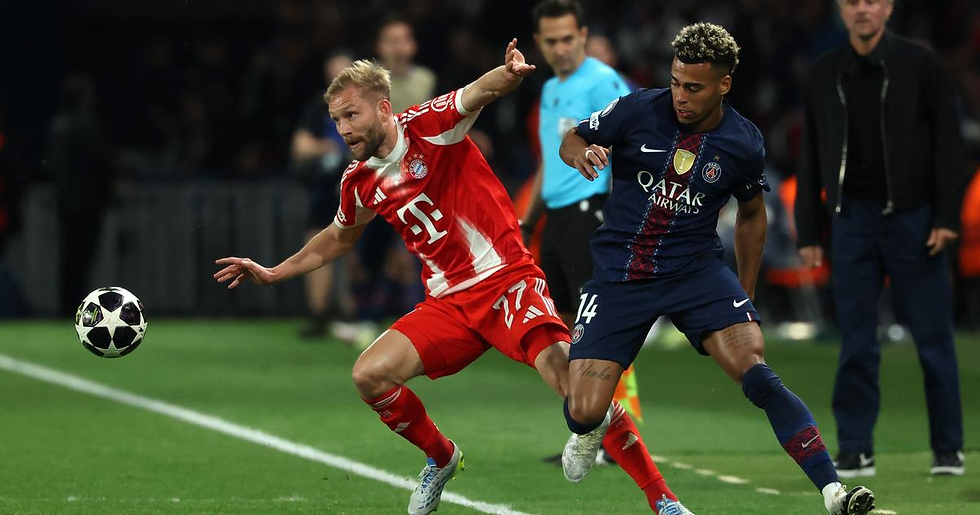
Before halftime, PSG were awarded a penalty after a VAR review confirmed a handball incident. Dembélé stepped up and converted confidently, restoring PSG’s lead at 3-2. His role in the attacking system has grown significantly, with his movement between the lines and ability to finish under pressure becoming key assets for the Parisian side.
The second half initially began at a slightly more measured tempo, though the underlying intensity remained unchanged. PSG extended their lead in the 56th minute when Achraf Hakimi found space on the right flank and delivered a cross that Kvaratskhelia finished clinically for his second goal of the night. Moments later, Dembélé added another with a sharp, instinctive finish that made it 5-2.
At that stage, PSG appeared to have complete control of the match, with Bayern momentarily overwhelmed by the pace and precision of the French side’s attacking sequences. However, the Bundesliga champions responded with remarkable resilience. Dayot Upamecano reduced the deficit with a header from a set piece, before Díaz added another with a composed finish following a fluid passing move involving Kane.
Despite Bayern’s late surge, PSG held on to secure a narrow 5-4 victory, though the margin did little to reflect the unpredictability of the encounter. Both teams were applauded off the pitch, acknowledging a match that defied conventional tactical categorisation and instead resembled a continuous exchange of high-level attacking improvisation.
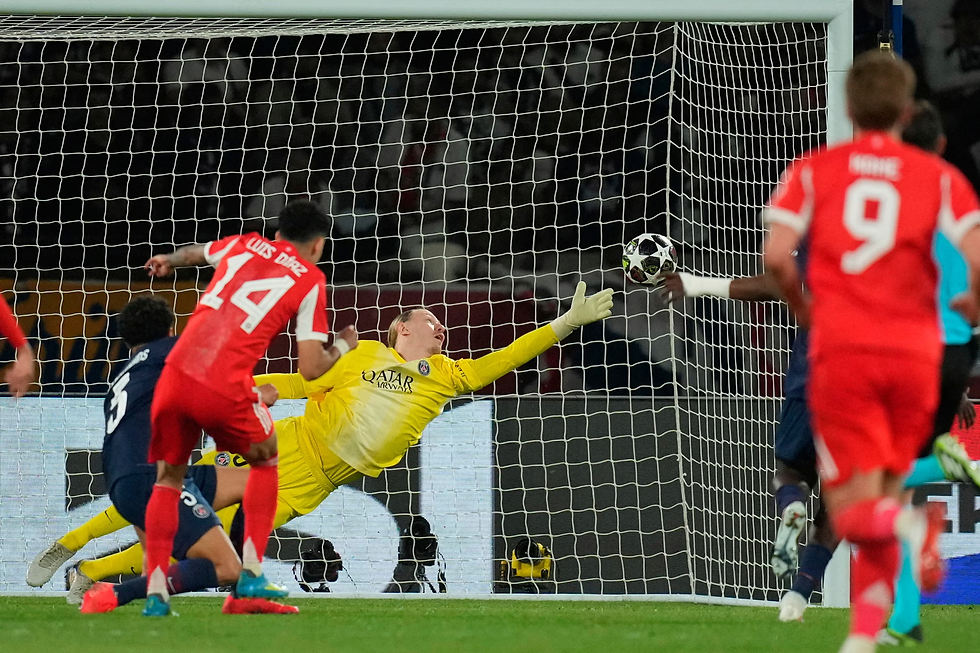
The performance of players such as Olise and Kvaratskhelia stood out in particular, each offering contrasting styles of creativity. Olise’s elegant dribbling and spatial awareness contrasted with Kvaratskhelia’s explosive, direct approach, yet both proved decisive in shaping the rhythm of the match.
Beyond the immediate spectacle, PSG’s evolution under their current project has been closely tied to their ambition in the Champions League. The club has invested heavily in balancing individual brilliance with collective structure, aiming to finally secure the European crown that has eluded them despite years of high-profile signings.
For Bayern Munich, the match highlighted both their attacking strength and defensive vulnerability. While Kane continues to deliver consistently in front of goal, the team’s transitional defensive structure was repeatedly exposed by PSG’s speed in attack. Nevertheless, their ability to score four goals away from home ensures the tie remains open.
The broader context of this fixture also reflects the changing landscape of European football. Both clubs represent modern super-teams built through a combination of elite recruitment and global commercial power. PSG, in particular, have shifted from a project centred on superstar acquisitions to a more balanced approach integrating emerging talents like Neves and Kvaratskhelia alongside established figures such as Dembélé.
Dembélé’s resurgence at PSG has been one of the defining narratives of his career. Once criticised for inconsistency during his time at Barcelona, his role in Paris has evolved into that of a decisive attacking force. His ability to influence high-stakes matches has added a new dimension to PSG’s offensive structure.
Kvaratskhelia’s rise has been equally significant. Since establishing himself in European football, his unpredictable dribbling and attacking intelligence have made him one of the most closely watched players in the continent. His adaptation to PSG’s system has been seamless, allowing him to operate both centrally and from wide positions.

On the Bayern side, Kane’s impact continues to be transformative. His arrival brought not only goals but also a deeper creative dimension to Bayern’s attack. His link-up play with Olise and Díaz has become a central feature of their offensive strategy, particularly in high-pressure matches.
Michael Olise, meanwhile, has undergone rapid development, emerging as one of the most technically refined attacking midfielders in Europe. His ability to manipulate space and tempo has made him a crucial component in Bayern’s transition-based approach.
The second leg now looms as a decisive moment in the tie, with both teams aware that defensive stability will likely determine progression. While PSG hold a narrow advantage, Bayern’s attacking efficiency ensures that the outcome remains far from settled.
Historically, PSG’s Champions League campaigns have often been defined by moments of brilliance offset by tactical instability. Their current squad, however, suggests a more balanced identity, blending attacking freedom with greater structural discipline.
Bayern, by contrast, continue to embody a philosophy rooted in intensity, pressing, and vertical progression. Their ability to recover from setbacks has been a consistent feature of their European campaigns, and the four away goals scored in Paris underline their resilience.

As anticipation builds for the return leg, the first encounter will likely be remembered not only for its scoreline but for its sheer unpredictability. It was a match where tactical expectations were repeatedly overturned, and where individual brilliance dictated momentum as much as collective organisation.
In a competition often defined by narrow margins, this semi-final first leg stands out as an exception — a rare instance where elite football resembled controlled chaos, and where both PSG and Bayern Munich demonstrated the full spectrum of modern attacking football at its highest level.


Comments