


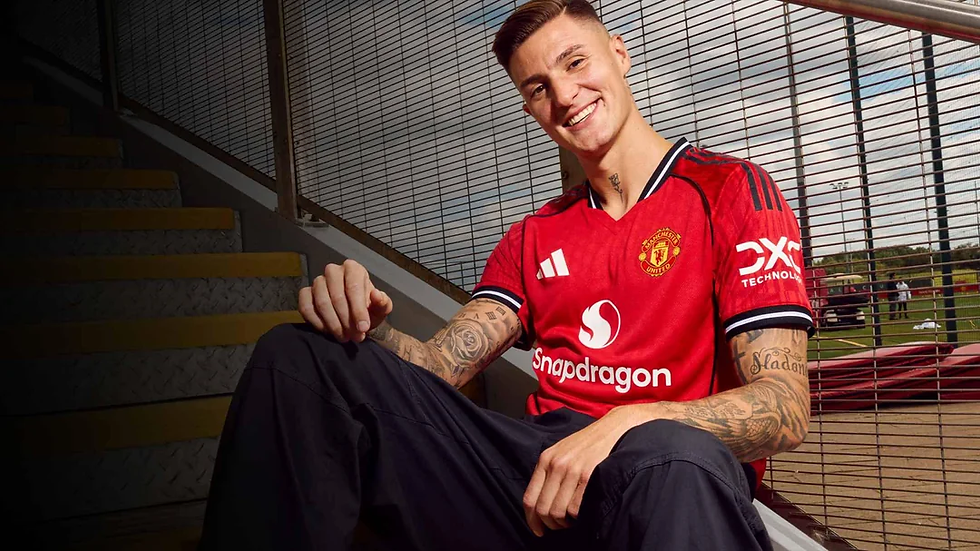
Benjamin Šeško will wear the Manchester United No. 9 shirt next season.
- May 1
- 5 min read
Benjamin Šeško will wear the Manchester United No. 9 shirt next season.
The iconic No. 9 jersey will become vacant once Rasmus Højlund completes his permanent move to SSC Napoli, with Šeško set to inherit the famous number and lead the line as Manchester United’s main striker.
The No. 9 shirt carries serious weight at Old Trafford, and all eyes will be on the young striker to deliver, lead the line, and become the focal point of United’s attacking play.

Šeško has already bagged 11 non-penalty goals and registered 1 assist this season.
The decision to hand Benjamin Šeško the No. 9 shirt at Manchester United reflects both a strategic shift and a symbolic moment in the club’s ongoing evolution. At Old Trafford, the number has long been associated with players who define attacking eras, individuals entrusted not only with scoring goals but with embodying the identity of the team in the final third. Assigning that responsibility to a young striker signals a degree of confidence in his development, as well as an expectation that he will grow into a central figure within the squad.
Rasmus Højlund’s impending move to SSC Napoli marks the end of one chapter and the beginning of another. His departure creates both a vacancy and an opportunity, allowing the club to recalibrate its attacking structure. In Šeško, Manchester United appear to be investing in a profile that combines physical presence with technical potential, attributes that align with the evolving demands placed on modern forwards in elite competitions.
Šeško’s statistical output this season, highlighted by 11 non-penalty goals, offers an initial indication of his ability to contribute consistently in open play situations. Non-penalty goals are often viewed as a more reliable measure of a striker’s effectiveness, as they reflect positioning, movement, and finishing under dynamic conditions. While the single assist suggests room for development in link-up play, it also underscores the primary role he is expected to fulfill: that of a finisher capable of converting opportunities into tangible outcomes.
The historical context of the No. 9 shirt at Manchester United adds an additional layer of scrutiny. Over the years, the number has been worn by forwards who have shaped the club’s attacking identity, establishing benchmarks that extend beyond raw statistics. Expectations surrounding Šeško will inevitably be framed against this backdrop, with performances evaluated not only on individual merit but also on their contribution to the team’s broader ambitions.

From a tactical perspective, Šeško’s integration into the starting lineup will influence the structure of Manchester United’s attacking phases. His physical attributes suggest a capacity to operate as a central reference point, capable of holding up the ball and facilitating the involvement of supporting players. This role becomes particularly important in matches where space is limited, requiring the striker to create opportunities through positioning and awareness rather than relying solely on pace.
The transition to a leading role at a club of Manchester United’s stature also involves an adjustment to increased visibility and pressure. The scrutiny associated with the Premier League, combined with the expectations of a global fanbase, can shape both perception and performance. Managing this environment effectively will be as important as technical development, particularly for a player still in the early stages of his career.
Within the squad, Šeško’s presence may also influence the dynamics of the attacking unit. The relationship between the central striker and wide players, as well as attacking midfielders, is critical in determining the fluidity of offensive play. Establishing an understanding with teammates such as creative midfielders and wingers will be essential in maximizing his effectiveness and ensuring that the team’s attacking patterns remain cohesive.
The move also reflects broader trends in player development and recruitment. Clubs increasingly seek to identify and invest in emerging talent, with the aim of shaping players into key contributors over time. In this context, Šeško’s appointment as the No. 9 can be seen as part of a longer-term strategy, one that prioritizes potential alongside immediate impact.
Comparisons with other forwards in the league are likely to emerge as the season progresses. The Premier League features a diverse range of attacking profiles, from traditional target men to more mobile, versatile forwards. Šeško’s ability to carve out a distinct identity within this landscape will depend on how effectively he adapts his strengths to the specific demands of English football.
The psychological dimension of wearing the No. 9 shirt should not be underestimated. For many players, shirt numbers carry symbolic significance, influencing both self-perception and external expectations. Embracing this symbolism can serve as a source of motivation, but it also requires a level of resilience to navigate periods of inconsistency or criticism.
From a performance analysis standpoint, metrics such as shot conversion rate, expected goals, and involvement in build-up play will provide a more detailed picture of Šeško’s impact. While goal totals remain a primary indicator, the broader contribution of a striker encompasses multiple facets, including pressing, movement off the ball, and the ability to create space for teammates.
The role of coaching staff will be instrumental in facilitating Šeško’s transition. Tactical guidance, individualized training, and consistent communication can help accelerate adaptation, ensuring that the player’s strengths are effectively integrated into the team’s overall approach. The alignment between player characteristics and tactical philosophy will ultimately determine the success of this transition.
As Manchester United continue to navigate a competitive domestic and European landscape, the importance of a reliable central striker becomes increasingly evident. Matches are often decided by fine margins, where the ability to convert limited chances can define outcomes. In this context, the expectations placed on Šeško extend beyond development; they encompass the immediate need for efficiency and consistency.
The broader narrative surrounding the club also plays a role in shaping perceptions of this decision. Manchester United’s recent seasons have been characterized by efforts to reestablish a clear identity and competitive edge. The appointment of a new No. 9 represents a tangible step in that process, signaling a commitment to building a cohesive and forward-looking squad.
At the same time, patience may be required as Šeško adjusts to his new environment. The transition between leagues, combined with the increased demands of a leading role, often involves a period of adaptation. Balancing short-term expectations with long-term development will be key in evaluating his progress.
The departure of Rasmus Højlund, meanwhile, introduces its own set of considerations. Player exits can reshape team dynamics, creating both challenges and opportunities. For Manchester United, the ability to manage this transition smoothly will be reflected in how effectively Šeško integrates into the existing structure and contributes to maintaining attacking continuity.

Ultimately, the decision to entrust Benjamin Šeško with the No. 9 shirt encapsulates a blend of ambition and calculated risk. It reflects a belief in his potential to evolve into a defining figure within the team, while acknowledging the demands associated with such a role. As the season unfolds, his performances will be closely observed, not only as an individual narrative but as part of the broader trajectory of Manchester United’s development.
In this evolving context, the No. 9 shirt remains more than a number; it is a symbol of responsibility, expectation, and opportunity. For Šeško, it represents a platform upon which to build his career at the highest level, with each performance contributing to a narrative that will be shaped over time through consistency, adaptation, and the ability to meet the challenges inherent in leading the line for one of football’s most closely followed clubs.


Comments