


Barcelona’s comeback falls short: Lookman delivers the killer blow as Atlético Madrid reach the semi-finals in a nail-biting finish!
- Apr 15
- 5 min read
Atlético Madrid advanced to the Champions League semi-finals after a dramatic and hard-fought encounter against Barcelona, a night defined as much by resilience as by raw emotion. The final whistle confirmed defeat on the night, yet qualification on aggregate, creating a paradox that perfectly captured the essence of knockout football. In the stands of the Metropolitano, a banner declared, “We give everything to win the cup,” and the performance on the pitch had reflected exactly that commitment. For the first time under Diego Simeone, Atlético lost a Champions League knockout match at home, yet the reaction was one of celebration rather than despair.
The Argentine coach, visibly moved, summed up the moment with characteristic intensity. “Buah! You don’t know how lovely it is to be among the four best teams in Europe,” he said. The sense of achievement ran deeper than the result itself. A decade after eliminating Barcelona en route to previous European campaigns, Atlético had once again overcome their historic rivals. “This is the third time we’ve done this – against Messi’s Barcelona, against Lamine’s Barcelona – and it isn’t easy,” Simeone reflected, invoking the long arc of rivalry and evolution between the two clubs.

Barcelona entered the match trailing 2-0 from the first leg, yet their response was immediate and emphatic. Within 24 minutes, they had drawn level in the tie, goals from Lamine Yamal and Ferran Torres igniting belief in a comeback that seemed entirely plausible. Yamal, still in the early stages of a career already marked by extraordinary promise, set the tone from the opening seconds. His direct running and technical precision unsettled Atlético’s defense, while his composure in front of goal belied his age.
For a brief period, Barcelona appeared in control, playing with the fluidity and confidence that has become synonymous with their identity. Hansi Flick had insisted that his team did not need a miracle, only a performance—and for much of the first half, they delivered exactly that. The equalizer, crafted through intelligent movement and incisive passing, reinforced the impression that momentum had shifted decisively in their favor.
Yet Atlético Madrid have built their modern identity on resistance, and their response was swift. Just seven minutes after Barcelona had drawn level on aggregate, Ademola Lookman restored Atlético’s advantage. The goal originated from a moment of clarity provided by Antoine Griezmann, whose vision and composure have long been central to Atlético’s attacking play. His perfectly weighted pass released Marcos Llorente, whose pace carried him beyond the Barcelona defense before delivering a decisive assist for Lookman.
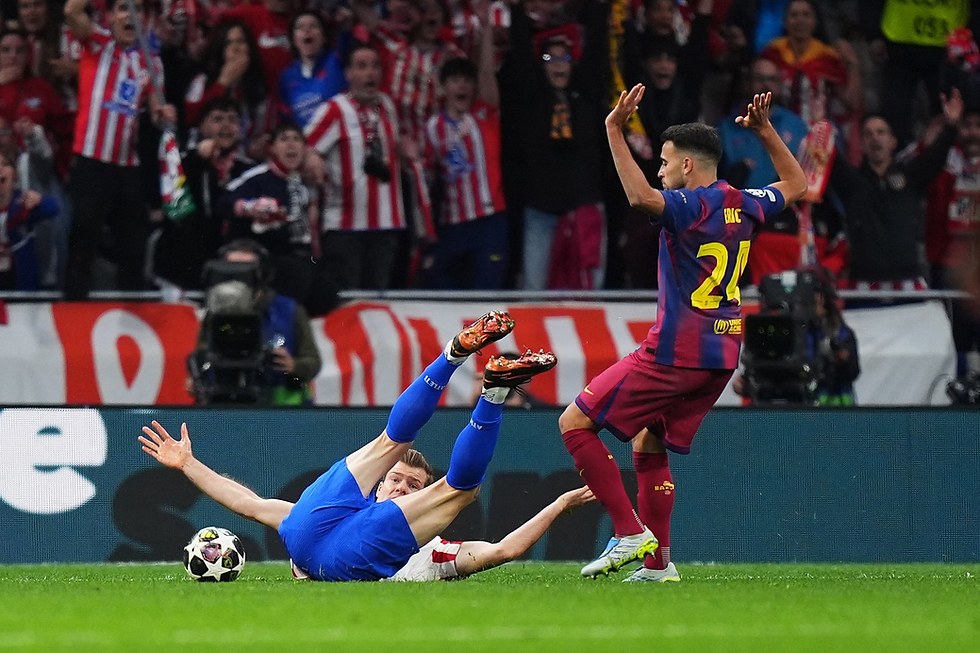
The goal shifted the psychological balance once more. Atlético, buoyed by the energy of their supporters, embraced the chaos of the contest. Simeone’s team has often been defined by its willingness to suffer, and this match was no exception. “There was a moment when we might have folded,” Simeone admitted later, “but we refused.” That refusal became the defining characteristic of the evening.
Barcelona, to their credit, continued to push forward. Dani Olmo and Fermín López combined effectively, while Yamal remained a constant threat. However, Atlético’s defensive structure, anchored by discipline and collective effort, absorbed wave after wave of attacks. The physical toll of the match was evident, with players from both sides sustaining injuries and requiring treatment, underscoring the intensity of the encounter.
The drama intensified further when Eric García was shown a red card, reducing Barcelona to ten men during a critical phase of the match. Despite the numerical disadvantage, Flick’s side continued to press, embodying the spirit their young star Yamal had promised: “If we do get knocked out, it will be fighting to the end.” That fight persisted until the final moments, when Ronald Araújo, deployed as an emergency striker, came agonizingly close to forcing extra time.
Atlético, however, held firm. Their victory—secured 3-2 on aggregate—was not a triumph of dominance but of endurance. It was a performance that encapsulated Simeone’s philosophy: discipline, sacrifice, and unwavering belief. Even in defeat on the night, the sense of accomplishment was unmistakable.

Beyond the immediate drama of the match, the figure of Diego Simeone loomed large. Since taking charge of Atlético Madrid in 2011, he has transformed the club into a consistent force in European football. His tenure has been defined not only by trophies but by a cultural shift, instilling a mentality that allows Atlético to compete with clubs possessing far greater financial resources. His emotional connection to the club was evident in his post-match remarks, reflecting a relationship that extends beyond professional obligation.
Ademola Lookman, the match-winner, represents a different narrative. His career has been one of gradual progression rather than immediate stardom. Having moved across several European leagues, he has developed into a versatile forward capable of influencing high-stakes matches. His decisive goal against Barcelona may well mark a defining moment, elevating his profile on the continental stage.
Off the pitch, Lookman has maintained a relatively low profile, focusing primarily on his development as a player. His journey—from promising youth talent to a key figure in one of Europe’s most competitive teams—illustrates the value of perseverance. Unlike some contemporaries, his career has not been dominated by controversy, allowing his performances to speak for themselves.

For Barcelona, the defeat raises questions about both the present and the future. Under Hansi Flick, the team has shown signs of tactical evolution, blending experienced players with emerging talents such as Lamine Yamal. The teenager’s performance at the Metropolitano reinforced his status as one of the most exciting prospects in world football, combining creativity, confidence, and technical excellence.
Yamal’s rapid rise has inevitably drawn comparisons with past greats, a narrative that Simeone himself acknowledged. Yet his development remains a work in progress, shaped by both triumphs and setbacks. Matches like this, where promise meets adversity, are likely to play a crucial role in his maturation.
The broader context of the Champions League adds further significance to Atlético’s achievement. Reaching the semi-finals places them once again among Europe’s elite, rekindling memories of past campaigns that fell just short of ultimate success. Simeone’s reference to Lisbon and Milan—sites of previous final defeats—highlights the enduring motivation within the club to finally claim the trophy that has eluded them.
As the competition progresses, Atlético’s blend of experience and resilience may prove decisive. While other teams may boast greater attacking flair or financial power, few can match their collective determination. This identity, forged over years under Simeone, continues to define their approach.

In the aftermath of the match, the contrast between the two teams was striking. Atlético celebrated progression achieved through hardship, while Barcelona reflected on a performance that, despite its quality, ultimately fell short. The thin line between success and failure in elite football was once again laid bare.
Ultimately, the night at the Metropolitano will be remembered not just for its goals or its turning points, but for its narrative richness. It was a contest that encapsulated the essence of the Champions League: drama, intensity, and the relentless pursuit of glory. For Atlético Madrid, it marked another step in a journey defined by resilience and belief. For Barcelona, it served as both a reminder of their potential and a challenge to convert promise into tangible success.


Comments