


“At 22, Victor Wembanyama does the unthinkable in NBA history: every single DPOY vote goes his way – the beginning of a new era?”
- Apr 21
- 5 min read
Victor Wembanyama has rewritten another chapter in his already extraordinary rise, becoming the first unanimous Defensive Player of the Year in NBA history at just 22 years old. The Victor Wembanyama phenomenon, long heralded as a generational talent, finally turned overwhelming expectation into undeniable reality, collecting every single vote for the award and leaving no room for debate. It is a rare moment in modern basketball, where consensus replaces controversy, and where a young player’s dominance is so complete that even the most skeptical observers are compelled to agree.
“There had never been a unanimous NBA defensive player of the year. Until now.” That statement alone captures the magnitude of the achievement. Wembanyama’s season was not merely impressive; it was historically conclusive. After finishing second in the voting during his rookie campaign and seeing a promising sophomore season cut short due to medical concerns, he entered this year with something to prove. What followed was not just a response, but a statement of authority that reshaped the defensive landscape of the league.

“The real struggle might have been getting to 65 games,” Wembanyama admitted, referencing the eligibility threshold required for major awards. “But I’m super, super happy to win this award and actually super proud to be the first-ever unanimous.” His words reflect both relief and quiet satisfaction, a recognition that durability, as much as talent, was the final hurdle in a season that demanded consistency as well as brilliance.
Standing at 7ft 4in, or perhaps even taller depending on the listing, Wembanyama has transformed the geometry of the game. Opponents do not simply play against him; they adjust entire offensive schemes to avoid him. For a third consecutive season, he led the NBA in blocked shots, but the raw numbers only hint at a deeper influence. His presence alone alters shot selection, discourages drives, and forces teams into uncomfortable decisions. In many ways, his defense begins before the ball is even released.
“Best player in the world,” said teammate Keldon Johnson, offering a succinct yet powerful endorsement. While such declarations are often hyperbolic in the NBA’s culture of constant comparison, in Wembanyama’s case they feel less like exaggeration and more like a glimpse into a future that is arriving faster than expected.
The voting results confirmed what had been evident throughout the season. Chet Holmgren finished second, while Ausar Thompson took third place, both having contributed significantly to their teams securing top seeds in the playoffs. Yet this was never truly a contest. From the opening weeks of the season, Wembanyama established a defensive standard that others could only chase from a distance.

His victory also places him in rare historical company. By becoming the youngest Defensive Player of the Year, he surpasses a lineage of elite defenders who typically reached their peak later in their careers. Moreover, he joins David Robinson and Michael Jordan as the only players to win both Rookie of the Year and Defensive Player of the Year, a testament to his immediate and sustained impact on the league.
For the San Antonio Spurs, Wembanyama’s triumph represents a continuation of a storied defensive tradition. The franchise, already associated with discipline and structure, becomes the first in NBA history to have four different players win the award, joining past winners such as Robinson, Alvin Robertson, and Kawhi Leonard. It is a lineage that Wembanyama both honors and elevates.
“I’ve had the chance to have great coaches over my career who have taught me great habits on defense,” he said, acknowledging the system that helped shape his instincts. Despite his individual brilliance, Wembanyama consistently emphasizes structure, preparation, and teamwork, a perspective that reflects maturity beyond his years.
Indeed, he was careful to frame his success as part of a broader collective effort. “We often overlook the team aspect,” he noted. “I’m sitting here. I happen to be the guy who’s put in the spotlight, but I am part of a system and I couldn’t get this award and I couldn’t do what I do if it wasn’t for my teammates ... and my coaching staff.” In an era that often celebrates individual accolades, such remarks highlight a grounded approach to fame and recognition.
Beyond defense, Wembanyama’s season carries even greater implications. He is also a finalist for the league’s Most Valuable Player award, alongside Shai Gilgeous-Alexander and Nikola Jokić. This dual recognition places him among the elite two-way players in the game, those capable of influencing both ends of the court at the highest level.

His journey to this point has been closely followed since his early years in France. Born into a family with deep sporting roots, Wembanyama’s development was carefully managed through the French basketball system, where technical refinement and tactical awareness are prioritized. Long before his NBA debut, he was already being described as a once-in-a-generation prospect, a label that often carries as much pressure as promise.
Yet his transition to the NBA has been marked by a rare balance of expectation and execution. Unlike many highly touted prospects who require years to adjust, Wembanyama adapted almost immediately, blending his unique physical attributes with an understanding of spacing, timing, and anticipation. His defensive instincts, in particular, seem almost intuitive, as if he processes the game a step ahead of everyone else on the court.
Off the court, Wembanyama has maintained a relatively private and disciplined lifestyle, avoiding the controversies that often accompany rapid fame. His focus has remained largely on development, recovery, and long-term sustainability, a mindset that aligns with the Spurs’ organizational philosophy. There have been no significant scandals, no public distractions, only a steady progression that mirrors his performance on the court.
His influence, however, extends beyond statistics and accolades. Wembanyama represents a shift in how the game is played and perceived. Traditional positional boundaries are becoming increasingly fluid, and his ability to defend guards on the perimeter while protecting the rim challenges conventional definitions of a center. In many ways, he embodies the future of basketball, where versatility and adaptability are paramount.
The unanimous nature of his award adds another layer to this narrative. In a league where debates over MVP, All-NBA selections, and defensive honors often dominate headlines, unanimity is exceptionally rare. It suggests not only excellence but clarity, a shared understanding among voters that a particular performance stands above all others without question.
For Wembanyama, this moment may be both a culmination and a beginning. At 22, he has already achieved milestones that many players spend entire careers pursuing. Yet there remains a sense that his potential has only begun to unfold. Each season brings new adjustments, new challenges, and new expectations, but also new opportunities to redefine what is possible.
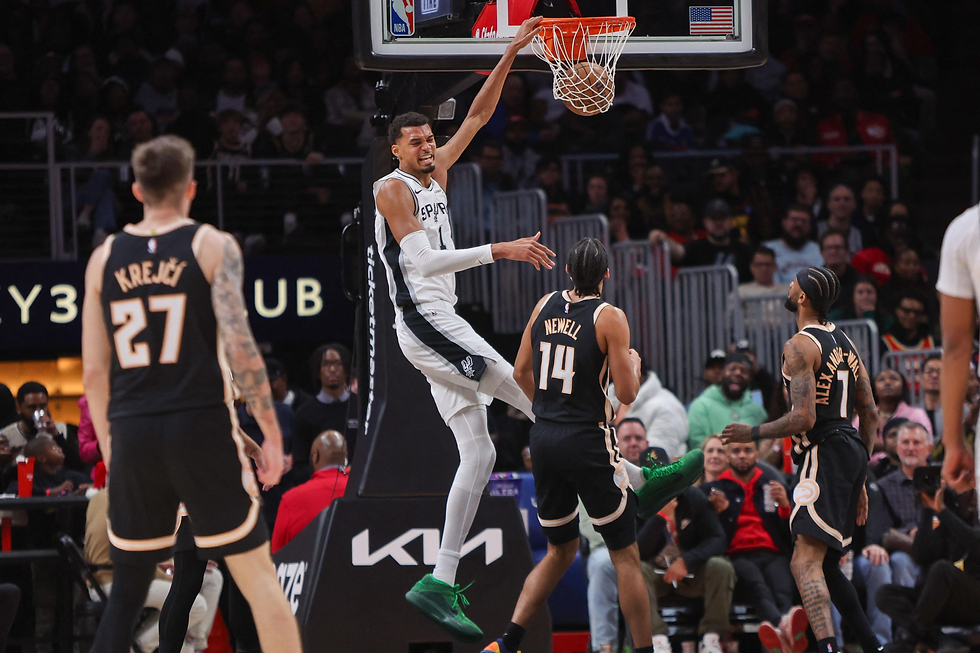
As the playoffs approach and the MVP announcement looms, the spotlight on Wembanyama will only intensify. Whether or not he secures additional honors this year, his Defensive Player of the Year award has already established a benchmark for his generation. It is a recognition not just of what he has done, but of what he represents: a player capable of reshaping the game through sheer presence and precision.
In the broader context of NBA history, moments like this serve as markers of transition. Just as previous eras were defined by dominant figures who changed the sport’s trajectory, Wembanyama’s rise signals the arrival of a new paradigm. His blend of size, skill, and intelligence challenges long-held assumptions and invites a reimagining of the game’s possibilities.
For now, the image remains clear: a young player, standing at the intersection of expectation and achievement, holding an award that no one before him has claimed in such definitive fashion. The unanimity of his recognition speaks not only to his performance but to the certainty it inspires. In a league built on debate, Victor Wembanyama has, at least for this moment, ended the conversation before it could even begin.


Comments